
Translated material
The Federation Council unanimously approved the Anti -Magnitic Law
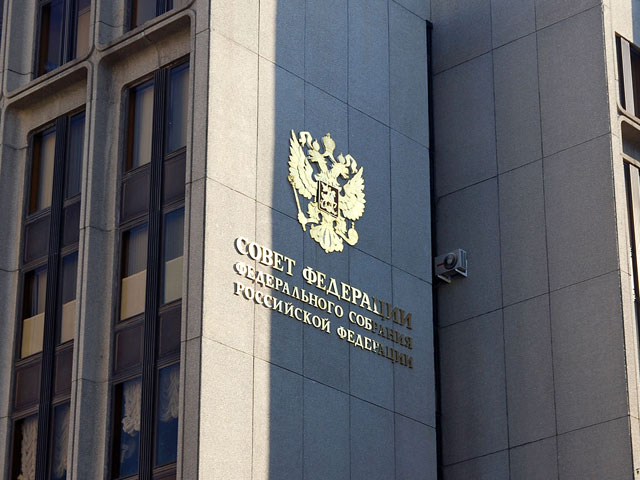
The Federation Council on Wednesday approved the anti -Magnetic law adopted by the State Duma, which caused a violent discussion in society and fears in the government of Dmitry Medvedev. The bill "On measures of influence on persons involved in violations of the fundamental rights and freedoms of a person, rights and freedoms of citizens of the Russian Federation", designed to answer the American "Act of Magnitsky", provides for sanctions against the Russian Black Lists submitted to the Russian "Black Lists" and, in particular, prohibits US citizens to take Russian children to their families.
For the adoption of the document, senators spoke unanimously - 143 people. “There were no such unanimity #cannibals even in the State Duma,” journalist Vladimir Bartholomeev notes on Twitter . Indeed, in the lower ward the document was received with eight votes "against" and one abstained deputy-country.
In the Council, even temporarily disabled senators expressed approval. Five of them handed written statements to the speaker, in which they asked, given the importance of the bill, to take into account their votes "for".
- Khabensky came to the Kremlin for a reward with a large icon "Children outside politics"
- Video: "Orphan Law" adopted to applause
- 20 senators evaded voting "for" without coming to the meeting
- a new reason for indignation - 46 kids betrayed
- In the spring, the Council will be offered to completely ban foreign adoption
- As the project claimed in the committees: the senators "Obelled the press" and "scattered like cockroaches"
- survey Newsru.com: "Reply to the Magnitsky list"
According to the text of the document, the law, in case of signing by the Head of State, will enter into force on January 1, 2013. However, the regulation allocates to Vladimir Putin for this for two weeks. So the first day of the New Year “anti -Magnitic” may not become - about this, at least, they talk in the Kremlin. “According to the law, there are two weeks for consideration by the president,” Dmitry Peskov quoted ITAR -TASS. When asked if Putin can make a decision on the document before midnight on the 31st, his spokeswoman replied: "We'll see."
During the recent press conference, the head of state had to answer the questions of journalists about this document either. Putin then evaded the answer to the question whether the bill would sign, but stated that he considered the ban on "American" adoption adequate.
Matvienko - "For", and no one crushed it on it
The “anti-magnetic law” was listed as the 38th point in the current agenda of the Council, but the senators began to work with a shock pace, spending only five to seven minutes on the approval of each document, Kommersant FM notes. And the journalists at that moment were indignant in the corridor: they did not keep up with nimble senators, and even the musicians interfered - in the lobby of the Council, VIA, who was invited for the New Year holiday. A few minutes before the consideration of the "Orphan bill" the choir struck: "And the smile, no doubt, suddenly touches your eyes," Interfax reports.
At this moment, the protesters were detained at the walls of the Council. Before the vote, the police sent seven activists to the department who tried to convey their point of view to the senators.
In the outcome of the vote, however, few doubted, although these days they acted almost about the "panic" among senators. They seemed to have objections to the wording of the document, and the speaker Valentina Matvienko even publicly called on his colleagues not to rush to make a decision on such an important issue. However, before the meeting on Wednesday, Matvienko told reporters: “Having weighed everything“ for ”and“ against ”, I understood for myself - and believe me, no one crushed me ... I decided that this law is necessary,” RIA Novosti quotes.
As for the reservations, which the Committee on International Affairs allegedly recommended that the bill is not, then by and large there are not, the Kommersant FM correspondent said: “At the end of each conclusion, the phrase is:“ We recommend approving. ”In one of the paragraphs, the Committee notes that not all of the strengthened Russian children are subjected to violence from adoptive American parents. As well as such The wording that can be considered important: "The ban on the adoption of Russian children by US citizens is an extreme measure and can deprive them of the opportunity to find a full -fledged family."
20 senators evaded voting "for" without coming to the meeting
The adoption of the so -called "law of Dima Yakovlev" in the upper house, as experts predicted, passed with certain complications. This was especially noticeable against the backdrop of the demonstrative solidarity of deputies of the lower house, where only its eight members managed to demonstrate a position that was different from the recommended by the Kremlin administration.
As the New Region notes, some senators, not wanting to go to direct confrontation with the Kremlin, seemed to demonstrate their position with a simple indifference in the vote: who, according to medical reasons, and someone simply did not appear at the meeting.
In total, as noted by the publication, 20 Russian senators did not vote for the adoption of the scandalous law: Bogdanov, Gorbunov, Trees, Dobrynin, Ivanov, Ignatenko, Kazharov, Kerimov, Koramov, Mezhevich, Malkin, Novikov, Palancoev, Fetisov, Spiegel, Petrov, Ponomareva, Rushailo, Tulpanov, Sinyagin.
Such behavior of the members of the Federation Council was quite predictable. Among the members of the upper house there are much more status politicians and businessmen with a greater degree of freedom relative to the power vertical than in the almost completely “built” state Duma.
As the agency recalls, a few days before the vote there was a scandal in the Committee on International Affairs of the Federation Council. The Chairman of the Committee Mikhail Margelov refused to act as the main speaker under the law at a meeting of the upper house, and proposed to play in this role Arthur Chingarov. However, he rebuilt this role as deputy chairman of the committee and former KGB officer Valery Shnyakin. As a result, the Committee of the Federation Council on International Affairs with the mouth of Valery Shnyakin still recommended that the chamber approve the “Law of Dima Yakovlev” at the meeting on December 26, however, according to Shnyakin, “with a number of reservations”.
The law also encountered resistance to the committee on constitutional legislation, legal and judicial issues, the development of civil society, where some senators also staged a vote with “legs”. Then, for various reasons, Alexey Alexandrov, Vitaly Bogdanov, Konstantin Dobrynin, Boris Spiegel, Evgeny Tarlo, that is, five of the twelve members of the committee, did not appear at the meeting. And Senator Anatoly Lyskov at the same time collapsed with both the provisions of the law and the Senator Valery Shnyakin and quickly left the meeting in the meeting.
Vadim Tulpanov (Committee on Rules) and Larisa Ponomarev (Committee on Social Policy and Healthcare) were also not present in their committees. On December 26, they also for various reasons did not vote for the "law of Dima Yakovlev."
The chairman of the upper house Valentina Matvienko was also very critical of the "anti -magnetic" law and only after dense consultations in the Kremlin changed its position.
Senator Svetlana Zhurova said that the ban on adoption could be a temporary measure: "As long as the Americans provide our diplomats access to our children. When this happens, the current conflict will come to naught."
Zhurova believes that the problem of monitoring how adopted Russian children live in the United States, requires speedy permission. Touching upon the situation with adoptions in Russia, the senator, referring to its own, said that more than 60 thousand children are adopted annually in the country.
Zhurova noted that in Russia there is an institution of trustees in orphanages. "I myself bring up two of my own children and help 170 inhabitants of one orphanage. Many of our citizens have the opportunity to do the same," said Zhurova.
"Children will feel devoted"
Experts criticizing the bill have a new reason for indignation. Recently, diplomats, deputies and children's Ombudsman Pavel Astakhov said that a year after his entry into force, adoption processes will continue. However, having read the wording of the document more closely, the same authorized person admitted : as soon as the law begins to act, the doors in the USA for Russian orphans will be closed.
The Russian Foreign Ministry has already confirmed that in the near future the procedure for denouncing the Russian-American adoption agreement , which will take exactly a year will be launched. It was on him that opponents of the law said that there would still be time to send orphans to foreign families after the entry of the "cannibalist law". But no: the law will simply prohibit Russian courts to issue permits to leave the children, although the international agreement will still act.
So 46 children who have already found American foster parents and are in the design procedure will not fall into new families. “This is a deep trauma,” the Russian coordinator from the Hand -In -Hand adoption agency told the Russian news service Alena Senkevich. “Children who were returned from the family once were told that this is mom and dad would feel devoted. And they had already met with the first betrayal when biological parents left them.”
Supporters of the "Orphan Law" are ready to go further
Note that the supporters of the bill are also many. Moreover, they are even among the opposition, as a rule, in bayonets of the perceiving majority of "United Russian" initiatives. Thus, the leader of “Other Russia” Eduard Limonov believes that Russian orphans cannot be given not only in the USA, but also abroad. “In modern history, there are no such examples for a healthy state to give its children,” Interfax quotes Limonov. “We are not the USSR of the 20s, but even then Dzerzhinsky was busy with street children ... Now in an endangered country to give children abroad. And liberals, all the abundance, have become a“ demyza ”, they fell into hysteria.”
In the Council, this idea has already sounded today. In particular, Senator Valery Shtyrov, when discussing a document on Wednesday, said: "I consider it immoral to deal with our children to any abroad ... I propose to return to this issue in the spring and prohibit the transfer of children anywhere in general."
And the Ompubsman Astakhov is ready to convey this point of view to the president: "The more our children are adopted by foreigners, the less efforts we make in this direction ourselves. I do not have the right of legislative initiative, but I am ready to introduce the country's leadership the corresponding substantiation."