
Translated material
The Holy Filaret Institute and Humanitarian University of Yekaterinburg talked about the dialogue of the church and society
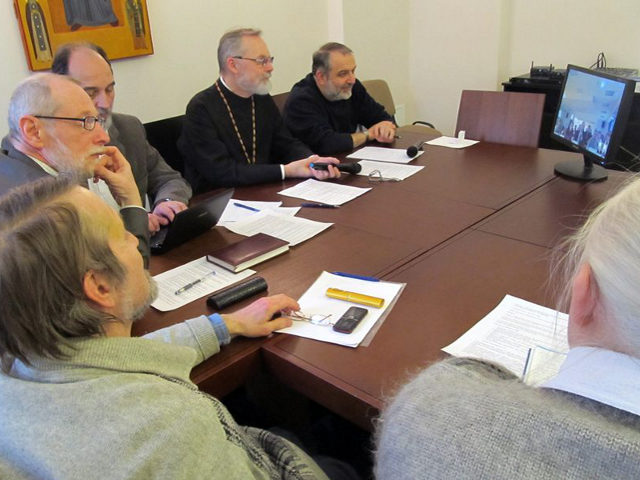
The Moscow Holy Filaret Orthodox-Christian Institute (SPI) and the Humanitarian University of Yekaterinburg (GU) held a Skype Most dedicated to the dialogue of the church and society in modern Russia.
In the conversation, along with representatives of both universities, employees of the Ural branch of the Russian Academy of Sciences, the Russian State Humanitarian University and the Yekaterinburg Theological Seminary took part, accordingto a press release from the SPI information service .
“Today in society there is fatigue from endless relativism and a stake,” said Professor Galina Brandt. She noted that the theater is more responsible for the longing for fresh air, when she poses the spiritually acute problems regarding, for example, paternity, crime, hope. However, a person who crosses the threshold of the temple does not face such questions.
Lyudmila Myasnikova, the vice -rector of science, admitted that she does not meet joy in the church, attention to the "otherness" of people, does not feel the space in which the border between lies and truth, beauty and outrages would become a clearly distinguishable.
The paradox is that in a dialogue on spiritual life, the church often finds himself in a marginal position. Moreover, as noted by Elena Stepanova, the chief researcher at the Ural Branch of the Russian Academy of Sciences, often the church itself is looking for places "on the sidelines", leaves uncomfortable issues and challenges of our time in the "ghetto". So, the recently discussed law on the protection of the feelings of believers looks like their claim to a special status.
“The establishment of a dialogue is associated with a distinction between genuine and not indispensable,” said the rector of the SPI, priest George Kochetkov. "In the field of social relations, there are many simulars, fakes that lead away from communication. So far we still live in the post -Soviet space in which there are many crooked mirrors. The society sees the church completely crookedly. What it sees in the church is not the Church," he believes.
The opposition of the genuine and inconsistent permeates the creature of the Church, the Church itself poses this problem in the center of its being, said the head of the department of theology and Liturgics of SPIs David Gzgzyan. It is with authenticity that the presence of creative energy in the church is associated.
The question of protecting the feelings of believers, as well as the “campaign around the young lady from XXS” (meaning a scandal with the participation of the Pussy Riot group. - Approx. Ed. ), It does not have religious content at all. These are fakes that speak only of various trends and interests in our society and its violent reaction to clumsy response statements of individual church figures. The Church itself is silent about this, because everything is clear to everyone, according to George Kochetkov.
The problem is that today, as in Soviet times, the voice of the Church does not sound on more important, actually spiritual issues, the rector of the SPI is convinced. Church, like society, has yet to find their face and their voice. Here, humanitarian science can play a huge positive role.
Speaking about the problems of modern society, the rector of GU Lev Sachs indicated the crisis of personal responsibility, moral culture and sociality as the ability to communicate with intelligible communication and cooperation. "The inexplicable negatives of the past brother with modern ones. The merits of the past civilization disappear, root, are damaged, and the qualities of the new manifest themselves extremely perverted," he said.
Lev Sachs believes that the church, returning after the tragic historical failure of the 20th century to the civilizational series, turns to society in an incomprehensible language, "in pluskvamperfect", and can hardly manage the rapidly changing world.
Although external church structures often lag behind and look marginal, genuine renewal does not happen anywhere faster than in the church, George Kochetkov objected. "After all, this update is associated with the renewal of personality, and the personality can be revived in an instant. Speed is a hint of a miracle, the possibility of not somewhere behind the clouds, but here to find the qualities that you only dreamed about or that you saw on examples of others. Problems begin with the socialization of these qualities. We want the church to show an example here, but so that in our society there is the same renewal."
The language that would be obviously understandable to both the Church and society does not exist, the head of the Department of the Philosophy of the SPI Grigory Gutner is sure. After all, the church is as heterogeneous as society. The common language is developed inside small communities, and it is important to find topics for conversation, to understand the subject of general concern. In this case, this personality, authenticity. It is necessary to achieve the goal in this dialog, so that this authenticity is revealed in it. It is more constructive to talk not about the church and society, but about yourself.
When we talk about the dialogue of the church and society, we artificially separate one from the other, Elena Stepanova agrees. There is no wall between them: they consist of the same people. Many perceive the Church as a “reserve of sacredness” (there should be something stable in the world!) And they have false expectations to it, which she cannot and should not answer. “The dialogue similar to today, like the phenomenon of Orthodox fraternities, makes it possible to avoid the expectation of“ big things ”and switch to the local level of a simple conversation that gives a true perspective,” she said.
Representatives of the two universities decided that the general conversation begun to continue.