
Translated material
From the Embassy of the Russian Federation in Washington, three disabled people who left Russia with a petition to Putin were driven away from Russia
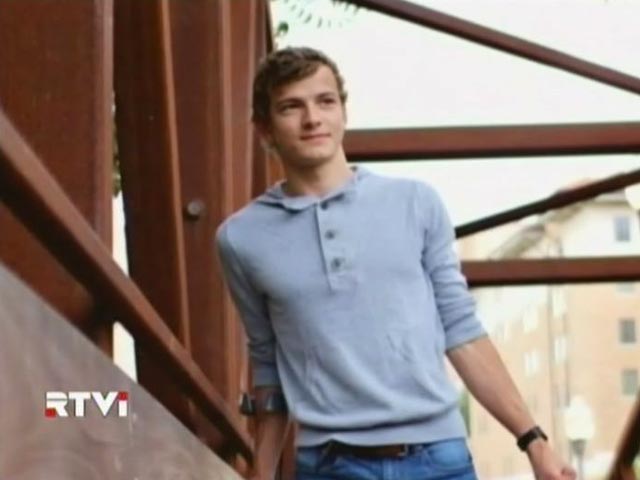
The “anti -magetri law”, adopted by the Federation Council , holds not only Russians who are worried about the fate of Russian orphans, but also the Americans themselves, for whom all the adoption procedures of Russian children will be suspended on January 1, 2013, if the law is signed by Russian President Vladimir Putin.
On the day of voting, according to the law in the Federation Council, Russians, taken to seven American parents, came to the Russian Embassy in Washington with a petition to Putin, but were roughly expelled by the police, reports Public Post . Another 1.5 thousand families, which began to engage in the design of papers on adoption before discussing the law, are worried about the fate of the Russian orphanages, who already call them their parents, American journalists already note.
The author of the petition, which was brought to the Russian Embassy in Washington, was 21-year-old Russian Alexander D'Jamus, who at the age of 15, with deformed arms and legs, was adopted by a family from Texas. In the document, which collected seven thousand signatures, D'Jamus asks Vladimir Putin not to adopt a law, "whose victims will be about 800 thousand orphans." In order to convey the petition, several people approached the embassy, including 24-year-old Tatyana McFadden, who was adopted from the Russian Federation, who became a three-time Paralympic champion this year.
However, the orphans were not met in the most hospitable way. At first they were asked to wait 40 minutes, while the rain was on the street. And then, together with the official, the police came from the embassy. The representative of the diplomatic mission took the petition and, not letting the petitioners inside, ordered them to leave. And the policeman hinted that the company of the audience looked like picketers. “We were told that this is a“ mass unauthorized protest ”, although there were only three children with Russian passports,” said Tatyana Deborah McFadden's adoptive mother. Such a rude technique very surprised her, given that the meeting at the embassy was negotiated in advance.
The Russian Foreign Ministry responded to the incident. The official representative of the department, Alexander Lukashevich, promised on Thursday that he would deal with the situation. “Each country has its own rules and forms of bringing public opinion. Our embassy in Washington very often gather various groups that, say, are dissatisfied with the position of the Russian Federation on a particular issue. And we always go to the dialogue, listen to these points of view,” Interfax quoted Lukashevich. At the same time, the diplomat added that if it was a spontaneous action that was not agreed with the authorities of the Colombia district, then "the police intervention is a normal phenomenon."
The story of Tatyana Makfadden
According to MK , the press repeatedly wrote about a 23-year-old paralympics, who held part of her childhood in the orphanage of St. Petersburg. She was born with an underdeveloped spinal cord and a paralyzed lower body. The girl survived only a miracle.
The shelter was so poor that it was impossible to buy even pencils for children, not to mention a wheelchair. The first six years of her life, Tanya used her hands instead of her legs to move. In 1994, the American Debbie McFadden, who worked in the American Ministry of Health as the Commissar for Disabled Affairs, visited the orphanage, where Tatyana lived. And she decided to take the girl in the United States - then for the first time in her life she had a wheelchair. In an interview, Tatyana answers the question of how she felt when she arrived 18 years ago in the United States: “Oh my god, you wouldn’t even recognize me. I was terribly bony, very sick and anemic. If they hadn’t accommodated me, I would probably not have survived. But after moving to the United States I had done several operations, and life became much easier.”
Debbie wrote down the adopted daughter in various sports sections, Tanya began to study, she was engaged in archery, ping-pong, basketball. And really fell in love with race in wheelchairs. At the University of Illinois, the comrades of Tatyana on the command called her beast (Beast) - for her strength. She herself, however, hearing her nickname, laughs. Now Tatyana lives in the American state of Maryland, she is a winner of the last three Paralympic Games. In 2004, in Athens, she won “silver” in a female hundred -meter and “bronze” in a 200 -meter race. At the 2008 Paralympics in Beijing, Tatyana won three silver medals-in races for 200, 400 and 800 meters among women, as well as bronze in the relay. And at the 2012 Paralympic Games in London, Tatyana won three gold medals (at 400, 800 and 1500 meters).
1.5 thousand families in the United States may not end the adoption procedure
Meanwhile, 1.5 thousand American families who are at an early stage of the procedure for adopting orphans from Russia are the alarm, USA Today reports. “It's so hard,” shared a resident of Los Angeles Sharon Benama, who was flying in October with her husband to Russia to meet with the twins, whom they are going to take up education. “Now I don’t know what awaits them,” the woman said in despair.
"Children become hostages of the diplomatic game. Russia does not have a plan for 700 thousand pupils of orphanages," said Adam Pertman, Executive Director of the Institute of Adoption of Evan Donaldson. To prohibit the adoption of children by Americans, from whose hands 19 orphans were killed, taking into account the fact that 60 thousand Russians were adopted in total, Pertman believes unreasonably. “People simply do not understand what the foster parents have to go through,” Lisa Wong from California was surprised, who became a guardian of a two -year -old Russian girl a few days ago. The woman said that for this she had to collect a pile of papers and pass three FBI checks.
But the adoption procedure costs not only nerves, but also large material costs. According to the head of the Adoptions Together adoption agency, Jenis Goldberg, to adopt a child, must be given from 40 to 60 thousand dollars. At the same time, Russia is the third in the list of countries by the number of children adopted by the Americans. In the past year, 962 children were taken to educate American families, and the “adoption peak” came in 2004, when parents in the United States found 5862 pupils of Russian orphanages.