
Translated material
How who? Volodin!
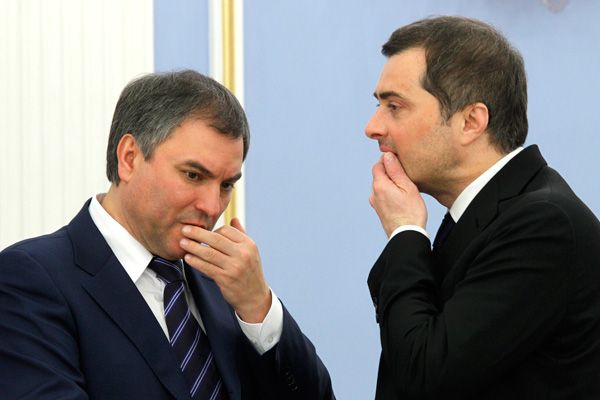 Photo: Vyacheslav Volodin and Vladislav Surkov (from left to right). ITAR-TASS
The fall of the ratings of United Russia and its final replacement with the All -Russian Popular Front, the prospect of government resignation and a clear understanding that Medvedev will no longer be the president - these are the results of the year of the Russian political elite. Numerous conflicts regarding the adoption of the law on the ban on adoption only aggravated the situation.
It seems that the law on the prohibition of adoption greatly influenced the degree of openness of those who are considered to be sources in the presidential administration, government, and State Duma. If earlier they had to ask something, then a strange thing happened a week ago-the sources began to tell. Long and in detail. They all, or almost everyone, were ashamed of a law that deprives the right to human life of children. They could not say about this publicly-the workshop solidarity, I understand-but willingly shared the information off-peace. And it is difficult to even consider an informational stuffing-everything that was said, repeatedly and crossily confirmed by sources in various structures and sources somewhere near these structures. Of course, the conversations went beyond the law on adoption - it became clear that the law is simply the penultimate blow of an ax, which almost split the political elite.
Several trends are traced. The PublicPost source in the government tells that there are no one among ministers who support the ban on adoption, despite the Kremlin’s tough statements, part of the State Duma deputies and members of the Federation Council. And even Prime Minister Dmitry Medvedev said more at a meeting of the General Council of United Russia about what needs to be done to protect orphans, but he did not express his personal position. As a result, the government unexpectedly became independent. The Minister of Education Dmitry Livanov, Deputy Prime Minister Olga Golodets, Minister for Work with Open Government Mikhail Abyzov, Foreign Minister Sergei Lavrov, and even the Ministry of Justice drew attention to the fact that the ban was contrary to a number of international agreements was expressed against the law. Especially critical, but not publicly, the law also speaks of Deputy Prime Ministers-Igor Shuvalov and Arkady Dvorkovich. Moreover, a few days ago, as it became known to Publicpost, Medvedev already asked his colleagues not to comment on the topic. “We can’t do anything anyway,” the source says. He considers it likely that the government will resign during the year, and "everyone works while he can." Another interlocutor Publicpost clarifies: "They did not agree with the Kremlin not only on this issue, on the sidelines they argued about the Pussy Riot case and the laws on rallies and NGOs." "In fact, all this is a matter of not specific laws, but foreign policy courses - some look east, towards China, others - to the west, to Europe." It would be logical to assume that the opinion of the government is formed by the former deputy head of the presidential administration, the current head of the government apparatus Vladislav Surkov, but he, as they say, focused on hardware - strengthening his positions in the White House and cooperation with religious organizations. Surkov transferred the entire domestic policy to Vyacheslav Volodin, with whom he changed places in the administration and government.
However, the interlocutors in the State Duma say, Surkov still affects the "United Russia", but he loses the battle with Volodin and his, that is, the Putin, the All -Russian Popular Front. "Now there is a specific drain of" United Russia "in favor of the front, and this law (on adoption - publicpost) set up the whole batch," says a PublicPost source in the faction. “There will be little to remain from United Russia by 2016,” one of the deputies from “Fair Russia” argues, in turn. “I communicate with different deputies, they already say what they think about the new party, and we think how to explain that this is all the same. All now Volodin, but“ United Russia ”is not his, but Surkovskaya.” About one fifth "front -line soldiers" was in parliament in the YP faction. These people are now very noticeable in the corridors - they behave much more confidently by ordinary united Russia. The ONF coordination council includes, for example, Ekaterina Lakhova, Vyacheslav Lysakov, and Valery Trapeznikov, Mikhail Slipenchuk, have good positions. The selection is quite tough, according to the principle of loyalty - that is, the most pure in their understanding of the reputation. So, from the preparation of the May congress of the ONF, deputies Ilya Kostunov were already removed (in the election he was in the Voronezh list "EP") and Alexander Sidyakin (walked along the ONF line). Kostunov was removed for an interview with PublicPost , the second - for the fact that last week he did not vote for the ban on adoption. Many of those who voted were forced to do this to the leaders of the internal fractional groups, and especially disagreed were invited to a meeting with the head of the domestic policy of the Presidential Administration Oleg Morozov.
As a result of all these hardware games, all PublicPost sources say at different levels of power, Volodin wins the most. After the chances of Medvedev again headed the state completely evaporated, the question arose of a new successor. Although, of course, there is a variant of the defense minister Sergei Shoigu - he, according to the interlocutor in United Russia, will gain 60% "at least tomorrow."