
Translated material
Religiosity in modern Russia
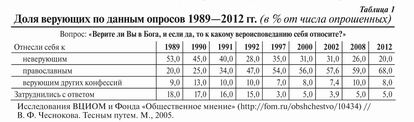
The religiosity of the Russian population in recent decades at different stages has changed differently. Such stages, it seems to us, can be distinguished by four. The first: since 1989 (when mass surveys began to be conducted), in the mid-1990s-its own is sometimes called a “religious boom”. During these years, the number of believers, more precisely those who call themselves Orthodox, has almost doubled: from 20-30 % in 1988-1989 before
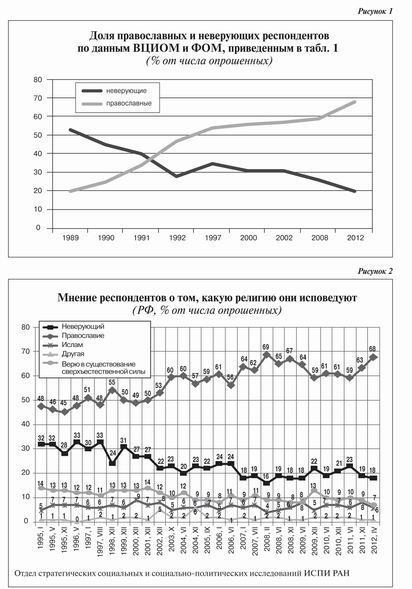
50-60 % by 1995. Accordingly, the number of unbelievers (atheists) from 50 to 30 % (Table 1, 2) decreased. Some sociological surveys show that the number of respondents calling themselves Orthodox has been especially sharply increased in 1991-1992. Perhaps this is due to the collapse of the Soviet Union, when people had a need in return to find a new identification in return, somehow determine themselves. Since they ceased to be Soviet, they again became Russian, and "Russians - means Orthodox."
In the mid-1990s, some sociologists (D.E. Furman, M.P. Mchedlov) expressed the opinion that the level of religiosity reached the maximum, and a number of symptoms indicate that it will begin to decline. In fact, these forecasts were not justified [1] , the level of religiosity continued its growth, but at a lesser rate
(Table 1, Fig. 1, 2). Thus, we can say that in the mid-1990s a new, second stage in the development of religiosity, which lasted approximately 2004, begins. During this period, according to the FOM and the Sociology Department of Religion of the RAS RAS, the share of respondents related to the Orthodox increased from 45-50 to 60-65 %. Also, after a sharp fall, the percentage of unbelievers was relatively stabilized. As at the first stage, here the general picture was mainly determined by the processes that go in an Orthodox denomination, since the proportion of respondents related to Islam remained practically unchanged, and the total share of those who profess other religions did not exceed 2-3 %.
In the middle of the zero years (2004-2005), the growth of the level of religiosity has practically stopped. This period is the third of the mentioned stages. We must admit, we assumed that the growth limit has practically reached, however, as studies showed, starting approximately 2008, the number of believers again began to increase by a noticeable pace, in fact the process entered the new, fourth stage.
One of the reasons for the fixed growth of religiosity, unexpected for most sociologists, is called the economic crisis.
The second largest denomination in Russia is Islam. The proportion of respondents defining themselves as Muslims has remained, according to polls, within 4-7 %over the past 15 years. The remaining denominations are gaining 2-3 %in total, and this figure also changed little. True, it should be noted that some researchers record an increase in the number of Protestants and sectarians (“Jehovah's Witnesses”) in certain regions, especially in the Far East, but at the All -Russian level this growth is almost invisible.
Thus, since about 1989, the dynamics of the religiosity of the population of Russia can be schematically described as follows: rapid growth - slow growth - stabilization - slow growth.
In the first half of November 2011, the SPIP RAS REPARO Sociology Department conducted the next (the first two were conducted in 2004 and 2006) the All -Russian study of the religiosity of the population [2] according to the method of V.F. Chesnokova, which allowed to trace the dynamics according to several indicators of religious consciousness and behavior.
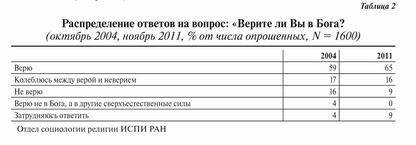
The preliminary analysis of the data led us to the conclusion that the tendency to grow the level of religiosity remains, although among the sociologists of religion in recent years there has been an opinion that the potential of extensive growth of religiosity is close to exhaustion. The share of the respondents increased from 59 % in 2004 to 65 % in 2011 (Table 2). The proportion of respondents fluctuating between faith and unbelief remains unchanged - about 16 %. There is also a decrease in the share of unbelievers - 9 % compared to 16 % in 2004. The substantial growth of the share of respondents who find it difficult to answer the question: “Do you believe in God?” Pays attention. One gets the impression that Russian citizens are increasingly willingly identifying themselves as unbelievers. The data of our February 2012 survey with a sample of 3,000 respondents is even more eloquent: believers - 78 %, fluctuating - 13 %, unbelievers - 6 %. It is interesting that in the 2011 study, and in the 2012 survey, none of the respondents chose the answer option: “I believe not in God, but in other supernatural forces” (2011) and “I believe in fate, higher mind, higher energy, healers” (2012). It can be assumed that the proportion of citizens who believe in various supernatural forces is reduced. This is also confirmed by the data of polls of the crap of the wounds (see Fig. 2).
The proportion of respondents who consider themselves Old Believers (5 %) (Table 3) is relatively high, this is a new phenomenon that requires additional study and analysis [3] . Catholicism and Protestantism include 1 % of respondents.
The 2012 survey, in which the issue of confessional affiliation was raised, showed that 82 % of all respondents include Orthodoxy, 5 % to Islam.
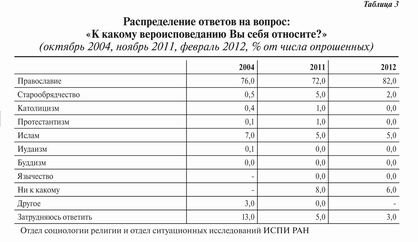
For comparison: according to a survey of April 2012, VTsIOM [4] , 77 %of the surveyed, Islam - 6 %, are the followers of Orthodoxy, and 7 %. In April 2012, the question specified by sociologists [5] question: “Do you consider yourself a believers? And if so, what religion (denominations) do you belong to? ” 68 % of respondents answered - to Orthodoxy, 6 % to Islam, consider themselves to be unbelievers 20 %, less than 1 % of respondents relate to other Christian faiths [6] .
From our point of view, the data obtained indicate a certain stabilization of the growth of the share of Orthodox respondents. The 2011 study confirmed by many a feature of the religious situation in Russia: the share of respondents related to the Orthodox exceeds the share of those who consider themselves believers. This means that some unbelieving citizens consider themselves belonging to the Orthodox culture and, in this sense, Orthodox. 8 % of respondents do not attribute themselves to any denomination. Most of this group are unbelievers - 68 %, oscillating - 7 %, believers - 4 %. Thus, believers outside the faith are a very small group.
Considering the acute discussion of the role of the Church in the life of the state and society, which has been conducting recently, I would especially like to dwell on the analysis of the dynamics of the indicator of the level of trust in the church as a social institution.
Distribution of answers to the question: "What religion do you belong to?"
(October 2004, November 2011, February 2012, % of the number of respondents)
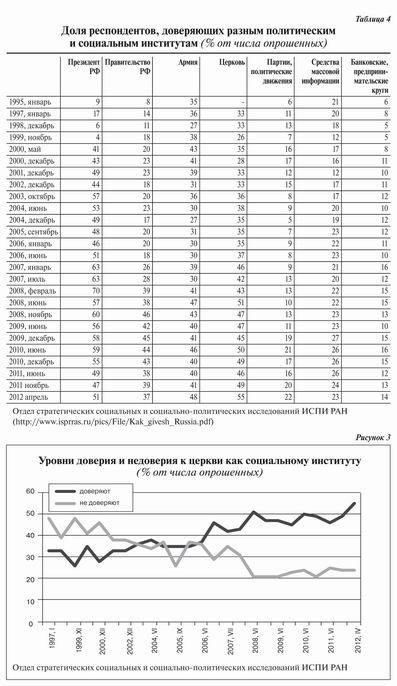
The share of respondents trusting different political and social institutions (% of the number of respondents)
Table 4 and illustrating her schedule in Fig. 3 demonstrate constant on average an increase in the level of trust in the church since 1997. Moreover, in 2011, for the first time since 1999, the church was ahead of the presidency institution in this indicator. The level of mistrust since 2008 remains more or less stable. For a long time, the church has been steadily occupied by at least second place in terms of trust among all public and state institutions (see Tables 4, 5).
Polls data from other sociological centers confirm the high level of confidence in the church. According to the VTsIOM survey [7] in April 2012, in general, 71 %approve of the activities of the Russian Orthodox Church and clergy, they do not approve of 11 %, and 17 %are difficult to answer.
According to the FOM [8] survey, in May 2012 according to an array, in general the church trust 64 %of respondents, partly trust, partly do not trust 14 %, do not trust 8 %.
According to a joint survey of the department of sociology of religion and the department of situational research of the RAS RAS in July 2012, 62 %of respondents trusted the Church, did not trust 25 %, found it difficult to answer 13 %. Patriarch Cyril was trusted by 56 %, did not trust 24 %, it was difficult to answer 20 %9.
If we evaluate the influence of scandals of 2011 and 2012, then, judging by polls conducted by different groups, they did not affect the level of confidence in the church, moreover, in comparison with the data of previous studies, it grew up. It can be assumed that in response to numerous negative reviews about the activities of the Russian Orthodox Church, a certain consolidation of the Orthodox around the church occurred. Does this mean that she has no reason for concern? Of course, there is. The negative attitude to the activities of the Russian Orthodox Church has been preserved for the last decade at a noticeable level. By virtue, it seems to us, in the general activation of the Russian society in 2011-2012 and the revival of the political process, the critical part of society began to more openly express its views on all problems, including church-public and church-state relations. However, insignificant growth in these years on a curve of distrust (Fig. 3) does not indicate an increase in the number of those who do not trust the Church - just dissatisfied ROCs began to openly express their position, especially since they had a platform - the Internet.
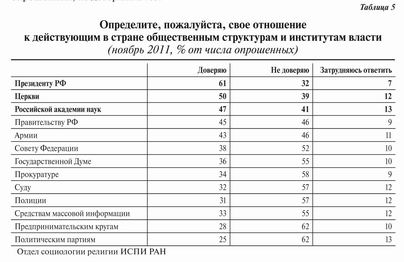
These studies of the Sociology Department of the REPI RAS RAS RAS 2011 demonstrate a slightly higher level of distrust of the church than other research, as well as an increase in the level of distrust compared to 2006. In 2011, churches as a social institution were trusted by 50 %of respondents, did not trust 39 %, it was difficult to answer 12 %. In 2006, 51 % of all respondents trusted the church, did not trust 24 %.
Most likely, the growth of distrust of the church occurs to a greater extent among the non -objected Orthodox (about 40 % did not trust the Church in 2011), as well as, of course, unbelievers (75 %). But there are among those who do not trust and those who visit the temple several times a year, but less than once a month (20 %), and communion several times a year (6 %).
Let's move on to a more detailed analysis of the Orthodox group. We attributed to her respondents (64 % of respondents) who identified themselves as Orthodox believers and Orthodox, fluctuating between faith and unbelief.
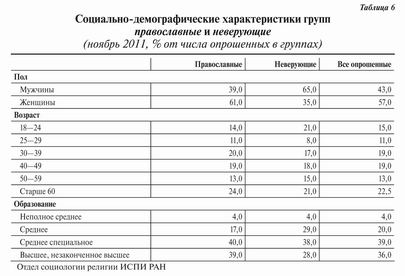
In the group of Orthodox 39 % of men and 61 % of women (Table 6), which is not very different from the average distribution in array - 43 % of men, 57 % of women - and throughout the population (according to the last census, 45 % of men account for 55 % of women). In 1992, men made up 29 % of Orthodox respondents, so we can say that over the past 20 years, the sexual structure of the Orthodox group has changed significantly. The level of education in the Orthodox is slightly higher than the average in array. They have higher than that of unbelievers, a share of higher education, which refutes the established myth of the low education of the Orthodox. The most educated group, according to all studies of the last 20 years, is the churching Orthodox (the share of those surveyed with higher education in this group in 2011 amounted to 44 %, including more than 3 % have a scientific degree). In general, the socio-demographic characteristics of the Orthodox group coincide with the average data according to the array. Attention should be paid to the fact that in the group of unbelievers the highest proportion of young people - from 18 to 24 years old, as well as the fact that unbelievers are the only group with the predominance of men.
Let's move on to the analysis of the worldview characteristics of the Orthodox. According to the 2011 study, the immortality of the soul believes 40 %of those included in this group, fluctuate between faith and disbelief 35 %, do not believe 19 %, it was difficult to answer 5 %. In 2006, the numbers were 55, 21 and 23 %, respectively. In 2011, we somewhat changed the formulation of the question, adding to two positions: “I believe in the immortality of the soul”, “I don’t believe” the third-“I hesitate between faith and unbelief”, which, as it seems to us, reduced the share of those who answered “I do not believe”, and the share of the response from 23 to 5 %. Previously, many oscillating respondents preferred to choose the answer “believe” in order to avoid the categorical “I do not believe”. In 2011, the question of the importance of religion in a person’s life, which is rarely posed in domestic research, but is obligatory among Americans and Europeans, first appeared in our questionnaire. In general, 23 %of all respondents are very important, quite important - 38 %, not very important - 19 %, not important at all - 11 %, and 9 %found it difficult to answer. Thus, religion was important for 61 % of respondents (Table 7). In the group of Orthodox, 28 % considered a very important religion, and 46 % - quite important, religion for 3 % of respondents is not important at all.
One way or another, 21 % of the Orthodox participate in the life of a religious community or parish, another 11 % feel their involvement in the life of a certain parish (Table 8).
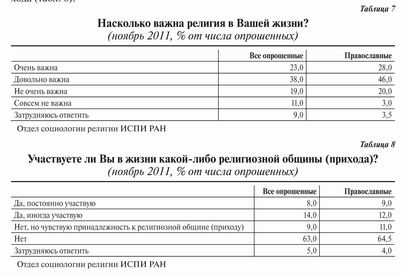
More or less regularly visit the temple over 40 %of the Orthodox (Table 9) (of which 10 % - once a month and more often; several times a year, but less than once a month - 33 %), once a year - 23 %, very rarely, not every year - 20 %, there were never in the temple - 9 %.
Orthodox are confessed and communed once a month and more often than 2 %of those related to the group, several times a year - 10 %, once a year - 12 %, rarely, once every few years - 27 %, never confessed and parted - 40 %. Thus, 24 % of the Orthodox are confessed and communed more or less regularly.
65 % of the Orthodox respondents are familiar with the Gospel, however, only 7 % regularly read it from them. 23 %of Orthodox respondents are praying with church prayers (they read the morning and evening rule 2 %of them, they pray with church prayers almost every day 6 %), 53 %pray for their prayers, do not pray at all 23 %. To some extent, 35 % of the Orthodox observe the posts, do not observe-60 %.
Consider how some indicators of the religious life of Orthodox respondents have changed from 1992 to 2011 (according to the All -Russian Studies, FOM 1992, 2000, 2002 and All -Russian Studies of the RAPI RAS 2004, 2006, 2011).
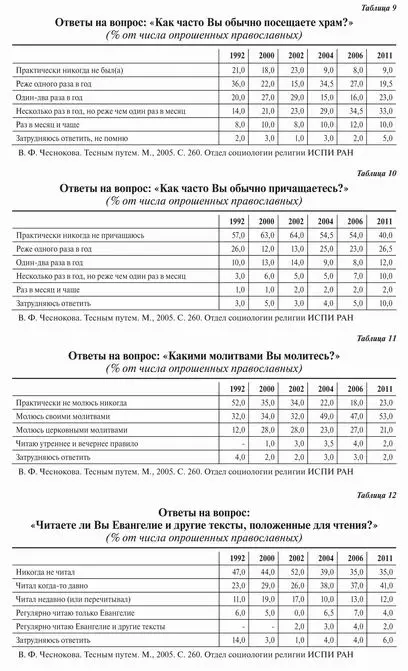
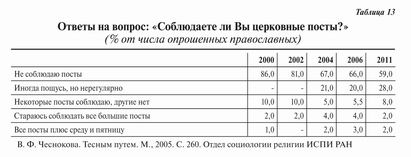
Studies of 2004 and 2006 showed that out of five indicators of churching, visiting the temple and prayer prevail. The 2011 studies demonstrate some decrease in the share of Orthodox prayers, as well as regularly reading the gospel. The percentage of regularly visiting the temple remained almost unchanged. But the proportion of those who regularly communes has grown, and this is an important indicator of churching. The post in this regard is not so indicative, however, it should be noted that the share of the post -non -observing posts has decreased significantly. In all respects, the share of the respondents who chose a “zero” position - never in the temple, never communed, never prayed, never read the gospel, never fasted. The percentage of non-prayers decreased especially noticeably-from 52 % in 1992 to 20 % in 2011, as well as not observing posts-from 86 % in 2000 to 55 % in 2011.
Using the methodology of V.F. Chesnokova, five groups can be distinguished by the level of churching: “churches”, “half -church”, “beginners”, “non -objected”, “zero subgroup”. The corresponding distributions for all respondents and for the Orthodox are shown in Fig. 4 and 5.
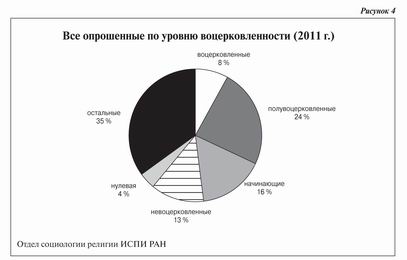
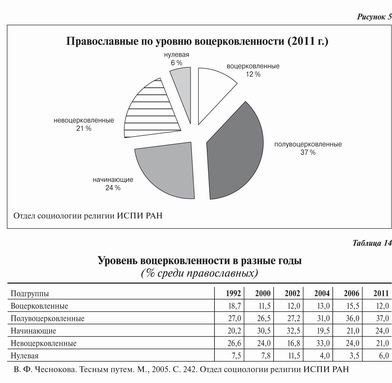
Thus, the analysis of the religiosity of the population, based on the data of perennial polls of the Public Opinion Foundation and three All-Russian studies of religiosity of the population of the department of religion and the Department of Strategic Social and Socio-Political Studies of the Russian Academy of Sciences, allows us to draw the following conclusions.
• Orthodoxy is one of the basic grounds for the self -identification of Russians. If we talk about cultural self -identification, then more than 70 % of all respondents are identified with the Orthodox culture, 32.5 % of unbelievers and most (75 %) oscillating are called Orthodox. The share of the respondents continues to grow, and unbelievers - to decline, the share of hesitating practically did not change.
• Religion consider most Russians to be important for themselves.
• The share of Orthodox respondents who are more or less actively involved in the life of religious organizations is approximately 30 %, constantly participating - 8 %.
• Indicators characterizing the level of religious consciousness remain low, in other words, a significant part of the respondents who consider themselves believers, in fact, they poorly imagine what they believe in, and faith has little effect on their life goals and attitudes.
• Indicators of the religious behavior of the Orthodox over the past 7 years have changed slightly, only a decrease in the share of the respondents who have never been in the temple, never communed or prayed. The only relatively significant change is that there are somewhat more communion, which is an extremely important symptom.
• We can say that the core has formed in Russia - about 10 % of the population - believers and religious citizens with relatively high indicators of religious behavior and participation in religious life. This nucleus surrounds the “periphery” (25-30 %) - people who have religious behavior indicators slightly lower, but their life, nevertheless, is associated with religious communities and parishes, they believe in the immortality of the soul and consider religion an important part of their life. These two groups can be defined as a "church people." The rest of the respondents who called themselves Orthodox can be attributed to the cultural Orthodox. For them, religion is a way of cultural self -identification, not the basis of a worldview.

[1] D. E. Furman notes this in his work "Old Church, new believers." SPb., M.: Summer Garden, 2000. S. 16, 19.
[2] В ходе исследования было опрошено 1600 респондентов в 33 населенных пунктах РФ по репрезентативной выборке по полу, возрасту, типу населенного пункта. Исследование проводилось при поддержке гранта РГНФ № 10-03-00185а. Следует, однако, отметить, что у нас несколько изменились параметры выборочной совокупности по типам населенных пунктов. Выборка остается репрезентативной, но ее изменение могло определенным образом сказаться на полученных данных.
[3] Повторные опросы и результаты других исследований не подтверждают роста доли россиян, относящих себя к старообрядцам, что, скорее всего, свидетельствует о региональной специфике выборки 2011 года, о чем упоминалось выше.
[4] http://wciom.ru/fileadmin/nayka/sovet/fedorov.pdf
[5] http://fom.ru/obshchestvo/10434
[6] На первый взгляд, приведенные варианты вопросов ВЦИОМ и ФОМ сильно отличаются друг от друга, но в обоих исследованиях разными методами устанавливается определенный фильтр, чтобы отделить респондентов, для которых православие или ислам — это просто культурная самоидентификация, от тех, кто осознанно называет себя православным или мусульманином, а также установить границы, в пределах которых находятся те или иные показатели. В первом случае используется слово «последователи», что подразумевает более активную позицию респондента — он все-таки «следует» какой-то религиозной доктрине. Во втором — фильтром является вера в Бога.