
Translated material
Wake the student
Union of teachers and students
It would be necessary to start with the fact that the very concept of "universita" (universitas) in ancient times meant a kind of spiritual, intellectual union of students and students in the name of tradition and culture. The traditions of democracy have been cultivated in European universities since their appearance. In some, for example, Bologna, the rector and professors were chosen and hired by the students themselves. The university in the Italian Padua, known for its motto “Universa Universis Patavina Libertas” (“Freedom Padua, universal and for all”, gave the world the term “nation”, which designated students at the time of its appearance. One of the main forms of learning, in addition to lectures, the universities were disputes , of course, giving the policy of the new time the instrumentation of political debates and oratory. The ideas of Wilhelm Humboldt, who received recognition in the 19th century, breathed into universities the ideology of cooperation professors and students, when the teacher ceased to be considered as a simple lecturer, and the student as an ordinary listener, but both became the creators of a general scientific act.
University traditions in Europe have become a matrix for the public and political views of students and youth in general. Already in the Middle Ages, it was one of the advanced classes of society, a kind of active guide - a catalyst for progressive social ideas. However, by the end of the 19th - beginning of the 20th century, European students began to claim its party not only in the market of ideas, but in real political life.
The French student, which actually became a co -founder of modern France, is especially significant in this regard. Many French students then became active participants in the resistance movement. All forty years, student organizations defend the rights of higher educational institutions. At the turn of the 60s, dozens of thousands of students participate in protests against the war in Algeria, which became one of the rotary points of the development of the Fifth Republic. Since the mid-60s, French students have been conducting thousands of protests against a number of social reforms, including the reform of higher education of Fouche. During the famous May events of 1968, almost all trade unions of teachers, teachers and scientists, as well as the deeply bourgeois French human rights and television trade union, will soon join the students of Nanterra and the Sorbonne, who acted under the naive Libertarian slogan.
On May 13, 1968, trade unions called on workers to support students, and France was paralyzed by a universal 24-hour strike, in which almost all the able-bodied population participated-10 million people. In Paris, a grandiose 800,000 demonstration was held. And although the events of 1968 did not lead to the fall of the De Gaulle government, it became clear that France would develop already in another way, and the student itself almost officially secured the status of an influential political class of Europe. Many participants in these events, including the charismatic Daniel Kon-Bendy, the current leader of the European Green, became famous politicians, and the student community itself more than once (for example, in 1976, 1983 or 1994) seriously corrected the policy of the French government.
I must say that the arrival of French socialists, led by Francois Mitterin, is also due to a powerful student movement with an undoubted left shade. Thanks to this, France in the 80s began to resemble a social state more, and Paris began to less resemble a city of contrasts-screaming wealth and flawed poverty.
Students played and played in the political life of Greece no less. The legendary act of students of the Apostleus Santas and Emmanuel (Manolis) of Glezos, who torn the Nazi flag, hoisted by the German invaders over the acropolis, went down in history forever. By the way, in 2010, 87-year-old M. GLLIZOS again participated in a student demonstration in Athens, and even suffered from the police when he tried to intercede for his young social wrestling comrades.
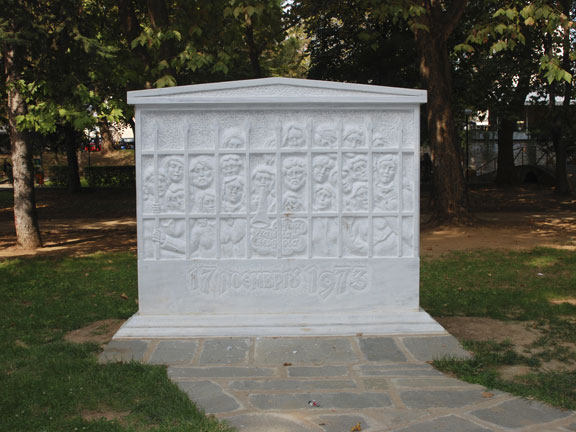
But the central event, the starting point of growth in the influence and authority of Greek students was an uprising at the 1973 Atheno Polytechnic University. On November 14, students of the University of Polytechnic (εθνικό μετσόβιο πολυτεχνείο), against the backdrop of a silent and frightened society, openly contrasted themselves with the regime of the “black colonels” who seized power in 1967, saying: “And the king is naked!” Students of Zamarikadadadi in the central building of the university, and, having built a short -wave radio station, turned to Greece citizens with an appeal to oppose the dictatorial regime: “ This is a Polytechnic! The people of Greece, the Polytechnic carries the flag of our and your struggle, our common cause of resistance to dictatorship and for democracy! ” Soon, tens of thousands of residents of the Greek capital joined them, having arranged protests both in the territory and in the area of the Polytechnic and the Archaeological Museum itself.
The head of the military junta, President Papadopulos gave the order to use force against the protesters. In the early hours of November 17, 1973, about 25 tanks approached the fence of the Polytechnic. Despite the fact that the student performance was suppressed, confidence in the regime of the Black Colonels was finally undermined. The junta was self -discrediting, using tanks against one of the oldest universities. In the army, in the sea fleet, mass disobedience began. During NATO exercises, several warships escaped abroad, and their crews asked for political asylum there. In 1974, after the parliamentary elections, the dictatorship fell.
The participation of Greek students in the overthrow of the regime of “black colonels” laid a huge imprint on the whole modern history of Greece. In fact, students received the status of "grave workers of the fascist dictatorship." Greek universities after these events began to have extraterritoriality - the police entrance is prohibited. Only a unanimous decision of the rector council, which consists of teachers and students, can allow the police to the territory of the university. Many students who participated in those events later became politicians, some of them are European level. For example, the announcer of the Leval Student Radio Polytechnic Radio Maria Damanaki now holds the post of European Commissioner for Marine Resources and Fisheries. Without understanding the historical role of Greek students, it is difficult to understand the political features of modern Greek society, and those unrest that have been observed in Greece since 2008.
It is also important that many teachers of French, Greek, English and American universities in the “moments of truth” have repeatedly supported students, thereby confirming the old university principle of the Union of Teachers and Students.
Transition time
Soviet students and his heir - Russian student were very far from the traditions of university democracy, corporatism and liberties. The revolutionary traditions that existed in Russian universities until 1917 were safely eradicated by the Soviet regime. European students since the Middle Ages, represented an active social stratum with their worldview and customs. Soviet students did not represent any special corporation. However, due to a small number of universities in the 70s and 80s. Only confident in their abilities went there, the most trained school graduates. High competitions forced some to submit documents to the treasured university for 2, 3 or more years. No more than the fourth or even fifth of school graduates entered universities of the USSR.
Since the late 80s, the situation has changed dramatically. The system of vocational education was destroyed, many private and semi-state universities were opened, which began to enter up to 95% of secondary school graduates. Higher education from Desidurate has become the norm. Most of the current students do not act for the sake of some high goals of education and science or future career, but for the cherished “crust”. In fact, training at a university was not a choice of life path, but a continuation of school idleness, a kind of extension of childhood (for young men, which is also important, also a way to “slide” from the army). Russian "Dunno" was quickly disappointed in a chosen specialty, because the fluidity of students from the department to the department, from a university to a university became the norm.
Russian students have never been widely united around any political or even social requirements. In the 90s, most of them seemed to have barely survived in the conditions of a cruel economic crisis. But in reality it turns out that this force was only tearing. Some groups of students, on their own initiative, took an active part in the political life of Russia. Students of left-wing views in the 1990s took part in the events of the Communist Party and especially in the shares of levoradic organizations. They made up the backbone of such parties and movements as NBP, AKM, RKSM, Antifa groups and others. In the 90s, the Left trade union organization “Student Protection”, which consisted of about 13 thousand people, gained certain fame, its departments were opened in one and a half large universities of the Russian Federation. Students did not stay away from the tragic events in the country. The fifth of those killed during the events of October 3-4, 1993 were students of Moscow and nonresident universities.
Already in the mid-90s, students were perceived as a potential danger to the regime. If you do not take into account students who have entered into such organizations as “Choice of Russia”, “Our House Russia”, “Unity”, “Walking Together”, “Our” and other official parties and organizations, none of the youth leaders nominated by students has been able to become a federal politician over the past 20 years. Youth Self-Made, a native of a politically active student environment is perceived by the power itself as its potential enemy. Even harmless measures, by and large, not related to political activity, were brutally suppressed. As an example, we can cite events in the hostel of Tver State University, when students decided to celebrate on May 19, 1994 the old Soviet holiday Pioneer Day.
The city authorities called the units of riot police, removed, as later told in the ATS of the Tver region, from the detention of a large batch of illegal weapons transported from the Baltic states. Police officers conducted the "cleansing" of the hostel. Several dozen students who did not put forward any political requirements were beaten, but law enforcement agencies were able to report to the government about the suppression of the next “red-brown” rebellion. Prime Minister Chernomyrdin, commenting on these events, said: "Revolutions do not begin with mining strikes, but with student riots."
In the second half of the 90s, when the Russian parliament began to drift to the left, and the government of Primakov-Maslyukov came to power, state power began to look closely at university students. When April 14, 1998 in Yekaterinburg, riot police dispersed the student rally, this case not only received a great resonance in the central media, but caused the creation of a special commission in the State Duma. During the investigation, it was found that only four police officers exceeded their powers by applying rubber sticks. Nevertheless, the State Duma adopted a resolution in which she supported the students' demands to “preserve the rights of citizens to free higher professional education in state and municipal educational institutions”. Moreover, it was precisely as a result of this that parliamentarians spoke out for "the prevention of law enforcement agencies in relation to citizens expressing a fair protest against the policy infringing their constitutional rights."
Student unrest of 1998 took place in some other cities: Chelyabinsk, Irkutsk, Orenburg, Cheboksary, Omsk. The result of this wide and so far unique in the history of modern Russia of the student movement was the resignation of the Minister of General and Professional Education of the Russian Federation Alexander Tikhonov and his deputy Alexander Asmolov.
Sleep stability?
With the beginning of the era of "stability" in the 2000s, student activity began to decline steadily. An increasing number of private universities and paid departments in the state have created a critical mass of students who are little concerned about any social requirements-they pay for the education themselves . The struggle for the depreciated scholarship almost completely lost its meaning. The times when it was possible to live almost fully on it, have long passed. One and a half thousand rubles will be enough only to go to the cinema and visit McDonald's. Students spend the remaining time from study on a part -time job. Fortunately today, students are willingly taken by waiters, couriers, cleaners, promoters and salesmen.
On the other hand, over the past years, the government has done everything to deprive student associations of any independence. In modern Russia there are no independent student trade unions. All trade union organizations of students and graduate students, one way or another, were affiliated either with the leadership of their higher educational institutions, or with officials of the Ministry of Education and other state bodies. In no history of recent years, when the students were involved in political conflicts, they were arrested or even convicted, the trade unions did not show themselves.
On the site of small but active student groups of the 90s, large, but passive student organizations created under the patronage of power with one purpose appeared: preventively canalize student movements in the right direction. An example is the Moscow Student Center, created by order of the Moscow government 12 years ago. Today it is called the "City Organizational and Methodological Center for the Development of Student Self-Government in educational institutions of higher and secondary vocational education in the city of Moscow." It is clear that in such "bureaucratic" centers, no student self -government does not smell. However, young careerists willingly go there. Why spend years of life on the fight against windmills, if through a system union or municipal center it is easiest to get into the desired ranks of the municipal, or even federal bureaucracy?
Students whose interests extend further than the size of the scholarship and warm place in the city administration, realize themselves as part of the “adult” political associations: from the Russian “defense”, the Libertarians, the “Pirate Party” to the “Eurasian Youth Union” and “other Russia”. However, in recent years, virtual network communities have competed with traditional organizations. Social networks allow students to create groups devoted to specific events, promotions, flash mobs, as well as, unlike parties and other public organizations, make it possible to be friends not only “for” someone, but also “against” someone, which is undoubtedly psychologically simpler. The lack of traditional party formalities helps these groups mobilize faster. Undoubtedly, students of Moscow universities compiled a significant part of the participants in the protest manifestations, who swept through the capital in 2012.
At the same time, in recent months there has been an increase in student activity itself. However, unlike the 90s, students' performances are not associated with the size of the scholarship, travel benefits or prices in university canteens, but with the beginning of the obstetric universities and the prospect of their reorganization - up to disbandment. And to anyone, even to the most unplained student, it is clear that the closure of the educational institution will mean the loss of his personal “ticket to life” or at least its complication. The protests of the students of the RGTEU managed to stop quite quickly, but the next future will show whether the student movement will grow and whether the state will be able to depreciate the closure of university by the opening of special technical educational institutions following the example of the USSR. And this is a question not only of controllability, but also in social mobility.