
Translated material
Without shame and conscience
What happened to those who opposed the antidesta law
At the December press conference a year ago, Vladimir Putin was forced to answer questions about the “law of Dima Yakovlev” several times, which he was only about to sign. This year, the theme of Russian orphans sounded only once, at the very end of the meeting. Putin’s answer to the replica of Bloomberg journalist that some children who did not have time to adopt the foreigners died over the past year consisted of one proposal: “Have you forgotten that some children who were adopted in the United States also died?” It was a signal: the topic is no longer relevant
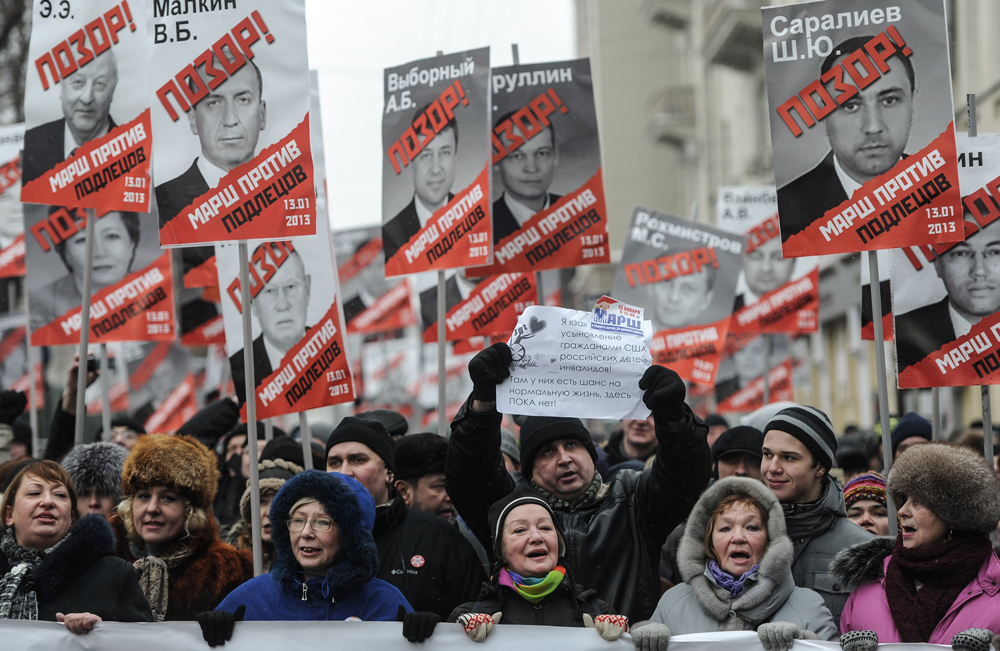
"Mars against the Schools" January 13, 2013
The statistics for 2013, which is expected in January, will show whether Russian and other foreign foster parents were able to adopt 600 orphans more-about the same, according to www.usynovite.ru, had to be adopted in 2012-and how many children are disabled (the Americans took 71 last year). But today it is known that out of 259 orphans, who have already met their future American parents, but remained in Russia because of the law, 95 did not find a family for a year. Some of them - those who are older - still remember the Americans and ask when they come for them. So, according to the Commissioner for the Rights of the Child from St. Petersburg, Svetlana Agapitova, two brothers 6 and 7 years old and a girl of 7 years in a year did not forget those whom they presented to their dad and mother. “Of course, it’s okay, except for a very difficult psychological situation for a child who should have been explained:“ They will not come for you and you will not be taken away. ” At least two children with Down syndrome during this time died. However, not one of them was listed in the “American list”, since their failed American parents did not manage to draw up all the necessary documents before the ban. ” (The New Times, who did not leave for America, spoke about these and other children in the material “Divine Children” in No. 40 (307) of December 2).
Not only the president does not want to talk about the fate of these children today, but also the majority of State Duma deputies who have adopted the law a year ago - in three readings at once. Questions about children here seem to be appropriate: the thing is the past, the topic is closed, everything that could be said has long been said. In the building on Okhotnoye, they are preparing for the New Year: plenary meetings are still going on, but in the corridors it is already smelling of fast winter holidays. The deputy chairman of the State Duma, Sergei Zheleznyak, handed over to the assistant that he could not comment on The New Times The results of the year after the adoption of the "Law of Dima Yakovlev", as he was "busy." From herself, the assistant added that Zheleznyak is not the only author of the law. The head of the United Russia faction Vladimir Vasiliev also did not find time to talk about orphans, and his assistant noted that Vladimir Abdualievich prefers to comment on security problems.
One of the main lobbyists of the law, deputy chairman of the Committee on Family, Women and Children, the deputy from United Russia Olga Batalina assures that her position has not changed since the adoption of the law, since the “set of extremely serious claims to the state system of the United States, to the work of social services, and the norms of the legislation”. Yes, she knows from the press about the fate of specific children remaining in Russian orphanages due to the law adopted by the deputies. He knows about the problems of children with disabilities, for which so far in Russia there are catastrophically lacking adoptive parents, despite the fact that even in France they prefer healthy ones. But there are other fate of the children crippled in America: Batalin refers to the investigation of Reuters, published in September, telling how some American families transferred the adopted abroad, including Russia, to unauthorized persons through the Internet, when they understood that they could not cope, and some of these children were later terrible.
“I voted for this law absolutely consciously,” says Batalina. “There are probably deputies who have a different point of view.” “They also talked about unprecedented pressure on the doubters.” “There are questions and events - there are not so many of them - in the assessment of which the Duma is unanimous,” the deputy chairman of the family affairs committee answers. “Talking about pressure on individual deputies, when the whole Duma voted for this law, is ridiculous.”
The only deputy from the ruling party, who voted against the law, Boris Reznik, refused to discuss the motives of his disagreement with his colleagues in the faction: “What kind of journalism is this - to recall the law that has been adopted a year ago?! Well, they adopted the law and adopted, the topic has long passed. ” When asked if he was regretting his choice and what was his choice for it, Reznik said that he was not sparing, he had nothing to say, but he categorically does not want to speak on this topic today.
But it’s still worth talking.
Eight brave
The text of the amendment on the ban on the American adoption that appeared in the law “On measures of influence on persons involved in violations of the fundamental rights and freedoms of citizens of the Russian Federation” to the second reading, almost no one saw until the day of the meeting. Legislators discussed on the sidelines “male” options for the diplomatic response to the Americans to the “Act of Magnitsky” - from the closure of the NATO logistics base in Ulyanovsk to the withdrawal of assets of the Central Bank, located in the US Treasury obligations. The rumor that the answer will concern children-orphans appeared only on the eve of the second reading, and everyone immediately realized that the matter was serious.
“At the (meeting) faction, a number of people were against it,” recalls the deputy of the director Sergei Petrov. - But when we saw how Levich and Mironov shout temperamently: “What are you?!” -It became obvious that some promise was taken from them. With a high degree of probability at a meeting with the leaders of four factions, Putin asked to be one here. And it seems that this was reinforced by a promise to increase the financing of parties. In general, the Putin administration has fears that if there is a split of the elites, some kind of swamp or the Maidan will start there ... and this is dangerous. ”
From a legal point of view, voting “against” is equivalent to abstinence and non -participation in voting. But the deputies understand the nuances well. “If you do not vote in the Duma, this is enough to show that you do not support it,” explains Demissy Dmitry Gudkov. “And if you vote against, then you say: I challenge you - to those who invented it.”
In the second reading “Calling to those who came up with this,” quit four - Gudkov, Petrov, Zubov and Ponomarev (all from the SR), two more, Pakholkov (SR) and Maksakov (EP), 40 deputies did not participate in the vote.
“When we voted against,” recalls Sergey Petrov, “one of the deputies sitting nearby was horrified:“ What are you doing?! They will eat us now, what are you! " That is, frightened even people with a mandate is amazing. ”
But the example of the four deputies rather inspired what scared away: in the third reading the number of rebels doubled and was eight people: the marshmallows were joined by the uninterum deputy Boris Reznik, the Communists Zhores Alferov and Oleg Smolin, as well as the justoross Andrey Ozerov.
“In general, in this situation, the most courageous and cool is Reznik,” Dmitry Gudkov is sure. - His position is bolder than mine, because in this case he went against the party’s line while in this party. He could and can get more problems for this. ”
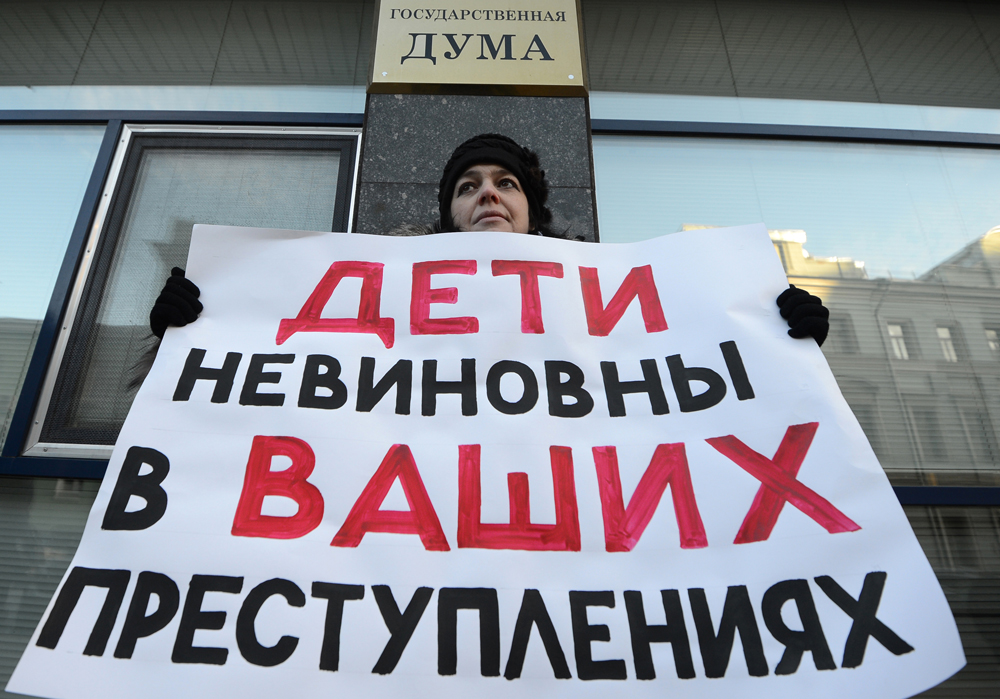
A single picket at the Gosdum walls during the vote for the "Law of Dima Yakovlev." December 2012
It is not dangerous to be fundamental
The deputy from the Rodin Communist Party - of those who, in the second reading, “fundamentally did not vote” for the law, for which he received the SSMES with gratitude from one of the voters. On the day of the third reading, he went to a meeting with students, passing his card to colleagues in the faction. “I asked my opinion to be observed, but it so happened that the one with whom I agreed, he also went away and handed over the card to another ... Well, this story, in general, is ordinary, a deputy’s household. I was sure that they pressed the right thing, I did not know who would press in the end. "
The fact that he voted for the law, the MP Rodin learned from another voter who wrote him a letter full of reproaches. “I got into the archives and became convinced, but it was already too late, the train left. This is already a claim to itself. ”
Despite this misunderstanding, Rodin is sure: there was no pressure in the faction to ordinary communists, every deputy could vote as he considered fit.
The Communist Party deputy Oleg Smolin did not vote in the second reading due to the absence of at the meeting, but in the third, one of the eight spoke out against. “Honestly, I was simply outraged when the children were tied with the struggle between different financial groups. I would not want a live shield from our children for our oligarchs and security forces, ”Smolin explained his decision, adding that his wife, a child psychologist, did not expect another from him. - And I still think that this vote was right. I think that patriotism is not at all to protect the participants in financial proceedings with the help of children. Patriotism is completely different. ”
"
“When we voted against, one of the deputies sitting nearby was horrified:“ What are you doing?! They will eat us now, what are you! "
"
Not even a month has passed since the third reading, as Smolin heard about himself from the television screen: “The building is in the center of Moscow. Mansion. As soon as the building went to the All-Russian Society of the Blind, where the deputy Smolin plays the first violin,-Andrei Karaulov’s voice from the program “The moment of Truth” sounded against the backdrop of anxious music, “Gay club opened there. The largest in Europe. "
Smolin does not exclude that this was a response to his fundamental position on children, although "I am not sure of this one hundred percent." What he is sure of is that it is not as dangerous today as a fundamental one as once: “I think, somewhere they took note of the presidential administration, but no radical consequences have happened. Now is not the times when for such votes you can lose freedom or something else. Now it is much easier to show character than in many other times. ”
“Still, it matters what position you take,” the deputy-the deputy-Valery Zubov, is convinced of the eight who “challenged”, is convinced. -If some personal or cheap populist element is seen in your position-this is one. If it is clear that you are doing beliefs, even enemies begin to treat you seriously and even, perhaps, with respect. I know that when there was a discussion, with whom to speak, and with whom it was not, it was said: it is not necessary, it is useless. And no one crushed. And really there are no consequences yet. ” - "Do you think it will not be?" “I think not.”
When he was the governor of the Krasnoyarsk Territory, he personally oversaw the device of the Krasnoyarsk orphans in the United States, and his wife was supervised by orphanages: “I just thought: now I will come, I will open the door, and my son will say with such eyes:“ Father, how did you vote? ” I just knew that (if I vote “for”) I would come home - they won’t understand me. ” Dmitry Gudkov had a similar motivation: “I even understood that if there was a threat of deprivation of the mandate, I would not vote,” says Gudkov. “Because my wife would not forgive me for this.”
Rebels from the regions
The deputy of the Pskov Regional Duma from United Russia, the director of the Pechora boarding school for orphans, Vera Pechnikov never voted for the law, she abstained when discussing on the profile committee and did not participate in voting twice-as before the emergency meeting of the faction with the governor Turchak, convened after the law did not pass, and after-when five Her colleagues in the faction changed their position and voted for.
The text of the resolution on the support of the "Law of Dima Yakovlev" appeared on the agenda of the meeting of the Pskov Regional Legislative Assembly on December 25, 2012. By that time, the law had already passed three readings in the Duma and there was no need to consider it to the regional parliament. The “apple tree” Lev Schlosberg spoke to colleagues with a speech in which he urged them to “refrain from participating in meanness, because participation in meanness is lifelong and it will be impossible to correct anyone.”
“At that time, it was my position, because we were not quite ready in Russia to cancel foreign adoption,” says Pechnikov, today a former deputy of the sector of the region. - And I still have some doubts, because they began to send children to the families unprepared to the families too generously and the children are returning to the orphanage. Many children found happiness there (in America), it was impossible this way: once, crossed out - and that’s it. If we were ready to make all the children happy ourselves, there would be no questions. ”
Pechnikova-and she is not only the director of the boarding school, but also the adoptive mother-she assures: today you can defend her position. As for her exit from the deputy corps shortly after the December vote, this is in no way connected with the position on the "law of Dima Yakovlev": "This is a completely different story, it just coincided in time."
The Commissioner for the Rights of the Child in St. Petersburg, Svetlana Agapitova, is known for his speeches against the ban on American adoption, for which she was publicly criticized by Pavel Astakhov, and sympathizers experienced that she might lose her post. But nothing of the kind happened, and a year later the authorized man reports 33 children from the “American List” in St. Petersburg about the fate: 8 orphans were arranged in Russian families (one adopted and seven taken under guardianship), 13 are adopted abroad, two more cases of foreign adoption are considered by the courts at the moment.
“The declaration that these are our children and we need them ourselves, we are not yet very implemented. Half (from the American list) still went abroad, they did not stay in Russia, ”concludes Agapitov.
The question of how difficult it was to oppose the law, it seems strange to her: “In general, I believe that an authorized person who is engaged in such children, in principle, cannot say that the child is better in the institution than in the family. And when it came to the fact that the child will either remain in the orphanage or the Americans will be taken away, I could not speak differently. ”
Photos: Maxim Blinov/RIA Novosti, Vladimir Astapkovich/RIA Novosti