
Translated material
The family of panicing killer whales saved from ice captivity in Canada thanks to the wind
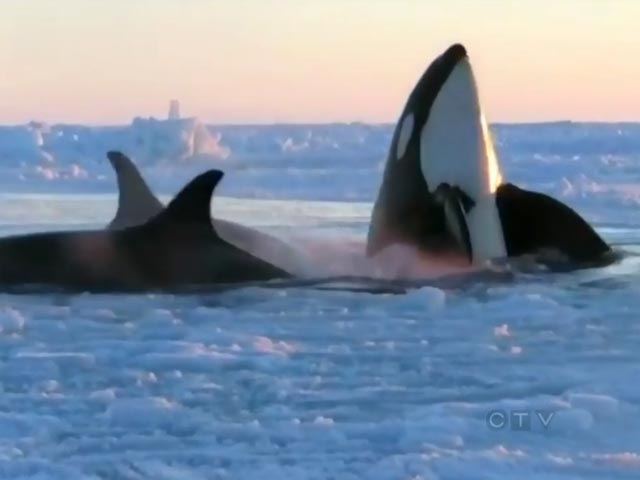
A dozen tuitions are also known as “killer whales” because of the reputation of dangerous predators, miraculously managed to get out of the cold Gudzon Gulf, where they spent two days, stuck in the ice, reports CTV News .
Mammals who fell into trouble were noticed by residents of the village of Inukjac in the Canadian province of Quebec on Tuesday. The killer whales did not have time to swim ten kilometers to the open sea before the bay began to freeze. They emerged alternately to take a breath, but, according to local residents, wormwood also began to drag on ice, which could threaten them with death from a lack of oxygen. According to the behavior of animals, it was clear that they were panicking.
Canadians turned to the Ministry of Fisheries and Ocean Studies of Canada with a request to deliver the icebreaker, to which the representative of the department, Natalie Stynders, refused, saying that this was too expensive. Nevertheless, it was decided to send oceanologists to the place of emergency. By the time on Thursday, a helicopter began to circle over the place of wormwood on Thursday.
According to one of the inhabitants of Inukjuak, Johnny Williams, most likely the ice was opened due to a change in the direction of the wind, which allowed the wanders to leave the captivity, reports The Globe and Mail . Nevertheless, as the representative of the World Wildlife Fund in Canada, Pete Evans notes in an interview with CTV News, the fate of animals should still cause concerns, since there is no guarantee that on the way to the open sea they will not get stuck in another of the same west.
As RIA Novosti notes, the fact that the wanders appeared in the Arctic region of Canada in January is unique, since they are not lovers of cold seas. “Most likely, they fell into the trap because of the warming of the seas, which allows animals to go further and further north,” the zoologist agency Christian Rampa quotes.
Nine rare whales were tracked by their songs
Meanwhile, in order to track the location of whales and provide them to protect, scientists use special machines that fix sound signals that mammals emanate. So in the Gulf of Men, located between the American peninsula of the Cape Code and the Canadian New Scotland, nine southern whales, which were at risk of destruction, were recently seen, despite the fact that they had not found their traces here.
“This is a much more effective way than inspecting the territories from a helicopter or sea vessel,” said Wan Parizh, a researcher at the Oceanographic Institute in Massachusetts in an interview with LiveScience magazine. Automatic machines are devices two meters long, which are immersed in water and periodically rise to the surface to transfer the information received to land.
Now, scientists have to find out why the southern whales seemed to be a previously unfamiliar water area, for which the water temperature will be measured and representatives of the animal world, living in the bay, who could attract whales as food, will be studied.