
Translated material
The experience of Bogota - to help Veliky Novgorod
In my spare time, I looked at the new “Travel Notes” on Varlamov’s blog , in which he describes Bogota, the capital of Colombia.
Varlamov is right when he writes about the first associations with this country. Indeed, for everyone who has a little idea what kind of Colombia it is in South America and what it is eaten with, the first associations with this country are cocaine, emeralds and the mafia. Bogota breaks the mold in a good way. Now it is a progressive city in terms of developing a human-friendly environment. After all, it was headed by one of the most famous urban planning specialists, Enrique Peñalosa. During his reign, many parks and pedestrian areas appeared in the city, public spaces developed, and new libraries appeared. And slum dwellers received free electricity and water supply at the expense of increased taxes on the rich. By the way, I am not a supporter of a progressive tax scale, but the measure has a right to exist.
We must understand that Colombia, along with its drug trafficking, cocaine and emerald mafia, has not gone away, and Bogota is also part of the country. However, in just three years (from 1998 to 2001, one term of office of the mayor), the attitude of citizens towards their city changed, it became cleaner and more elegant, people liked such a city. The previous mayor, Antanas Mockus, did a lot to decriminalize the city (crime dropped by 70%), accordingly, the ground was prepared for radical measures by Enrique Peñalosa.
Peñalosa abandoned the huge financial injections into the road network and directed these funds to pedestrian areas, switched the city to bicycles, created an effective public transport network and taught people to read. Some streets in the center have become pedestrian.
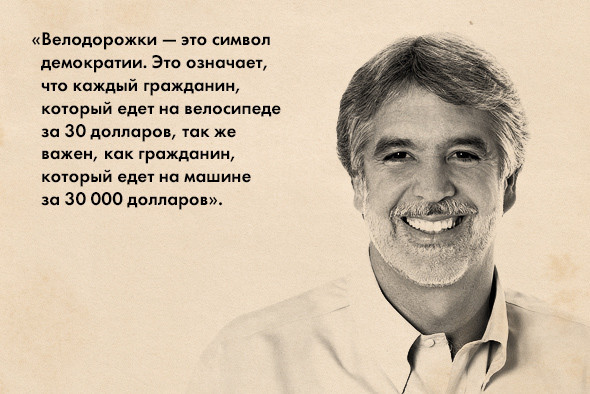
Image from the-village.ru
I really liked the law there, which exempts the owner of a building in the city center from taxes if he preserves the historical appearance of the facade. These houses are painted white, have ceramic tiles on the roofs and no advertising light boxes on the walls or above the roofs. Typical city houses in Spanish style.
This is a very useful experience that could be applied in our city. It is clear that you cannot free anyone from taxes so easily, and you don’t need to. You can find some other levers of influence and preferences for owners or tenants of buildings and premises. Now the administrative commission is looking for violations of the rules of improvement and orders to eliminate them. In special cases, fines. There must be a whip, of course. But where is the gingerbread? How do we encourage keeping the façade clean and beautiful? After all, something can motivate a person to take care of his premises and the area around him? It is better to inspire than to repress. The city already understands this and entrepreneurs who develop priority areas of the economy are reducing rent. This principle could also be adopted in landscaping.
There are three times more pedestrians in the city than motorists. It is strange that currently spending not three times more on pedestrian infrastructure than on automobile infrastructure. The maintenance of each car is expensive not only for its owner, but also for the city itself. Motorists take up 40 times more space than pedestrians (compare 40 cars and 40 people inside one bus), cars require expensive maintenance, roads are repaired more often, and yards have turned into one large parking lot. You can build dozens of new roads and parking lots, create interchanges, but this will only encourage potential motorists to buy more and more new cars and ultimately will not solve the problem.

Another way out is to make walking not only cheaper, but also more enjoyable. So that you can not only ride on the bus, but also warm up. So that using a car in everyday life loses its meaning. Do you know why Mayor Yuri Bobryshev walks? Because it does this on the Yaroslavov Dvorishche and crosses the Volkhov River on a pedestrian bridge. It's nice to be there. I think walking along Shchusev and Korovnikov is not so pleasant. But many more people live on these streets. So why aren't they a priority? Just don’t say “because the mayor doesn’t walk there” - after all, where he lives, the sidewalks are not ideal either.
Nowadays there is a lot of talk about the fact that “there are only gopniks walking around in the city, they will break everything and piss on everything.” Firstly, there are not so many gopniks and vandals; our people’s self-image is greatly underestimated. The experience of Bogota, where many were born in slums, will help. Most city residents are normal people who love beautiful squares and courtyards. And when they see them, they will walk there. Gopniks will simply become invisible, and some will change their views. Secondly, there would be fewer gopniks if people lived in a normal human environment. In fact, when you grow up and see devastation throughout your childhood, it’s no wonder you absorb all this and give birth to similar things. The mayor of Bogota understood this and allocated money for the construction of libraries.
There are enough libraries in Novgorod. Another thing is that their condition is, let’s say, unimportant, which is why so few people go to them. But there is a more serious problem. In 2013, for example, not a single penny will be spent on the development of mass sports from the city budget. And in past years, this item of expenditure was spent on “prefabricated sports and health complexes.” Do you know many football fields and basketball courts in the city that you are not ashamed to show to visitors? I don't remember something either. But there is an Ice Palace and a Sports Palace. These are good establishments, but you have to pay for everything, and not everyone here is capable of this. Mass sport becomes truly mass when it is free and accessible everywhere. In the meantime, our old basketball courts are turning into spontaneous parking lots, and in the Kremlin park, instead of sports fields, used tacky carousels are spinning. This is also about the automobile curse that the city and its residents suffer.
Like education, sports make it possible to replace simulacra, such as alcohol, with real activities. But for some reason the city thought that everything was fine with mass sports in the city, although I, for example, don’t know where in the center I can throw the ball so that I can throw the ball for free and not run into a stunned motorist whose headlight I accidentally break with the ball. Just as Peñalosa built libraries, Veliky Novgorod needs sports grounds in every quarter. At least tidy up the old ones. There are still many of them, despite the fact that half have drowned in automobile hell.
It turns out that the capital of a state in which there has been a civil war for half a century and is ruled by mafia clans can teach a lesson to a city living in a stable and, it seems, developed Russia. In fact, the secret is simple and understandable to many - professionalism (or a team of professionals), plus political will. Especially with the latter there are problems at the municipal level, but without this, sorry, there is no way. We must be prepared that any breakthrough idea may be met with hostility, because motorists will not want to give up the land for their cars, and business will howl when expensive contracts are taken away from them where they may not be needed. But then ordinary residents will say “thank you.”