
Translated material
God without a car
In fact, there was a promotion by no means a memorial, but ritual property - the generation of innovators took the oath of the ideas of Stanislavsky on the scene he created. Oleg Tabakov, Konstantin Raikin, Alla Pokrovskaya, Natalya Tenyakova, Alexei Bartoshevich-in the performance of the documentary of the Novodarovtsy Mikhail Durnenkov, those who are familiar with the hero of the evening through one handshake. But the first to come to the stage are the directors with whom one part of the hall connects hopes to update the Russian theater, and the other is the horror of its imminent death.
A mirror is omitted over the stage, so that in the scene frame the gathered to honor the memory of Stanislavsky sees the highest theater society, first of all, itself. The first row in this group portrait is occupied by Kirill Serebrennikov, Dmitry Chernyakov, Mikhail Ugarov and Viktor Ryzhakov - for them the scenographer Nikolai Simonov installed a number of seats along the advance. Assenting the newspaper editorials who bury the Moscow Art Theater during the life of the founders, they talk about Stanislavsky in the past tense. Gradually, the Philippics grow into a bickering, clearly reminiscent of the current theatrical disputes: the Vakhtang Chernyakov responds to the Ugarov-Nonirovich as a “supplier of literature” and “misunderstanding as a director”, he throws Serebrennikov-Meyerhold, who remembers him from the first year and never noticed genius in it. Only Viktor Ryzhakov on behalf of the Knight of the Sulerzhitsky Theater appeals to Stanislavsky: “Do not listen to anyone! You are doing a big job, do it excellently - and therefore forward! Beat, beat and beat in the hearts. "
So they coexist in one space - the heirs of Stanislavsky and the new frantic. From the screen, Vladimir Sorokin performs on behalf of Chekhov, Zakhara Prilepin got the role of Gorky, Alla Pokrovskaya and Natalya Tenyakova - the writers of Knipper and Andreeva, look at them in a folk region. Ilze Liepa-Isadora Duncan and the white scarf, is also floating behind her, fluttering not by the wind of time, but young students. Later, Konstantin Khabensky appears on behalf of Nemirovich-addressing Stanislavsky with Tirade about mutual misunderstanding, he leaves the stage, returns, leaves, returns again, and so several times, just like in life. The contradiction between the founding fathers of the Moscow artistic will be resolved only under the curtain: Stanislavsky will tell Nemirovich that if he leaves the theater at five o’clock, he will not be there at a quarter of the sixth.
Oppositionist Ugarov was even allowed that in state theaters it is strictly forbidden-smoking on stage.
“Outside the system” is written and set precisely what about reconciliation. Composing about specific people in the calculation of specific performers, Mikhail Durnenkov and Kirill Serebrennikov are actually talking about their own generation, with whom the well-known metamorphosis has been adopted in recent years-Anfan-Terils inevitably find themselves in the circle of those who have recently rebelled. Protagonists “outside the system” in the final not only reconciled with Stanislavsky, but also become its evangelists. From the lips of Chernyakov-Vakhtangov, we hear the words “God” and “our father”, “father”-from the mouth of Meyerhold-Serebrennikov. The story of Yevgeny Mironov - Mikhail Chekhov about how Stanislavsky healed him from stuttering, sounds a certificate of a miracle in Capernaum.
The pathos of what is happening, of course, as far as possible, is reduced by irony: the oppositionist Ugarov was even allowed that the state theaters are strictly forbidden-to smoke on the stage. True, a fireman with a fire extinguisher was put nearby: where the leader of the “theater.doc”, as it would not work there.
Only Stanislavsky himself is not on the stage - its text is read out from the screen by the artist Anatoly Bely, who chose the most velvet and soulful from the arsenal of his intonations, which is no longer in use today. Most of the replicas in the play are pronounced on paper: “outside the system” wants to be extremely documentary, because the second most important plot of the production is an attempt to reconstruct the image of the Stanislavsky-human. Reconstruction is carried out both in textbook and unfamiliar facts, statements about him and himself. There are also enough silent scenes: the same people in black launch a balloon with the face of Stanislavsky and torte in the NKVD of the dying Meyerhold - in this episode of silverniks, the unconditioned Utrashytus Klima is inferior to their role.
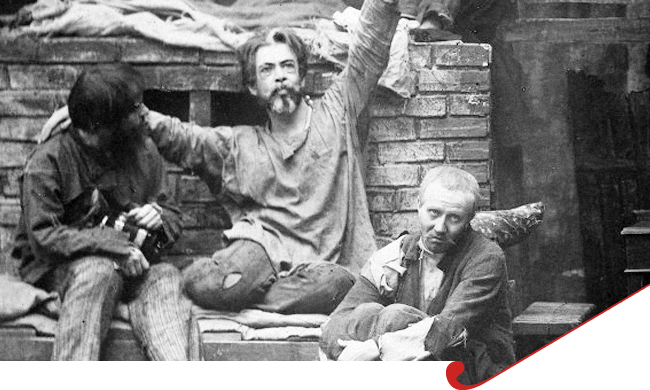 The photo is provided by K.S. Stanislavsky
And the solemnly-typical music of Alexander Manotskov for six piano with Suzumov solo Peter Aida on a prepared piano, from which naturally scraping the soul, and a video sequence in which the chronicle brings an animated snowball, and the endlessly polar facts and judgments themselves-all this works on the image of a person who eluded the world and eluding the definitions today. The only thing that the authors are “outside the system” are talking with certainty is about the state of theatrical business, which inherited from Stanislavsky. The sources used by Durnenkov relate to the period between 1918 and 1938 - to the era when the theater turned into an ideological instrument of Soviet power. Having grown from the utopia of the theater-house, the theater-guard, by that time, became an institution that has accumulated not only a unique experience, but also fatigue and illness. It was on this foundation that the building of the State Theater was built, in which we live to this day - a building that has turned over time into a deprived content, a half -empty, dilapidated shape.
In the final “outside the system”, Oleg Tabakov, Oleg Tabakov, rises from the stage holding in white - seems to be a booth. While the apostles come out from behind the scenes in order to glorify his theater God, the gray-haired “God from the car” reads the notes of Stanislavsky from the duty diary for the theater: rats run along the stage; Who has the keys to the cash desk - it is incomprehensible, it would be necessary to lock on the bolt; The sleeve was turned into a trash; dust and desolation everywhere; It’s sick to look at the tickets - the rabbits, it would be worth the uniform to turn over, it has already been done once, well, you need to do it again - the old “dirty wrong side is better and decent than the present face”.
It seems that the current head of the Moscow Art Theater pronounces the last words - and who would have taken to argue with him. The theater does not live either the idea of Stanislavsky about the team of like -minded people who recreat the “life of the human spirit”, or the Soviet idea of educating the art of builders of communism. Today, the words of one of the spectators “outside the system” of Mikhail Shvydky, the theater serves only “group egoism of artists”, who receive at the official account “pleasure to cast supersensible experience in sensory form”. However, the innovators still have a chance to manifest itself to the reformers-however, not in the Moscow Art Theater: Viktor Ryzhakov headed the Meyerhold center, Kirill Serebrennikov, a couple of weeks, opens his own Gogol Center. I would like to believe that in both cases it will not be about the label of the old dress.