
Translated material
Tango not for two
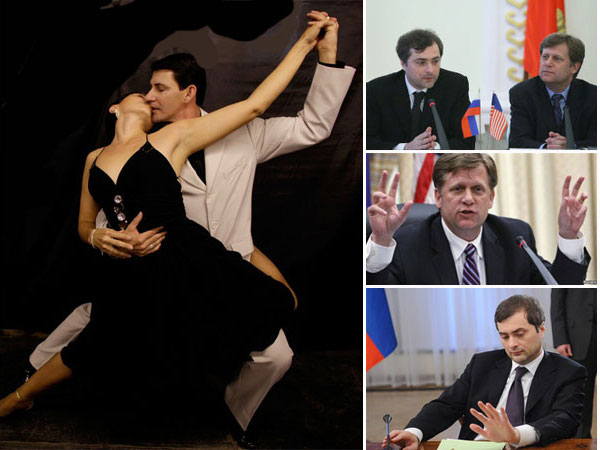
The United States has left the working group in civilian society. The de facto “Commission of Surkov-Makfol” ceased to exist. And even wider: in fact, the “rebooting” of relations between Moscow and Washington, which Dmitry Medvedev and Barack Obama, was so proud of.
The relations of Russia and the USA in the past few months, thanks to the "efforts" of both countries, are getting worse and worse. The Russian side with its strange anti -Sirot law here, of course, made more states. And here is a logical result: the United States is going on a working group on the civil society of a bilateral presidential commission.
About this Interfax told the deputy secretary on democracy, human rights and labor and co -chair of the working group from the American side Thomas Melia. The reason, according to him, was the "recent steps of the Government of Russia to limit civil society." The government here, of course, means the Kremlin with its efforts to suppress protest, with the same anti -Sirot law and ostentatious spit on any other position, except for Vladimir Putin’s position, “repressive” laws adopted last year and still not adopted, but considered. The activity of the Russian authorities, which can be described as a “limitation of civil society” has recently been very noticeable, apparently even in the USA.
The Ministry of Foreign Affairs, represented by the co -chair of the working group from the Russian side and the authorized Foreign Ministry of the Russian Federation on human rights, democracy and the supremacy of the law of Konstantin Dolgov, replied that so far he had not received an official notification from Washington, but admitted that such information reached him in oral form. The Kremlin, in the person of the Putin spokesman Dmitry Peskov, expressed regret. Pavel Astakhov regretted such a decision, noting that “work in this commission was very effective. We exchanged experience in the search for children and the help of orphans. ”
Strictly speaking, the fact that from the working group you should not wait for breakthroughs, it became clear already during the planned rotation of its co -chairs in January 2012. When the commission was created, the then first deputy head of the presidential administration Vladislav Surkov, a figure in Russian domestic policy, was appointed its curator from the Russian side and is indeed responsible for issues of compliance with the civil rights authorities in Russia. Replacing him with a personnel diplomat after the transition of Surkov from the Kremlin to the White House testified that the commission and a working group on civil rights are seriously losing in status. The same applies to the replacement of Michael Macfol, who had served to Moscow by the new US ambassador to Thomas Melia.
But more recently, everything seemed so rainbow. In June 2011, at the third meeting of the working group, it was decided to expand the agenda, by 2012 the same agreement on the adoption was prepared that Russia now de facto resigned the “anti-Magnetic” law. The participants in the meetings included public organizations, and those that are configured in relation to the authorities of both states are quite critical. In a word, one could hope for a certain result.
But, probably, it could not be otherwise, because the “Commission of Surkov-Makfol” was a direct consequence of the “rebooting” of relations between Russia and the USA declared by Dmitry Medvedev and Barack Obama. The new political line had few visible successes. The main failure was that the parties failed to agree on the Europrop system initiated by the United States - Russian diplomacy complained that the Americans did not even want to listen to Russian proposals.
In fact, the "reboot" has exhausted itself. In addition, the subjective factor affected: in September 2011 it became clear that Dmitry Medvedev, but Vladimir Putin, who is traditionally not a fan of all kinds of liberal games, would be the next president of Russia.
The post -piercing domestic agenda in Russia with protests and a tough reaction to them of the Russian authorities also made her editing. The United States condemned the tough actions of the Russian police (for example, the same McFol did this after the leaches of the protesters on March 5, 2012, the day after the presidential election in Russia), the Russian authorities said that this was an intra -Russian business.
It was for the authorities intra -Russian - in the sense that Putin and its administration, feeling the threat of their own political position, were not going to look back to the reaction of the United States. In addition, some representatives of the Russian authorities are seriously the opinion that all the same USA and their representatives in Russia are behind domestic political processes (to recall, say, Putin’s rhetoric against those who observe the NGOs or the law “On foreign agents” against them). In such an atmosphere, the “rebooting” automatically moved to the second, at least, the plan and the Kremlin almost frankly speaks of its failure. In an interview with the American publication, National Interest, the same Dmitry Peskov, the day before, said: “The course of our bilateral relations and some steps of Washington cannot be regarded by Moscow as a compliance with the spirit of the“ reboot ”.”
And one more thing: “We are very regretted in connection with this, as we hope for building working relations and close partnerships with the United States, the formation of mutual responsibility for global security, strategic security, regional security, as well as the solution of all related issues with diplomatic and peaceful methods ... But two are definitely needed for tango.” The United States, it seems, also has no intention of dancing tango alone.