
Translated material
The country is in the rollback
Results of the World Economic Forum in Davos
The world economy is far from recovery, but the worst behind: this is the conclusion of the World Economic Forum in Davos. Russia at a ski resort was represented by a powerful landing of 50 officials and businessmen. But they did not convince Davos: investors Russia in outsiders
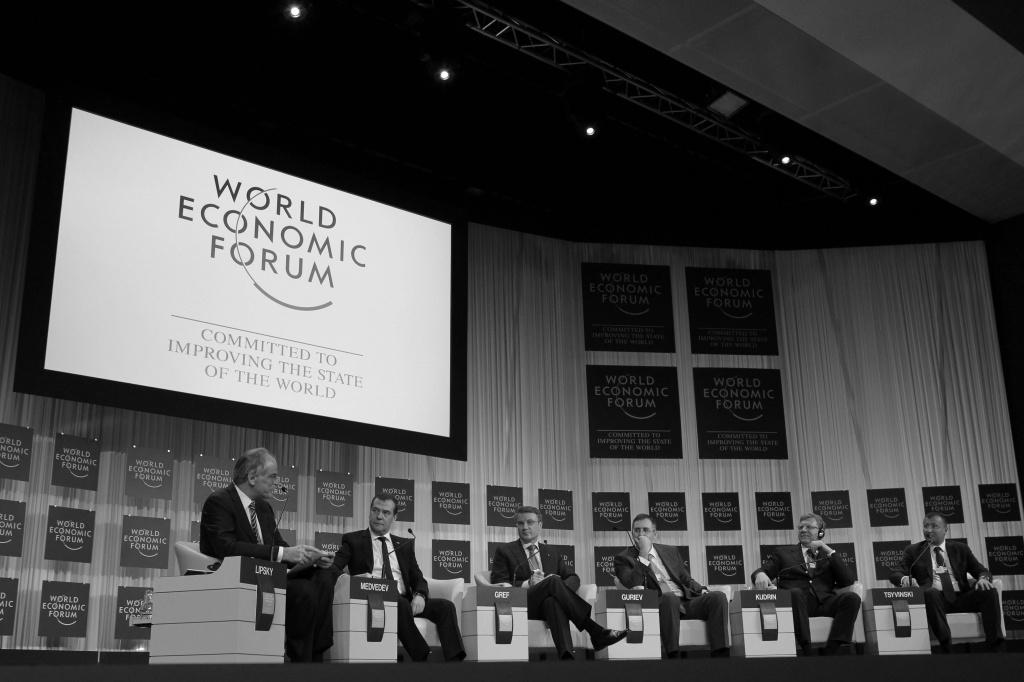
Russian round table in Davos: In addition to Prime Minister Dmitry Medvedev (second left), everyone else (from left to right after the Prime Minister of the Russian Federation) is the head of Sberbank German Gref, rector of Rash Sergey Guriev, former Deputy Prime Minister and Minister of Finance Aleksey Kudrin and professor of Yale University Oleg Tsvinsky-look at the future of Russia very pessimistic
This time, Davos guests were clearly more optimistic than a year and three years ago. Even a year ago in the expectations of Nuriel Rubini (the head of Rouni Global Economics and one of the most pessimistic forecasters) now does not consider Greece's exit from the eurozone inevitable. The markets underestimated the ability of European politicians to withstand negative trends, admits Rubini.
Europe ceased to be the main headache of investors: it is on the right track, although it moves along it too slowly, says Joseph Ackermann, ex-head of Deutsche Bank. Anyone who, believing in Europe, bought Greek bonds exactly a year ago (their cost sought to zero), earned 78 %in 12 months, calculated Bank of America Merrill Lynch.
Since the beginning of August, the euro has risen in price against the dollar by 9%, and even the cost of 10-year Spanish bonds fell from 7.75%last summer to 5.1%. Although the country is in a serious recession, it cuts budget expenses, and unemployment does not decrease. On Intrade, one of the leading prognostic sites in the world, the probability of eurozone decay is estimated at 12%, while a year ago - at 54%.
"
Europe has ceased to be the main headache of investors: those who bought Greek bonds a year ago earned 78%in 12 months. The probability of eurozone decay is estimated at 12%, while a year ago - 54%
"
The risks have not gone anywhere, but the government of the eurozone that reduced budget expenses, and the European Central Bank (ECB), which helped banks and bought up the debts of distressing eurozone countries, transferred problems to the future. “From a financial point of view, we are returning to a normal situation,” says the head of the ECB Mario Draga. A sharp part of the crisis is behind, and problems will have to be dealt with for a long time.
However, pessimists are also there: Greece at any time may not cope with the reduction in expenses and the payment of debt and over the next two years, it will still leave the eurozone with a probability of 90%, Citigroup believes. The ECB efforts will be in vain if European governments will not be able to form a real budget, banking and political union, notes the famous Harvard professor Kenette Rogoff. The period of calm will hardly be long, I agree Barry Eychengrin from the university in Berkeley. Most investors also think.
Where the money will go
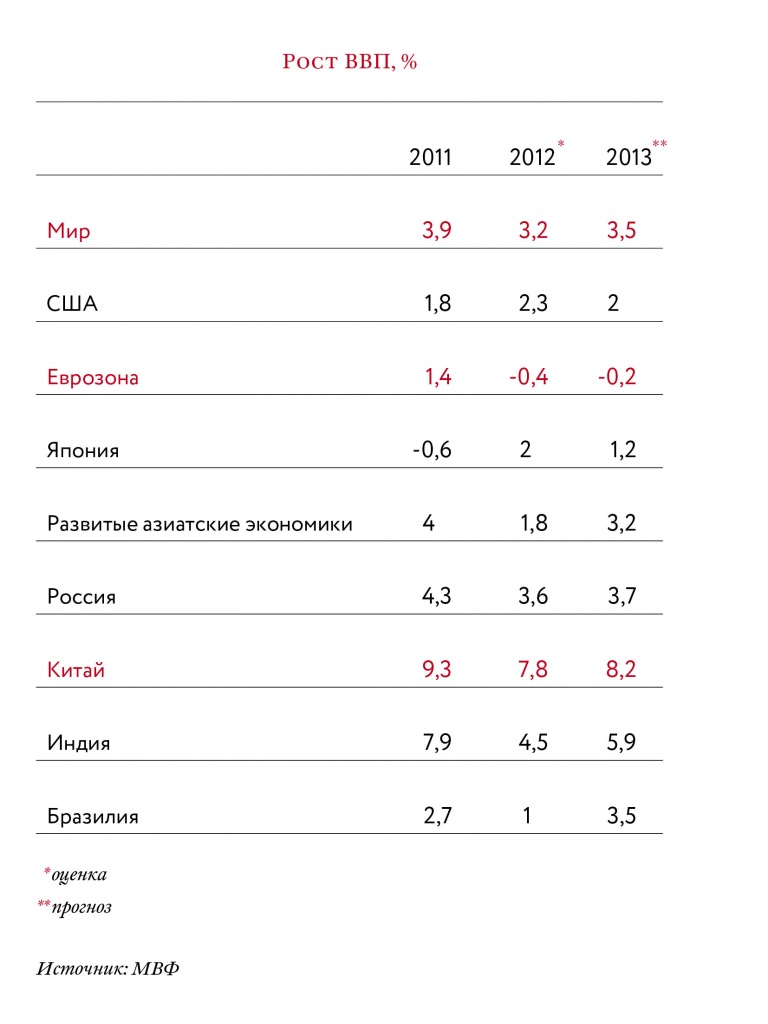
The main risks of this year are associated, except Europe, with the danger of slowing down the US economy due to budget maneuver and with the gradual attenuation of growth in China. In the perception of 921, the investor interviewed by Bloomberg, the risk of slowdown in the United States even outweighed the likelihood of negative development of events in the eurozone. But in general, they are optimistic (with the exception of the Eurozone). He looks quite positively at the situation in the updated world forecast and IMF released to the forum (see table).
The situation in financial markets is better than in the economy. Investors surveyed by Bloomberg are waiting for losses in the markets of the Eurozone and Great Britain, but they look optimistic at the stakes in the States, China and Brazil. The risks in the global economy are reduced, and the bonds will no longer bring acceptable profitability, especially considering that the Central Bank of the United States and the eurozone flooded the markets with liquidity. In general, managing investment funds plan to withdraw money from the “cache” and bonds (especially American), increasing the purchase of shares, including developing markets. However, the influx of investment can bypass Russia, as it was in the last two years.
In response to a request to name one or two markets that this year will give investors the best opportunity to earn, 38%chose the United States (13%are considered the worst market, the balance of estimates-25%). 31% of investors are optimistic at China, pessimistic - 14%. These are two favorites. Brazil among the best markets is called 20%, and the worst - 9%, are approximately the same for India. But Russia has a negative balance sheet-9% of investors call our country one of the best market markets, and 15% is one of the worst. This is worse this ratio only among the Eurozone and Britain. The negative plans of investors regarding Russia are especially offensive against the background of objective cheapness of shares: in terms of price/profit ratio, the Russian market is now the cheapest of the 21 developing country, for which this indicator is calculating Bloomberg.
Investors cannot go to developing markets. Only in order to comply with the expectations laid down in the quotes of shares, 1,200 largest global companies should annually increase sales by $ 5 trillion, the head of the AcCenture Strategy Department Mark Spelman noted at the forum. This implies sales growth, at 1/3 exceeding the growth rate of economies. In the past three years, this has managed only 60% of the companies out of 1200. Meanwhile, only 36% of the heads of companies responded to the PricewaterhouseCoopers forum are confident in the growth of sales over the next year. Developed markets cannot be provided for growth, and global corporations are forced to count on the growth of the middle class in developing countries.
Russia: cloudy
It would seem that against such a background to prove to investors the attractiveness of Russia for investment is not the most difficult task. It is necessary to demonstrate good opportunities for growth and a favorable business climate. “Russia-despite what people say, is a place where you can invest,” the first deputy prime minister Igor Shuvalov began artillery preparation a week before the forum. Investors are needed: this year the government plans to sell state property to a record $ 10 billion. True, this plan can almost half fulfilled by the sale of 5.7% of Rosneft BP as part of the absorption by the TNK-BP State Monopolia, which has already been reached.
The government, however, believes that the climate is already not bad, and the problem is only in the image. Argument: Foreign companies that are already working in Russia evaluate the working conditions in the country better than those who have not yet come. However, this argument does not pass in investors. Their assessments: a high level of corruption, frank rollbacks on public procurement and adds Citigroup, a growing dependence on oil and gas, which stimulates the strengthening of authoritarianism and extracting annuity officials is more than serious risks. When the money literally sways from the ground, and the prices for energy resources are rising, there are no incentives to improve business and the investment climate.
Improvements, even minimal ones, have not occurred in Russia in the situation with corruption in recent years. The investment climate is very harmful and the Magnitsky case, who accused state officials of $ 230 million, who was due to the state of VAT, said, which is not investigated in more than three years, says Roland Nash, investment strategist Verno Capital. The state of the state in the economy increased from 38% in 2006 and 42% in 2008 to about 50%, Counted Paribas. And this is not counting the $ 55 million transaction on the absorption of TNK-BP Rosneft.
Forecasts and ratings
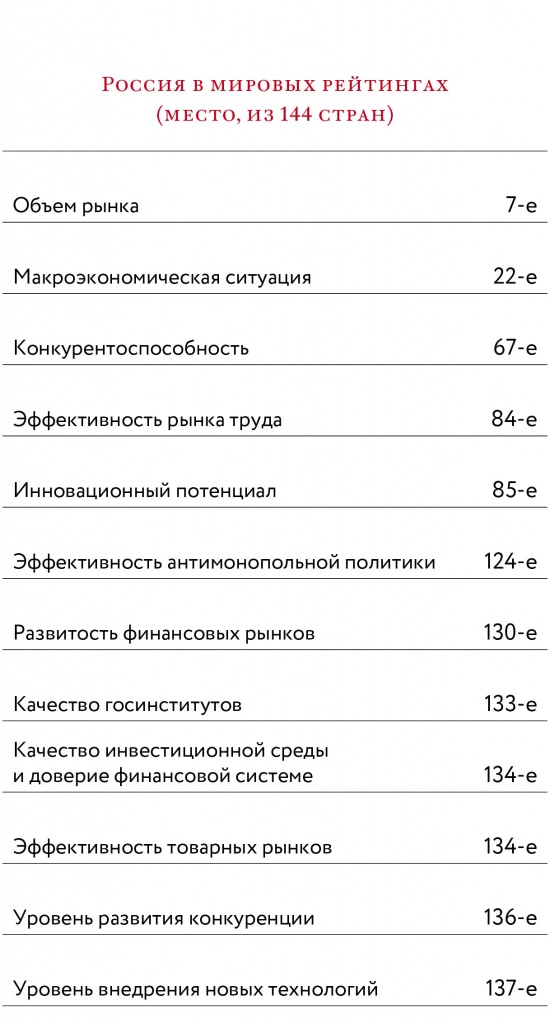
Almost any rating located in the field of view of a foreign investor testifies: things in Russia are far from ideal. And no exhortations of Prime Minister Medvedev, who in Davos promised that there would definitely not be negative development of events in the country's economy, will not help improve the investment climate. These are all words, statistics speak exactly the opposite. According to the latest competitiveness rating presented in a special report of the World Economic Forum on the Russian Federation, Russia takes 67th place out of 144. Moreover, only a good macroeconomic situation (22nd place) and the size of the market (7th) draw us in the middle. The rest is much worse-with the quality of state institutions (133rd place), innovative potential (85th). Ineffective commodity markets (134th place), labor market (84th), financial market (130s). The poor development of competition (136th place), ineffective antimonopoly policy (124th), restrictions for foreign investors and distrust of the financial system (134th), as well as a low level of implementation of new technologies (137th place in the world ranking) are completed.
None of the three experts of the World Economic Forum of Development Scenarios involves active reforming the authorities of the institutions that RASH Rector Sergei Guriev described in Davos as “backward”, and therefore there is nothing to wait for the business climate. If the price of oil and gas remains high, the reforms are completely frozen, inequality and corruption will grow, a split will begin in the elites. This is the first scenario. Second: the price of raw materials falls, the influence of the state in the economy is enhanced, the reforms are curled up. And only in the third are cautious reforms: due to the gradual decrease in raw materials, the authorities have to allow the regions to fight for financial resources, and they, to the best of their strength, begin to change the situation at their level. Participants in the session in Davos, where this design was presented, considered the most likely the third option. True, they still did not know that the State Duma once again decided to cancel the elections of governors, that is, the responsibility of the heads of the constituent entities of the Russian Federation to the population for the situation in their areas and regions.
Only the premiere of Medvedev all the VEFs proposed seemed unrealistic: he showed optimism. It looks like he is alone. The rules of the game and entering the market in Russia are unpredictable for foreign investors, quote Vedomosti attended at the session of Ruben Vardanyan, the chapter of Sberbank CIB: “It is not clear what situation you will be punished and in which it is not.” And in such conditions, the current 3.5% growth of the economy at stable prices for raw materials is almost the perfect option. Meanwhile, only at the expense of investments - and Russia, according to McKinsey, until 2030, you need to invest $ 1.5 trillion in the infrastructure - you can increase growth rates to 5-6%.
But money will come only if there are guarantees that they will not be taken away. In the meantime, almost any infrastructure project for Russian officials is primarily a means of personal enrichment. Only due to the thorough selection of investment projects to finance Chile and Korea by the state, they managed to save 15–20% of investments, calculated McKinsey, and on average estimates can be reduced by 40%.
And in Russia, as the story in the town of Sharya (Kostroma region) showed, there may be 96%savings. At the beginning of this year, the Internet flew around how the businessmen of this town independently repaired the bridge, deciding not to wait until the officials do it. The bridge was repaired for 0.3 million rubles, not counting the materials and technology provided by volunteers. The full cost of the restoration of the collapsed bridge, according to the organizer of the repair of Sergei Zakharov, the owner of the blacksmithing workshop, is no more than 0.6 million rubles. The authorities planned to spend 13.5 million rubles on this, including only on the design documentation - 1.5 million Zakharov received a letter from the local administration. True, observers are afraid that road services will find something to find fault, will not accept the bridge into operation and decide to demolish and build a new bridge.
Photo: ITAR-TASS