
Translated material
Who is to blame for the Egyptian tragedy
Around Russia
 Who is to blame for the Egyptian tragedy
January 29, 2013 Alexander Shumilin
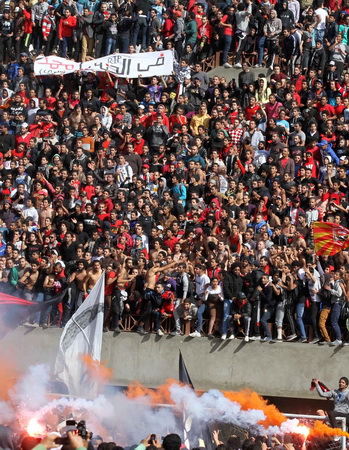
Parliamentary, and a little later - in the summer - the presidential elections had to create legitimate power and dispel the accumulated political tension in Egypt. This did not happen: with each month and for a variety of reasons, unrest flashing in the country becomes more large and bloody. On January 27, the inhabitants of Port Said buried 50 dead in excitement, in fact, an uprising that erupted in this city, as well as in Suez and Ismaili neighboring with him. The number of the wounded was running out for half a thousand people. These events turned out to be significantly more bloody than the so-called Tahrir-2-mass riots in Cairo and Alexandria in November-December last year. President Muhammad Mursi for the first time introduced a state of emergency in the provinces covered by the unrest. Why are these unrest continuing?
Today, perhaps, it is already possible to formulate the main reason: these are assertive actions of the new - legitimately elected - the leadership of the country (mainly, President Muhammad Mursi itself) to plant Islamic norms rejected by most part of the urban population. First of all, we are talking about the new Constitution, which the Mursi team managed to conduct through a two -stage referendum in December 2012. The accepted norms create many problems for the situation of women in society, create a legal corridor to enforce Sharia plants, etc. In addition, we recall, the efforts of Mursi on the accelerated adoption of a new constitution in November-December were accompanied by his attempt to usurpation of the authorities (this was the assessment of his decrees by the judicial corps of Egypt). These actions of the president only added oil into the fire, ensuring a significant increase in the number of protesters in city squares. As a result, almost all the opposition leaders and simple, secularly configured Egyptians spoke about their disappointment in the “Revolution of January 25”. What did the "revolutionaries" be mistaken?
They were mistaken, apparently, in the arithmetic of electoral processes. Having agreed with the full participation of moderate Islamists (“Muslim brothers”) in elected procedures (“one person-one vote”), the initiators of the “revolution” (mainly the middle, creative class, intelligentsia) did not take into account that the Islamists who joined their “anti-dictatorial movement” are much larger electoral potential in the country themselves than the instigators of the “revolution” themselves. This is the overwhelming part of the illiterate and patriarchal-minded province, which, it seems, with any voting option, is tended to support precisely the Islamist populist with their Fellaham-clear attitudes. Hence the impressive victory of the “brothers” in the parliamentary elections, as well as superiority, albeit insignificant, Islamist over a secular candidate in the presidential election. Hence the confidence of Mursi that his projects and initiatives will receive legal support for the majority. In the province, but not in cities. More advanced city residents are not ready to come to terms with this. And they declare their position for any reason: the latest unrest was timed to the second anniversary of the “Revolution”, which later resulted in an uprising against the authorities in Port Said and Suez in connection with the court’s decision to sentenced the participants of last year’s “football riot”.
Mursi maneuvers. On January 28, in the morning, he called on the leaders of 11 opposition organizations to his palace to discuss the prospects for leaving the prolonged political crisis. Toward evening, most of the opposition rejected this call. And not at all because it longs for blood. Oppositionists, including the organization of the front of national salvation led by Muhammad El Baradei, nominated two main requirements: to form a coalition government with the participation of representatives of the opposition and establish a commission to change the constitution. The requirements look radical, but they are absolutely justified in this situation. In fact, no matter how strange it seems, the opposition leaders appeal to the conscience and mind of the President-Islamist, emphasizing that the peaceful, conciliatory version of society is possible under the current conditions (dominance of the patriarchal electorate) only with the oncoming steps of Mursi himself. They can be achieved through a political pact or pressure from the side of the city street. Otherwise, it is inevitable to deepen the schism of society, the country, which is fraught with a large -scale civil war.
The chances of success with the opposition are not great, but they are. The fact is that, with all the support of the “patriarchal village”, the power of Islamists in Egypt cannot be absolute and sustainably predominant. Unlike most other Arab countries, Egypt is of socio-culturally extremely diverse, and therefore cannot obey the Islamists. In religiously, about 18 percent of the country's population are Christians-cops. In the mentality of urban residents and many regions of the country (Asuan, Luxor, etc.), there is a realization of themselves by the descendants of one of the oldest civilizations in the history of humanity, the keepers of the great cultural heritage. Many of them are quite secular. Islamists, recall, oppose the respect and veneration of the Egyptians of the pharaoh civilization, since it existed (which, incidentally, put into question) until the appearance of Islam. And therefore, the threats of Islamist fanatics to destroy the Pyramids of the Giza in Cairo's hill are perceived by many Egyptians not as idle talk.
Note that the moderate Islamists (AN-Nahda organization) who were similar to the Muslim Brothers and also defeated the para-Tunisia. In their traditionally secular and relatively modernized country, they abandoned the monopoly on power, voluntarily urging the opposition to create a government coalition, and also not so assertive the sharia norms that are inexperienced for cities. True, in Tunisia there is no president-Islamist. He is a liberal lawyer. And, by the way, the leaders of the Anga Nahdy are quite openly opposed. But in Egypt there is still protection against the Islamist vertical - this is an army. The army leadership has already threatened to restore order in its own way in December 2012. Then there was. How long?
Author - Preterior of the Center for Analysis of Middle Eastern Conflicts Square