
Translated material
"Do not be afraid of prison"
Physicist Valentin Danilov - about how to survive behind bars
64-year-old physicist Valentin Danilov, sentenced to 13 years for the Stateizer and freed from the colony by parole, told The New Times, how to survive the bars and what needs to be changed in the Russian criminal punishment system
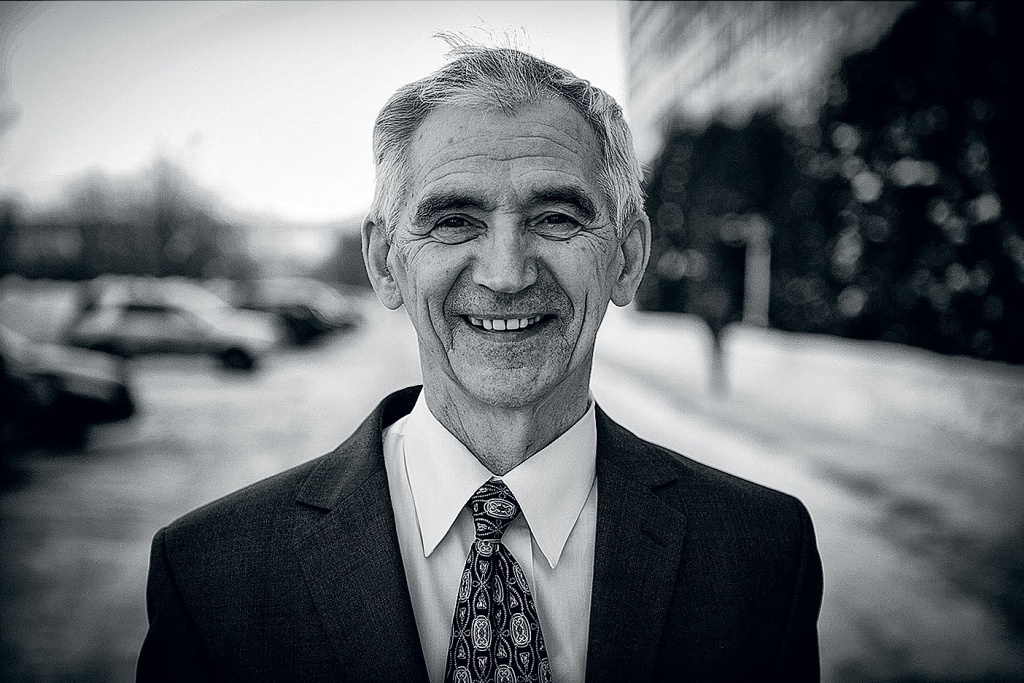
Valentin Danilov in Moscow, where he was not eight years old. January 25, 2013
The last time we saw Valentin Danilov in 2004, immediately after the decision of the Supreme Court of the Russian Federation, which canceled the acquittal in his case. Danilov was going to go to Krasnoyarsk for a new process. He said that he again hopes for an excuse: after all, scientists who are confident in his innocence are protected. He smoked a phone and radiated optimism. Today, 8 years later, having passed two camps in a strict regime, having put it in a prison hospital due to heart problems, he no longer smokes, but is still optimistic and an amazing thing! - He did not lose faith in Russian justice.
Spy for "ticks"
Why didn’t you leave when the Supreme Court canceled the acquittal? Indeed, for many then it was obvious: you will be imprisoned, and for a long time.
I could not leave. My reputation would suffer. When I sat under investigation, many people gave guarantees for me, signed letters in my defense. Academician Vitaly Ginzburg, Yuri Ryzhov, Edward Kruglyakov and others. If I left, it would be regarded as a flight.
Who was interested in your conviction?
This is still a mystery to me, I have not unraveled it in 12 years, since the criminal proceedings.
There is a version that, having concluded a contract with the Chinese, you either crossed the FSB road, or did not share with the security forces, and they always control this kind of operation.
Firstly, I concluded a contract on behalf of the Krasnoyarsk Technical University. We had to make an ordinary vacuum stand and sell a computer program on the basis of which you can simulate the impact on the objects of factors of the cosmic environment. One of the investigators said to me: “If you had a contract for $ 50-60 thousand, we would not pay attention.” There is a financial threshold behind which the system works. I concluded a contract for $ 360 thousand, and immediately problems arose. As for the fact to share with someone, no proposals were received on this subject. In general, all this could be stopped by one call to the rector: to say that the contract should not be executed, stop. And no problem. The contract itself was not very interesting. The long -term cooperation was interesting, which would provide the Institute with financing, because in 1993 the state financing was equal to zero.
Then why did they put it down? Cooperation with China would give the institute the opportunity to work?
Yes. I told the investigator: “China received nothing. The institute, the laboratory did not receive money either, we did not conduct any research. Russia also lost. But someone won? Who are you working for, lieutenant colonel? " I asked.
And he?
Well, what is he? When the investigation ended, I told him: “Then, when you recall your work, you are unlikely to become proud of this business.” And then he could not stand it: "You know, you are probably right." Therefore, I am surprised at this matter: who needed it?
Do you agree with the version of human rights activists that have become a victim of spying?
Human rights activists take a lot of similar affairs about espionage, compare and conclude that there is a certain unit, which, roughly speaking, should show their work. In general, this criminal case is very strange. The absurdity is complete. When I read Kafka, the “process”, I realized that all that happened to me is Kafka. I agree with the version that I was imprisoned for the "show".
13 years for "tick"?
Yes. But if you live in Russia, you should be ready for this. You can’t live in Russia and be afraid of prison.
"
When I read the “process”, I realized that all that happened to me is Kafka.
I agree with the version of human rights activists that I was imprisoned for "tick"
» Jurials with admission
Your complaint with the European Court says that the indictment of the jury was handed over to the indictable composition of the jury and the conviction must be canceled. Why are the jurors illegal?
It turned out that several jury had access
To state secret. Do you think they are dependent on the FSB?
Dependent. And it is amazing that people who have access to GOSTYNA got into the jury in the case related to the GOSTAINA. How many were there in the jury?
I don't remember exactly. According to the law, if you have reasonable doubts, regardless of the independence of at least one jury, the whole college is illegitimate. The defense of this spoke in court. But we were not listened to either during the process or in the Supreme Court on cassation.
Behind bars
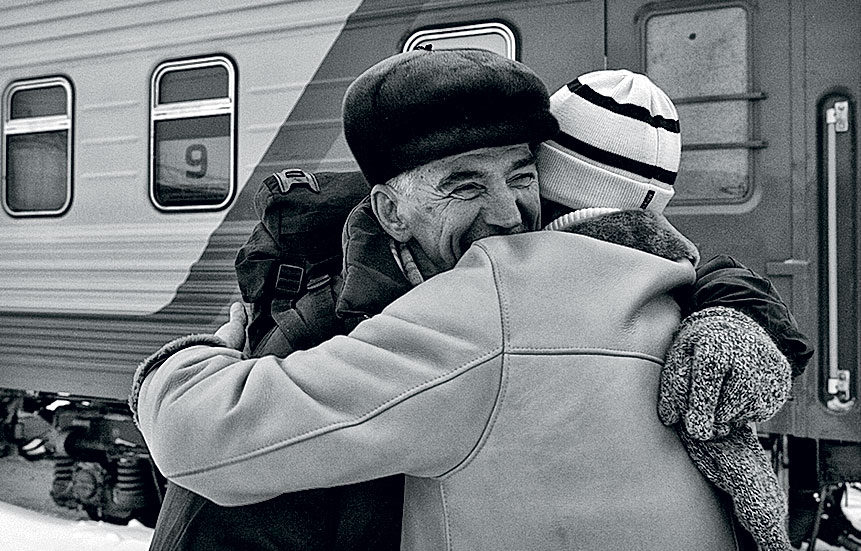 |
| After the release from the colony, Valentin Danilov came to Novosibirsk to his relatives. November 26, 2012 |
What was the most difficult in jail?
The first months were the most difficult. Since the scientist is the most important thing for a scientist, for me the prosecution and arrest became a strong blow. But when the lawyer brought me a letter from the American physical society and I found out that they sent a letter to President Putin that they were ready to provide several volumes of scientific literature confirming that I did not disclose any secrets that there were no secrets, then I was in spirit. I realized that there is no problem with the reputation. In prison, people mostly die because of stress. In a stressful situation, they eat themselves, and therefore support is so important. It is important to hear that you are not the first to sit here and not the last that there were a lot of worthy people. And that the term is not eternal, it all ends.
In what conditions did you sit?
Whatever they say, reform is still in prison. And the conditions of detention are improving. I explain this by the fact that the financial situation in the country is improving, and these are communicating vessels. There is a saying: if you want to quickly find out the country, visit two places in it - a cemetery and prison. For ten years, cardinal changes have occurred in prison: if earlier they slept in the pre -trial detention center in turn, and I found it, now this is not there.
Who was sitting with you together?
These are the same people, well, maybe a little special, because I was sitting in a strict regime camp, there were convicted of serious and especially serious crimes. As a rule, people with mental deviations or in a state of affect commit especially serious crimes. In life, you avoid such people, and in the colony they are concentrated. Communicating with them, I learned that I need to follow the speech very much. If, for example, sharp expressions are allowed at large and you can forgive this, then in prison it is impossible.
That is, you can’t swear, for example?
This is not welcome. And the second: there is a case there immediately. If you called a person, and he will not react properly to this, then this immediately changes his position. Instantly. At large, you can call it as you like, and in prison you have to be very careful.
What is the most common article in the colony now?
Probably a third of those with whom I sat are convicted by the so -called political article. The 228th is called political, the sale and sale of drugs.
Why is it political?
To sit down on this article, a crime is not necessary. Like in fable: you are only to blame for the fact that I want to eat. Drug control fulfills the plan, planting these people.
Do you think most of the convicts for drugs are innocent?
The fact is that people are guilty, but, as Henry Reznik says: "There is a law, above the law - justice, above justice - mercy, and above mercy - love." By law, they are convicted correctly. Yes, indeed, they sold drugs. But the sentence against them and the measure of punishment are unfair.
Why?
Punishment under this article needs to be differentiated. Of course, there are people who make business in drugs. And there are those who use drugs themselves, and since they are expensive, then to buy them, they sell to others: they sold three doses, and the fourth - as a reward. That is, this is not a benefit, it is a disease. They do not pose a public danger. They need to be sent into exile somewhere to Evenkia. We have many places where there are practically no people: the Kuril Islands are empty, Sakhalin, Kamchatka. Let them swing there in the garden, live with their family, there they can only sell drugs.
Have you met drug trafficking in prison?
One or two, no more.
"
It is important to hear that you are not the first to sit here and not the last that there were a lot of worthy people. And that the term is not eternal, it all ends
" " Red "and" black "
How did the convicts treat you?
Almost always with sufficient respect. The convicts have a very good visual memory. And they talked about my business on television. For example, the prisoner looks at me, recalls that he saw me somewhere, but cannot remember where. And starts: listen, were you there, in that zone? I say: "No," “Where did I see you, after all?” I say: "On TV, probably." - "A! Exactly! Physicist Danilov. "
In the Krasnoyarsk Territory, where you were sitting, “red”* zones?
| *Zones controlled by the administration, unlike the "black", where the rules are dictated by criminals. |
In general, it is believed that in the Krasnoyarsk Territory the administration controls the zones. But this does not mean that convicts have no self -government. “Black”, “red” zone ... I did not delve into it so deeply, but I know that almost every colony has prisoners who organize life in the zone. If there are any problems, then they resolve them. I have never turned to the administration to solve my problems. This is not approved.
What could be changed in the prison system?
The current system is just a penitentiary institution. That is, the place where the convicts contain: 20 people were accepted, for some time they left there, and 20 people released. Everything that is said about educational, correctional work is illusions: money is not allocated for this. The best education is labor. And for labor, what? We need modern machines, technologies, raw materials. It is necessary to lead this process.
Do you think - you need to return the gulag so that the prisoners work?
In no case. The zone consists of two parts - there is residential, there is industrial. Who is interested in the convict to be socialized? That is, he worked, had qualifications, etc. Governor. Why? As a rule, the victims are the inhabitants of his region, to whom this prisoner owes. He is serving the term, but there is another part by the sentence-he must pay the lawsuit. And if it does not work, then it does not pay. Therefore, the governor must provide him with work. It can provide the colony with orders. To involve local businessmen to this, to interest them. All good: colonies, businessman, governor and prisoners.
That is, the governor should take patronage over the local colonies?
He must organize the correction process. Because he does not need recidivists. Here will come out of the prison, say: give me a job. Where will you get it? And if the merchant has already invested in him, he taught him, then when he will be freed, he will take him to work.
In the near future, the European court will make a decision on your complaint. And perhaps the Supreme Court will decide to revise the case. Will you agree? Igor Sutyan, for example, refused, said that he did not believe in the justice of Russian justice.
I dealt with six professional judges. The judge of the Krasnoyarsk regional court Valentin Baranovsky refused to consider my criminal case due to fundamental violations of the procedural law. Judge Svetlana Berestov, after 19 months of detention, released me on a recognizance not to leave. Three judges from the regional court confirmed the decision of Berestova. Finally, Judge Evgeny Repin let me go on parole. So I am ready to ensure that my business is revised. Maybe this time I will be lucky with the judge again.
But it seems to me that in our legislation there is some kind of flaw. See: the verdict is sentenced to the case, then a complaint is filed in the European Court in Strasbourg. They decide that the right to a fair court was violated. The Supreme Court sends the case for a new consideration for new circumstances. Again, the court, again violations, again a complaint to Strasbourg and so to infinity? Somewhere you need to cut off this vicious circle. Obviously, if the right to a fair court is violated and this is confirmed by the decision of Strasbourg, then a point in the trial should be set. This is like in the United States: if, during the detention of the accused, they did not announce his rights, then the judicial persecution is terminated. Only what kind of State Duma faction will come out with such a legislative initiative?
Photos: RIA Novosti, Mitya Aleshkovsky