
Translated material
Euro in terms of weekdays
Eurozone crisis - sketches from European capitals
Over the past five decades, Europe has been a successful community that provided a high and constantly growing standard of living for its citizens. However, the prospects and competitiveness of Europe are at risk, British analysts from Roland Berger Strategy are alarming, who prepared a special report for the Davos forum-2013. Lack of investment, an increase in unemployment, which has reached a country of critical meanings in a number, general financial instability - all this undermines trust in the EU as an economic entity and speaks of the urgent need for structural reforms. The fire extinguishing method used over the past 4 years to solve the problems of the Eurozone has exhausted itself, experts warn. The Bloomberg and British Prime Minister David Cameron, who announced his intention to hold the Tori Party wins the election in 2015), said about the same in his program speech on January 23, a referendum on the further membership of Britain in the European Union, if the Brussels bureaucracy does not begin to work on European institutions, primarily economic.
As beggars in Spain, where unemployment has already reached 26%, they use the Internet, why the British were loving their banks, and the Germans show painful interest in non -ferrous metals - this is drawn from several European capitals
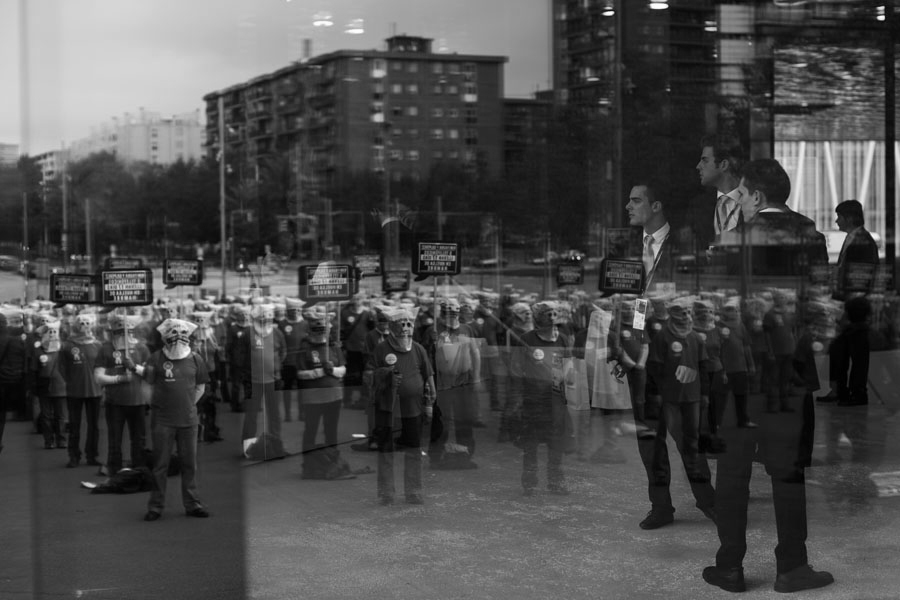
Barcelona. Telefonica employees entered the protest against dismissal and cutting salaries
The crisis of the eurozone, like a old tumor, has long become the norm of life of tens of millions of people. They live with this tumor, feeling it differently. Sometimes they think about its causes, while not ceasing to get sick. Sometimes frantically looking for medicines. And sometimes it’s no longer able to endure.
Spain. Lazy beggars
The fact that the country is bad in business can be understood by just walking along the streets of Madrid, where the author was only a couple of years ago. Since then, the number of Madrid beggars has increased significantly. Whole groups of beggars are found on the steps of the metro, in front of supermarkets, at the door of hotels and rich houses. Some have signs in their hands: “I am hungry”, “I ask for my children” or just “help”.
The faces show: not everyone is accustomed to such a state and kind of activity. Some are simply bashfully silent, looking into space. Some let go of a couple of jokes when someone throws a coin, some nod gratefully. But the middle -aged tramps Jose and Vincent are having fun. They have already traveled and went around the whole of Spain, were in France and Portugal, but invariably returned to Madrid. They met in a sunny grocean, on a park bench, where they first drank a bottle of wine together. They decided to wander together there, helping each other.
Vincent, a former specialist in the field of information technology, under forty, Jose, who once engaged in the maintenance of sunny batteries on Canaries, is sixty. In front of them are baskets and cardboard signs with inscriptions: “for wine”, “for beer”, “for whiskey”, “cat”, “dog”. A little thing before the largest basket reads: “For other vices”. Passers -by also have fun and throw coins into different baskets in accordance with their inclinations.
When one of the onlookers wants to photograph them, one of the homeless immediately raises a sign with the inscription “Photo-€ 278”. Everyone laughs. A coin flies into a basket ...
“Muchas Graxias,” the companions are thanks, “meet Facebook.”
“Joking,” passers -by are surprised.
But this is not a joke. The homeless are registered on a social network under the name Lazy Beggars (lazy beggars, beggars). And they have already established contacts with 3850 associates - the same as them. They created Jose and Vincent and their page on the Internet - to ask: www.lazybeggers.com (apparently, in the turmoil or with a deliberate subcutane, the English word “beggars” (Beggars) they wrote with a mistake).
“We are beggars of the 21st century,” Jose says, grinning.
Thanks to the web page, anyone can not only contact Vincent and Jose, but also pay their modest needs by a credit card.
Not all beggars, of course, are so funny. 25% of the unemployed in one country (namely, this is now the unemployment rate in Spain) is a record for Europe. Despite the fact that the size and coverage of social benefits in Spain is not as large as in North European countries: an average of about € 600 per person*.
| *It is unlikely that the Minister of Economics Luis de Gindos warned of the situation in this level, taking into account the situation in the country, taking into account the situation in the country. |
And here is clearly not up to fun. Not everyone can break away from home and family and go along the roads, like Jose and Vincent, making begging their main work. Although there are more and more such - some newspapers speak no less than one and a half million people.
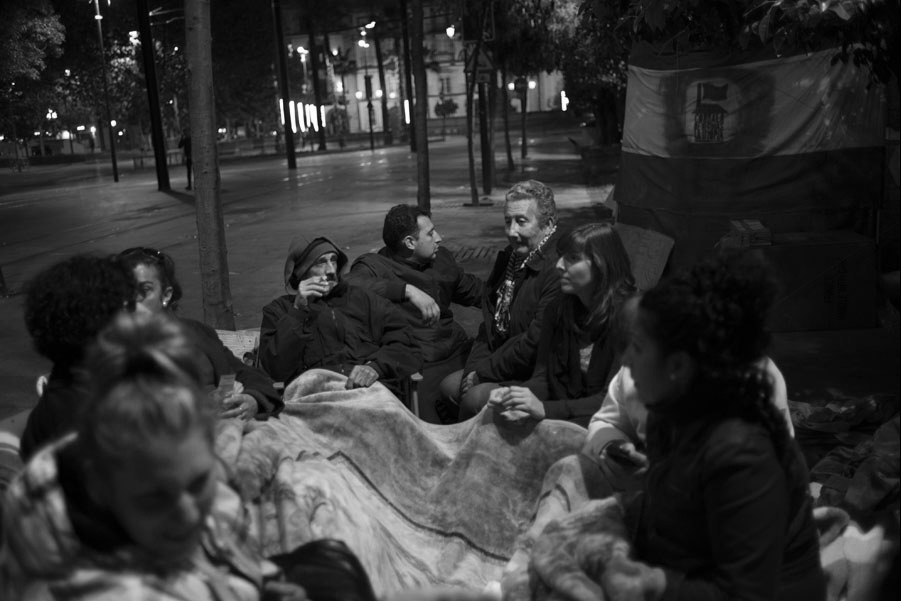
Seville. These people lost their homes during the crisis
London. "Look for me in Hong Kong"
The daughter of The New Times is often in London, where she appointed her parental date for her Bernets for the last time. She herself is not very interested in the atmosphere there. But here her British colleagues of the mouth do not close without scolding their own government, the European Union, the situation, the Greeks and the Spaniards and some personally on the list. One of the points necessarily concerns Margaret Thatcher, or rather, how she was right, not allowing to turn around then impudent Germany.
On Lanch, Leo, a relatively young specialist with a bank slope, joined us. It himself is arranged so far quite stable, but on this day he was terribly dissatisfied with the state of affairs in his field.
“Firstly,” he complained, “we are reduced.” And then he poured out the numbers: from the beginning of the crisis in 2009, almost 84 thousand people were dismissed at the 29 largest banks in the world. Moreover, these data do not take into account reductions in medium and small banks.
Secondly, Leo minted, London has already ceased to be the financial capital of the world. Since last year, the number of banking workers in the City has decreased by 30 thousand people and is now “only” about 250 thousand. The championship has passed to New York. And soon Hong Kong will squeeze London.
“And thirdly,” Leo was completely darkened here, “people no longer want bank loans. And they go to credit offices for money. ”
He explained that the most active players in the British financial market now became advance lending companies that provide short -term unsecured loans, usually only a few hundred pounds to let consumers reach their salaries. High fees for the use of overdraft and attempts to avoid debts on credit cards were forced by the British, especially young people with a low salary, and more and more often resort to their services. In 2011, 1.8 million customers of credit offices (and about 200 of them in London) took more than $ 4 billion. Money enters the borrower’s account almost instantly: after 15 minutes.
"Well, how is life at all?" - asked the author with Leo. He silently went into the corner of the pub, where newspapers were dumped, and brought a whole heap. Then he began to drew something in them, then passing on to me.
And this is what managed to subtract from this newspaper potpourri. The economic crisis kills the famous "trading streets." On average, five stores per day disappear. Entire trade quarters are closed. In the first half of 2012, 953 chain stores ceased their work alone, while in 2011 only 174 closed. Some previously popular retail chains have completely ceased to exist. Among them, for example, the Thornton's chocolate network, the CLINTON CARDS cards chain, PEACOCKS and Barrats clothing chains, GAME computer games, JJB Sports Sports Games.
People with burns are increasingly contacting hospitals: they are heated, overlaid with plastic bottles of hot water. Sometimes plastic bottles are torn, writes Daily Telegraph.
More than half of the British complain about sleep problems. At the same time, 15 million 300 thousand people are used. They began to dream of nightmares more often. Moreover, as the Daily Telegraph notes, the stories of dreams are affected by financial troubles - the most frequent guest of the nightmares of residents is the Minister of Finance George Osbourne. During the crisis, 65% (up to 40.6 thousand) increased the number of pets, which the owners are thrown out into the street, as they cannot contain. The decision was made to cut the police budget by 20 %. The old Scotland-Yarda building must be sold. It is planned to lease the country's symbol - the Big Ben tower. 22% has become more alcoholics. Due to financial problems by a quarter, the number of people involved in sports was reduced. Due to the crisis since 2007, more than a thousand British accounts have been accounting.
“That's how we live,” said Leo. - Need more? " He finished the pint of the vile El and waved his hand: “Bye-bye. Look for me in Hong Kong. "
Germany. Chushka
Not far from the Berlin Nodular Station of the East Cross (Ostkreuz) are the points of reception of waste paper and non -ferrous metals. A little away - the bus station where the NEW Times correspondent is repairing the car, and tire fitting. “Eccentricians,” says Dieter, Says, seeing how the police once again go to the scrap metal point, “do you catch someone.”
Diter himself is an enterprising person. On his car service more than once I had to see long segments of thick cable behind the racks with tires and some kinds, blanks, wheels, gutter. What is this? And only when in the spring of this year, several lines of urban train stopped due to theft of the cable, your author realized that it was impossible to imagine from the heels from the heels: in Germany, the delivery of valuable metals to the reception points was already seriously put on the stream.
They take everything that lies badly, stands or hangs: sewer hatches, drain pipes, park sculptures, and design of cemeteries. Remove railway rails and dig tram tracks on abandoned circles, cut cables and wires. The victims of hunters for non -ferrous metals are church utensils and even bells. And in the town of Plauen, a copper gutter was torn off the local Kirschi.
The average price in German non -ferrous metals, explains Diter - € 5 per kg of copper and € 3 per kg of copper -containing alloys. The receivers, as a rule, look through the fingers at the origin of the surrendered metal. It got to the point that they tried to take the excavator bucket in Dusseldorf. But it did not work out: the bucket simply crushed the car factory.
The German railway concern Deutsche Bahn estimated its losses from theft of rails, wires and other equipment for 2011 at € 15 million. And this is not counting the costs of repairing and compensation to angry passengers for an interrupted trip. The telecommunication concern Deutsche Telekom also carries large material losses. To solve the problem of Deutsche Bahn, Deutsche Telekom, RWe Energy Concern and National Association of Metal Trade Enterprises want to condemn the chain of resellers. It is assumed, in particular, to immediately inform the police about all suspicious objects handed over to recyclables. How exactly this will be done is completely unclear. Police raids? Raids on "metal scholars"? But the problem has already gone outside of Germany and is of a transnational character. The wires, bells or cemetery chains in the same country go along the Schengen routes to other states - EU members, where control over the boring is even weaker. And then - to China, an inexhaustible market for non -ferrous metals.
Only now the car dealer for the dutra for interruptions with transport and a connection deeply does not give a damn. “Now orders are already ineffective, a hundred or two euros per day-much more important.” Let the concerns themselves think about the rest.
France. Slight link
Michelle Melikoff - an architect, works in the Urban Planning Bureau. We met in a Russian grocery store on Montparnas, where he bought a sprat: his wife addicted. Michelle vodka, despite the Russian origin, drinks mediocre, but, as usual in such cases, loves to speculate. The bureau breathes on the incense, and he blames the government in everything that cannot protect local manufacturers and gives orders to the British, Germans, Spaniards, Italians, referring to the EU installations for freedom of competition.
Michelle is a fan of Andre Gluxman, a “new philosopher”, a native of the 1968 intellectual revolution. He today “dissects” crisis Europe in his articles and public speeches as a pathologist, tearing the applause of an increasing number of fellow citizens. Following Gluxman, Michelle stubbornly repeats that (I will reproduce from the tape recorder): European leaders think and act in the rhythm of the election and polling graphics of public opinion; The sense of crisis characterizes the entire modern history of Europe, which means that Europe is by no means a community in which natural processes of rapprochement are underway; Europe still remains a playground of ideas, but European thinking is now fragmented and burdened by domestic political interests.
However, not only thinking, but also economic realities are fragmented. And about this, if you listen to some authoritative experts, the French just do not want to hear.
“Crisis predictor” American Nuriel Rubini once again predicted: Europe will end not by Greece, but by France. He is echoed by a member of the Council of Economic Experts of Germany Lars Feld. In the annual report to the government, he stated that “France is now the biggest problem, because it did nothing to restore its competitiveness and even“ continues to move in the opposite direction ”, living beyond their means. And gives numbers: hourly wages in France are an average of $ 44 - this is 13% higher than in Germany. The costs of labor in France have increased by 19% over the past ten years, and in Germany remained almost unchanged.
Also in ten years, the share of France in export to EU countries decreased by 3.5%. Last year, Germany recorded the excess of the balance of a trading balance in the amount of € 150 billion. The French budget deficit is € 70 billion, the unemployment rate was 10% and continues to grow. The crisis of the French auto industry needs to be added to this. Only at Renault sales collapsed by 20%. And on the way and a crisis of real estate.
Architect Michelle Melikoff knows a way out of the situation: "France will cope with the crisis only if France again becomes."
And how is it?