
Translated material
The first meeting of the Publicpost discussion club (decoding)
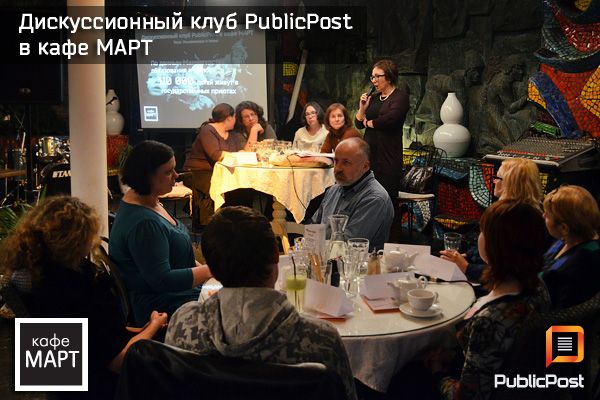 Photo: Alla Vlaskina/Publicpost
The first meeting of the Publicpost discussion club in the Mart cafe was devoted to the state campaign to stimulate the adoption of orphans by Russian citizens.
Public figures and experts gathered at a round table and talked about what can be done so that Russian citizens decide to adopt, so that foster families do not return children to orphanages and how to influence the motivation of potential adoptive parents. And also about how to organize civil control over orphans in orphanages. PublicPost was broadcasting discussion.
We post the decoding and video recording of the meeting.
 Lyudmila Petranovskaya, teacher-psychologist, family design specialist:
“My friend leads the center of early development for children. Nearby, in two quarters, was the child’s house where they went with a bright idea and study with children, for free.“ Woman, come out of here and never come again, because we are now fighting for the assignment of a specialized title of a child. ”Specialized houses, other salaries. In this situation, naturally, the main goal is the main goal, the main goal, the main goal, the main goal, the main goal is the main goal, the main goal is the main goal, the main goal is the main goal, the main goal is the main goal, the main goal is the main goal, the main goal is the main goal, the main goal is the main goal, the main goal is the main goal. Find the child as many diagnoses as possible and so that these diagnoses, God forbid, do not disappear.
No need to nourish the illusions that we can easily arrange all disabled children. There are very difficult children, who were greatly promoted by volunteers, tried to find a family for them, but did not find it, because it is very difficult to really raise a disabled child. But look what is happening with us. Who is responsible for this child now? Such a strange substance as the State Public is responsible for it. Under his guardianship, for example, 500 children can be. From the point of view of the law, his rights are almost more than our rights to our native children. He has a complete power over the child. This is the director of the orphanage, this is the head physician in the child’s house, this is the director of the shelter, in general, the institution. At the same time, he may have 500 children, he may not know them by names.
See what requirements for ordinary guardians are now. If you want to take a child under guardianship, you must undergo preparation, be sure to prove 225 times that you are not a camel. You can simply become a guardian of 500 children with a pedagogical diploma.
Imagine that our usual guardian could not do it, he said: oh, such a child is heavy, I don’t know what to do with him, he is sick, at school he won’t study, what a nightmare, I will give him to him ... Tell me, please, what will we say about this guardian? What will they tell him in custody, will he ever give him anyone else? If we have a state-owner says: oh, what a child is difficult, does not want to study, behaves badly, gets sick, I will give it from a normal institution: from the 7th type to the 8th species, from the 8th view to the house of the disabled. And the state -pend after that will not be fired, he will not be banned after that to take other children. Well, I lost and could not cope, the child is heavy, look how many diagnoses, it's okay. I am already silent that the usual guardian has no right to leave for a long business trip for three weeks from his child without informing the guardianship, and the State Pedagogical University can. And now, this will not change, there will be such a strange situation.
There can be two models here. Either we can bring the state-pendant as close as possible to the usual guardian, that is, he can also have no more than 7-8 children under his care, he should also engage in him personally, and not under him 225 staff, he must answer exactly if he could not do it, and he must receive training in order to work with children. Or the second option - then let's not pretend that these children have a guardian at all. There is, for example, European countries, where in such cases, the city of the city is a state -owned, for example. Everyone understands that this is convention, that he is a temporary person, he is engaged only in legal issues. He has no incentive to hold this child. Gosopecun, among other things, has now the child’s incentives, because it is again an institution, these are bets, children, and so on. The struggle for resources!
And here we again come to the conclusion that there is no systemic work. There is no place in any place, for example, some kind of compiled "road map": here we have five houses of the child, ten orphanages, seven boarding schools, eight shelters-we will re-profile into the day shelter, and this one will simply close all the children, and this is weed out. Everything is done in a simple way: we must report that we closed a couple of orphan institutions in our region over the year. There are 300 children - it will not go, here is 50 - it will not go, a city -forming enterprise - we won’t, there are only people with disabilities, it is difficult ... So, here we have a room in the city, 30 children - we will bury them and close them, we will report. That is, every director of the institution, every head of the orphan institution knows very well that as soon as he has less than 40 children, he begins to sit on his suitcases. On any day, he can receive a telephone message that buses come the day after tomorrow, and all children are transported to other institutions.
And in this situation, when I put myself in the place of this director of the orphanage, I understand that I would also hold the contingent with all my strength. Because I will give it now, I will become less than 40, and I put the rest of 38 under the blow, doom to the tragedy.
To begin with what needs to be done, and only then, it is possible or not - we will evaluate you with a common effort. We need global reform, systemic, the entire sphere of protection of children's rights, generally all children, and the sphere of protection of the rights of children-orphans in particular. Not only orphans, but also children in crisis families, too, who have not yet managed to be orphan, get the status of orphans. The problem clearly consists of four components.
The first component is common systems. I have already said about one - this is the institution of the state -reigning, which is now holding this situation, and this is the situation when the amount of human powers, his power over his child, is actually, are not in the duties and requirements that are presented to his preparation, to the results of his work. That is, the institution of the state -peek should be changed dramatically. The State Penentum should practically be no different from the usual guardian according to the requirements, by rights, and obligations. The only exception is that he may not live constantly with the child, since he is still at work.
The second is a system of responsibility of guardianship authorities. Now the responsibility system of guardianship authorities is arranged as follows. If something happens to the child in a blood family, from which they did not take him in time, although there was a signal in the foster family in which they arranged-everything, the guardianship authorities “hit”, they will have prosecutorial inspections. If anything happens to the child in the institution, there is no responsibility of guardianship authorities for this, the institution is responsible for this.
That is, we have a huge, expensive self -deception of society in the form of this system. That is, we spend crazy money on pulling children in all circles of hell, where they are faced with problems, mental injuries. And then we say: here, look how nervous it is, has been fighting ... genes or, probably, his diagnosis is not bad. Probably, we are in the place of children, if we were put in such conditions, we also rushed at everyone. That is, we must be aware of what we are doing, that we are really engaged in self -deception, that there is an illusion, that we solve the problems of children.
The responsibility system of guardianship authorities must be revised. They have responsibility, for example, for a refund, but they have no responsibility for university. From the point of view, custody is best that no adoptive parents, foster parents, candidates, blood parents, no one has ever come for a child at all.
Because this is an ideal situation: they are sitting and everything is fine.
And the second, systemic thing. Our problem is that the child in the institution is considered arranged, although he should not be considered arranged. The child who is in the institution is in a situation of defeat in rights. There is a child’s right - to live and be brought up in a family. The first thing to change is to be accepted, just as a postulate, that the child in the institution can only be temporarily. And the period of the temporary location of the child in the institution should be determined. If this is a small child, he has nothing to do longer than some very short time, if more-more, well, six months, a year, but no more. Six months - a sufficient time to understand whether he can return to the blood family. If in six months the child is still in the institution, this is the basis for conducting a check.
And finally, another systemic factor is catastrophic unprofessionalism in this area. That's where you do, starting from an employee of the guardianship in some kind of province to Mr. Astakhov, no one is absolutely professional in our country. All government officials in this area do not know elementary things. Mr. Astakhov is surprised that we identify cases like today, a scandal that erupted with violence in an orphanage. He is a children's authorized for two years, and he sincerely believes that the worst in the life of a child from an orphanage is cards in the nightstand. In the same way, OPEC employees, our guardianship officers do not know what attachment is. The concept of attachment and the role of attachment in the formation of the psyche, in the development of the child, in his well -being is the alpha and omega of our sphere. Imagine that we have an infectious diseases hospital in which doctors - it happened - do not know the words "infection", "antiseptics", "microbe", "virus" ... they do not know, but work, the patients are accepted, treated, and enemies are put. "
 Tatyana Tulchinskaya, director, charity foundation "here and now":
“Everything is to the point, but I want to say such a face about public opinion. In fact, we are talking very little about what has now sounded, and there is a certain mythology in society, and mythology is always simple. It says that there are bad directors and there are good ones. And it is very seductive to imagine the situation in such a way that the director is a monster, and it must be replaced by a good thing, and then everything will be so okay. It does not work good-the directors are sometimes hosted by the system, I was personally involved in the enormous conflict in the Tula region with one orphanage, when the directors simply rolled into asphalt that he sent some child to the psychiatric hospital and then this very director almost cried with me. My child makes a suicidal attempt, it becomes inadequate. I have more than 60 people. I am afraid that a certain chain reaction will go now, I do not want to. Teach me, give me resources, give me an alarming button, to whom to call, where to go. What should I do in this situation?! "This was not a case when a person from some sadistic motives is mocking the child. And indeed, the directors are hostages of the system, and we must stop dividing them into bad and good, this is not the question of this. And as for those that are really bad-this is the competence of the Criminal Code, and everyone else needs to help.
The medical system in Russia is currently worse by definition than the medical system in America, and there is nothing to say that they can, but we cannot. It's about something else - what can we do now, having the opportunities that we have? And so, in my opinion, there is a certain area that should give a very good result, but we practically do not use it. It is necessary to engage in education, that is, there must be programs of programs on how we should change. This is one part.
The second is just the most common information. Once, about 10 years ago, we had such a large contingent of orphans, and we and I and Natalya Alexandrovna called "market children." These are children of healthy young girls who come to trade in the market, and gastarbiteret children. The thought was simple-to take care of the idea that information about clinics for free termination of pregnancy reaches people who are not registered and often live in dormitories of 15 people or take something off somewhere.
The same goes for pregnancies with Down syndrome. According to American statistics, when people do the analysis and it is revealed that a woman is pregnant with a child with Down syndrome, 92 percent of citizens are terminating pregnancy. But 8 percent that make a conscious decision to preserve pregnancy, they grow further and do not leave them. That is why, for example, in America it is so difficult to find a downsa child for adoption, and we have 2.5 thousand children per year become orphans-these are only children with Down syndrome.
And the last thing I wanted to say that it is impossible to engage in the prevention of orphanhood while we believe that those parents who abandon their children are bastards. You cannot help people you hate in advance. These people should try to understand. Do not judge, do not control, but help. "
 Elena Alshanskaya, Head of the Volunteers Charitable Fund to help orphans:
"In fact, there were already a lot of turns of our discussion, but everything is terribly visual. We draw pictures, in fact, monstrous violations of children's rights, pictures worthy of a new Nuremberg process, if you think in a good way. That is, people are not the villains mainly, but when they become screws of a certain system, they begin to work inside the rules that are completely calm there. Because they say: well, the person was treated for the fact that he was treated with poor behavior - taught in a psychiatric clinic. And dance, algebra and geometry, a song about the "mammoth" to sing.
Inside the system, ordinary people are good, bad, evil, they love children, try to do something for them, not understanding what they are participants. Not understanding that the only thing they can do in this situation is to bring children to a psychiatric clinic. This is a disciplinary institution in which a normal person has absolutely nothing to do, especially if he is a child.
There are simple solutions, these solutions work everywhere, this is not Newton's bin. Here is the very first mechanism - this is an affordable field of services for any families.
No, I'm not talking about adoptive parents now, I'm talking about ordinary families. One child, five, ten, a disabled person, eight disabled people, do not matter - you should be able to grow them without perishing in the process.
The second stage is the work already prophylactically in a situation where the crisis happened when the family for some reason failed or could not cope. We now have two tools, in fact that they are engaged in the identification of families in a difficult life situation and somehow contact them-this is the KDN, a commission on minors, and guardianship and guardianship authorities, which have nothing but control. He can come and pick up, come and not pick up - this is his entire range of opportunities when working with his family in a crisis.
The family should see a person of the helping person, a specialist - a social worker, a psychologist, an employee of a public organization - to get the whole range of the help she needs and understand his situation. Each family needs different things.
We have a procedure for depriving the right - elementary. And juvenile justice has nothing to do with it. Without any juvenile justice, according to the Soviet condo of our legislation, you can take any child from any family and elementaryly deprive parental rights.
If we change the situation with the deprivation of parental rights and with normal assistance to families, then instead of 100 thousand orphans, we will have 20 orphans a year. I think we are quite able to arrange 20 thousand orphans in families. And if there are difficult children with adolescence, organize their accompanied accommodation. I am trying to propose all this, including our State Duma in the hope that it will still be heard, and we will really change first of all the system of preventive work with the family. "
 Alena Sinkevich, consultant on international adoptions:
"Conflicts of interests during adoption arise quite often for various reasons. For example, some adoptive parents are close to adoption, and at that moment relatives appear who have a priority right, adoptive parents still suffer. We must first think about the interests of children, and you can’t get anywhere here."
 Natalya Belova, pediatrician of the European Medical Center:
"It so happened that for almost 20 years I have been engaged in medical problems of orphans and children with disabilities.
I have two positions that I want to say about. The first, about biological families that grow a disabled child, and with whom I work a lot. Ситуация не только связана с отсутствием доступной среды. И, кстати, тут какие-то подвижки происходят. И не то чтобы этим никто совсем не занимается, просто медленно, плохо, в больших городах и так далее. Но что-то медленно, черепашьим шагом движется. А вот что вообще не происходит никак — это нет информационной среды. То есть, если ребенок находится даже в семье, не говоря уже о Доме ребенка, информация о доступной помощи, я в данном случае говорю не о психологической и уж тем более не о контроле, а доступной, высокоспециализированной помощи, — у семьи ее нет. У нас нет коммуникации врачей-специалистов. Семья, которая растит ребенка с тяжелым заболеванием, не знает, куда обратиться за помощью. Или не знает, как попасть в это место. А если знает, как попасть, считает, что это только за деньги, которых у них нет. В то время как у нас, на самом деле, есть возможность лечить этих детей. Это что касается биологических инвалидов, детей с ограниченными возможностями.
Что же касается Домов ребенка, то врачу попасть в Дом ребенка и уточнить диагноз — невозможно. Формально в каждом Доме ребенка ребенок с тяжелой патологией имеет довольно узкую дорожку, по которой он обязан идти. То есть, если ребенок с пороками развития лицевой области, они идут в одном направлении, и это — единственная организация, очереди могут быть многолетние. В то время как есть альтернативы.
Первое, что нужно сделать — создать базу данных центров, которые занимаются конкретной патологией, и распространить их Домам ребенка и детским домам.
Второе — это организация отправления туда детей. Потому что на сегодняшний день врачи Домов ребенка, я уже не говорю про биологические семьи, не имеют возможности получить высококвалифицированную медицинскую помощь, хотя на самом деле это можно организовать. И таким простым механизмом, с нашей точки зрения, является, например, создание института доверенных врачей, которые бы могли помогать Домам ребенка, оказывать помощь детям с конкретной патологией, и, что самое главное, на мой взгляд, давать информацию по родильным домам, где рождаются такие дети, обеспечивать помощь родителям на раннем этапе.
Еще одна большая проблема — у нас чудовищная медикализация происходит сиротства, особенно раннего возраста. У нас маленькие дети находятся в домах ребенка, которые являются медицинскими учреждениями, все они психоневрологические, у нас нет других. То есть считается, что если ребенок маленький, он автоматически больной. То есть мы часть букета болезней ему дарим, а часть находим, потому что смотрим под микроскопом.
А еще у нас происходит демонизация родителей, у которых отбирают детей. Она работает еще и против усыновителей, против приемных родителей. Потому что большинство людей, даже тех, которые стали приемными родителями, ждут опасности постоянно от ребенка. И выйди сейчас на улицу и спроси: "Почему вы не усыновляете ребенка?" — "Ну, я бы усыновил, но ведь отказываются только с такими генами..."
Мне кажется, что количество людей, которые готовы взять ребенка в семью, возрастет, если мы поможем им специальными книжками — о том, как сказать ребенку, что он родился у другой женщины, как объяснить ему, что он от этого не стал менее родным. В Америке есть, например, чудесные книжки и замечательная фраза: "я родился из твоего сердца". И когда родители знают такую фразу, им не так боязно, что общественное мнение будет против них. И тогда это станет действительно нормой, и это облегчит тоже ситуацию".