
Translated material
The romantic of the prison
On January 25, Valery Abramkin, a dissident who served in Soviet camps for six years, was one of the most passionate and effective defenders of the rights of prisoners in Russia in Soviet camps.
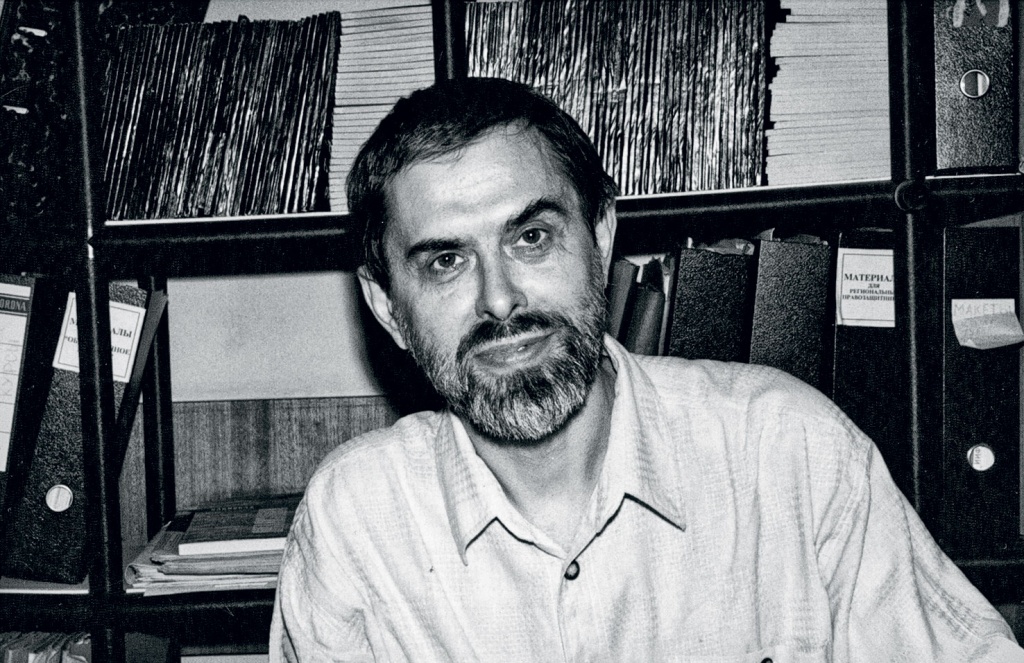
Colleagues and friends call Valery Abramkin the great human rights activist
He seemed to know and understood about the Gulag. In recent years, Abramkin has been seriously ill, and his voice was not enough. Now it's time to re -read his articles, stories, interviews. They did not lose relevance, on the contrary, today, when in society an increased interest in the prison world is again in society, it is important to read them to everyone who remembers that in Russia they are not excited from prison and from Sumy.
The funeral of Valery Abramkin was collected by the whole world. He lived poorly, he did not work for the past five years, and when he worked, being the permanent director of the Center for Assistance to the Reform of Criminal Justice, he did not accumulate the funeral. Friends gathered, the Human Rights Council under the President of Russia helped with a place in the cemetery. Even President Putin sent a telegram to his daughter's condolences. “He always consistently defended his position, an independent point of view. He sincerely sought to contribute to the development and humanization of domestic legislation, to strengthening the modern system of ensuring the rights and freedoms of citizens, ”the telegram says. Abramkin would have read her, probably, he would laugh for a long time. He himself spoke about relations with those in power definitely: "Dr. Gaaz once said:" Knee to kneel over the powerful is not a shame. " It’s not a shame if you ask not for yourself, but for a person inarly, humiliated, suffering. To ask for yourself (to make, “present”, etc.), it’s a shame and standing on the legs or on the pedestal of your own vanity. ”
Free person
Abramkin came to the dissident movement from the KSP (club of amateur song). Then it was one of the free sites. Members of the KSP were divided into the so -called "bushes", a kind of detachment. So the “bush”, uniting the like -minded people of Abramkin, was called “Oblet” - the Society of open windows. After the KSP, he began to look for other forms of the existence of a "free man in a non -free country." In 1977, he publishes the magazines "Sunday" and "Search", where he publishes literary and socio-political texts. There were printed Mikhail Gifter, Yuri Dombrovsky, Grigory Pomerantz. He knew that the KGB was interested in “searches”, he was called to the Moscow prosecutor's office and warned that they would put him if he did not stop releasing the magazine. But the "searches" continued to go out.
"
It’s not a shame to kneel down in their knees. It’s not a shame if you ask not for yourself, but for a person inarly and humiliated
"
Abramkin was arrested on December 4, 1979. Consequence. Court. Article of 190 (“Distribution of slanderous fabrications that defeat the Soviet social and state system”). Sentence: three years of general regime in a criminal camp. Sit in Altai. Two days before the end of the term, a new business was opened against him: for conveying information about violation of human rights to the will.
Prisoner
The second term was serving in the Krasnoyarsk Territory - already in the zone of strict regime. There he became infected with tuberculosis. “The fact that the prison is a completely different world, the afterlife - I could not imagine this,” he wrote already in the wild. - ... the system is crazy. I read the Dead House, read the Archipelago, read Marchenko ... It was just information for me. Unlike a person who first went to prison for ordinary crimes and did not read anything, for example, what went out in Samizdat, my situation was easier. But in fact, I did not find the similar content of the similar one. Having freed myself six years later and having lived in the wild, I again began to worry about everything and realized that all this felt very close to Dostoevsky’s “dead house”. Much closer than written by Anatoly Marchenko or the same Bukovsky ... "
Abramkin sat hard, but never complained. However, those who knew him said that he left the zone completely different. "Burned", or something.
| *We are talking about Gleb Pavlovsky, who also took place in the case of the “Search” magazine, pleaded guilty and received a link instead of imprisonment. |
From the story “Strange Feelings”: “In my thoughts about the prison there is such a plot:“ Non -game situation. ” “Supporting situations” are connected not so much with the state of internal shutter, with the position of a person in the zone, but with the events that took place there besides the prisoners. In the case of “searches”, several people were arrested. In 1983, I could already consider all judicial investigative stories detached. And it seemed to me that they had no choice, each of us was imposed on a role. One had to repent - and he was not that he repented in essence, but repentance came out in form*. The other had to be firmly held at the trial, but then, in conclusion, not too much to front - in order to free himself after the first term. And I was given the role of being a fighter to the end. In the first case, I could not compromise - say, partially plead guilty. I participated in the issue of the magazine, I had responsibility to readers, to the authors. But the accusations on the second process concerned me personally: "Agitation and propaganda in the zone." Pure "linden" from beginning to end! I admit, let's say that I was an agent of the CIA - this is my business. It seems to be more concerned. Well, I admit that I really “campaigned”. Well, he campaigned and campaigned, the demon is with you, since you really want - I admit. But when I tried to take such a compromise position, it turned out to be unacceptable for them. And they immediately tried to throw me into the role of a “fighter” ... ”
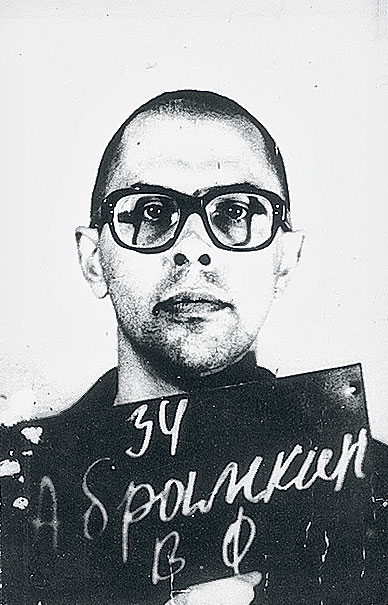 | 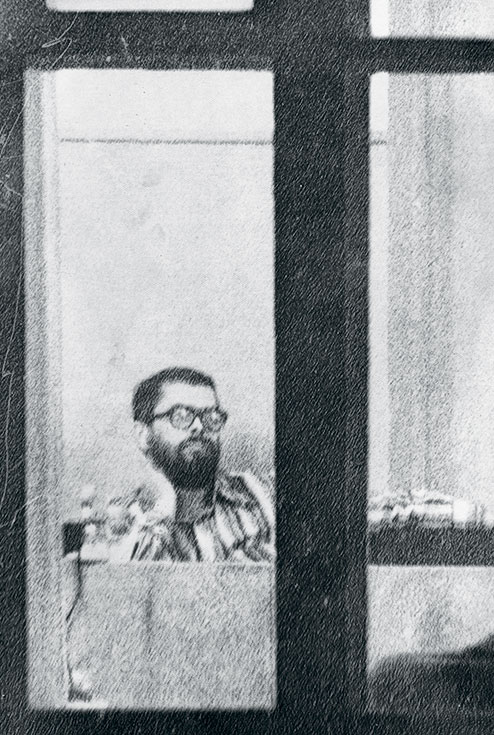 |
| Abramkin is a prisoner. Photo from a personal file | Valery Abramkin at a meeting of the Moscow City Court, October 1980. The photograph was taken by Gleb Pavlovsky |
The voice of the prisoners
Having freed, Abramkin spoke only about the prison. Only that in this system it is urgent to change a lot.
Most of all, he took care of the "youngsters" and convicted women, believing that they had no place in the zone.
He approached the problem very thoroughly. He began to collect evidence of exempted prisoners, analyzed them and began to develop the reform of the legislation of prison and criminal. The end of the 80s, the 90s-was a time of hopes when it seemed that much could be changed. In 1988, Abramkin creates a center for assistance to criminal justice reform, which became the most famous and authoritative organization engaged in the problems of Russian prisoners; Economist Vitaly Nayshul even called her a "national treasure." Abramkin arranged the annual exhibitions “Man and Prison”, where he first showed a photograph “Hell on Earth” later published later in many newspapers and magazines around the world. This is a picture of the SIZO Sailor Silence camera: on an area of 70 square meters. 36 Skkok-Krovathas and 140 prisoners fit meters. He was everywhere with this photograph to illustrate one of his main ideas: to reduce the number of those who are in prison. He made up graphs where he clearly showed the number of prisoners for 100 thousand people in various countries of the world - Russia was the leader. He wrote reports, played at international conferences, met with deputies of the Supreme Council of the Russian Federation, then the State Duma of the Russian Federation, with prison leadership. Surprisingly, some high -ranking
| ** From 1992 to 2009 he held leadership positions in the criminal executive system of the Russian Federation. |
The jailers, such as the former head of the FSIN Yuri Kalinin **, were imbued with the ideas of Abramkin. And Kalinin after him spoke of the need to reduce the number of convicts, repeated terrible numbers: a thousand people come out of the places of imprisonment every month with an open form of tuberculosis.
Is something changed? Yes, the prison population has since decreased from more than a million to 700 thousand people, and Abramkin in 1999 said that the system can provide survival of no more than 600 thousand prisoners. And although in the zones they still die from tuberculosis, the state has been worried about this problem, and there is no longer such a catastrophe as 10-15 years ago.
Abramkin was engaged in everything: he wrote amendments to the laws, traveled to the colonies, answered the letters of prisoners, invented the transfer of “clouds” on the RUSSIA radio and wrote scripts for more than ten years.
The idea of radio broadcasts occurred to him in the last months of his term in the Krasnoyarsk Territory when he was sitting alone. Abramkin understood: we need to come up with a program that would become a "thread connecting the prisoner with the free world." The “clouds” radio program, judging by the letters that are still received in packs, is very popular. She became, as Abramkin wanted, "The voice of the convicts."
Poet of prison
Another important topic for Abramkin was a prison subculture. He believed that the relationship between convicts in prison is much cleaner and more correct than relations in the wild. “I think that if the reformers studied the experience of prison showdowns, they may have understood what Russian justice should be,” he wrote in the report “Prison Disassembly as a possible model of Russian justice”. - The zone uses the principles of traditional culture, usual law. The prison showdown is based on biblical, even gospel justice. There is no task to find the guilty and punish him. There is a task to restore peace and consent. ” Abramkin, of course, romanticized, poetized the prison. When he was asked if it was worth introducing prison norms in the free world, he objected: "These are not prison norms, these are traditional values."
I would like to argue with this or ask him in more detail. You can’t ask anymore.
One of friends and colleagues considers him a genius, someone compares with Dr. Haaz, someone calls the great human rights activist.
Abramkin himself did not consider himself a human rights activist. I once wrote: “I hope that I belong to a certain“ correct ”(this is in the prison language) to a community in which Andrei Dmitrievich, Yuri Orlov, and Sergey Adamovich, Dr. Gaaz, and Serafim Sarovsky (along with the life“ Bear ”), and Dr. Janusz Korchak ...”
On the funeral service on January 30, there were a lot of people in the Andreevsky Monastery. But there were almost no young. Someone sadly said: "As if we were burying the human rights movement."
Photos: from personal archive