
Translated material
The return of the atoning sacrifice
Mikhail Yampolsky about new paganism in Russia
An attempt to introduce a criminal punishment for “insulting the feelings of believers” is nothing more than a new paganism
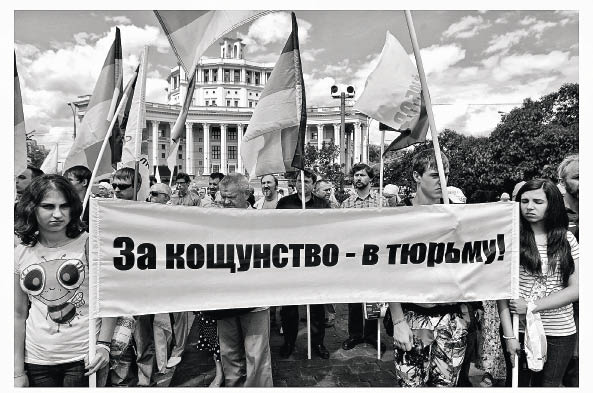
A rally in defense of the Russian Orthodox Church in Moscow on Suvorovskaya Square. 2012
| Mikhail Yampolsky - philosopher, philologist, historian and theorist of art, film. Doctor of Art History (1991). Since 1992-Professor of New York University for Departments of Comparative Literary Studies and Russian and Slavic Studies. Laureate of the Awards Andrei Bely for the book “Return of Leviathan” (2004), Awards of the Guild of Kinovs and Film Critics of Russia for the book “Language -Telo -Speech” (2005). |
It is known that the social space is heterogeneous, and its various zones determine the norms of behavior in them. When we enter the hospital, we behave differently than at a disco. If you begin to sing songs under the accordion in the reading room, you will be taken out of the library. These norms are more or less respected by adequate people around the world, and inadequate people are exhibited. Amendments to the bill “On the Protection of the Feeling of Beliefs” proposed by Joseph Diskin are trying to fix these norms in the Criminal Code, to determine the zones and norms of behavior in them. All this looks stupid and unnecessary. Well, they will set the tables everywhere that in the church you need to behave like in a church, and in a museum - as in a museum. A typical attempt for the last time to regulate all forms of behavior and put them under state control. It is interesting here, however, the connection of fines and prison terms with the feelings of parishioners. In principle, if you are atrocious in the temple, you interfere with prayer, atrocious in the library, you interfere with reading, but what does feelings have to do with it? I'm not talking about acts of physical violence or vandalism, here, as they say, not to feelings.
"
Since the XVII century, as religion moves from the public political sphere to the field of private experience, blasphemy has been decriminalized everywhere and ceased to be a punishable crime
" Masks
In the history of world religions, only feelings of believers in relation to God have traditionally taken into account. Aristotle did not feel any feelings at all and spat on people's lives. In Judaism, God humiliated Himself to emotionally react to people's actions: to be angry, love them, regret, etc. Accordingly, the feelings for God begin to experience believers. In Augustine, love becomes one of the main affects in relations between God and man. In Protestant theology, starting with Schleiermacher and Kierkegaard, Vera becomes an individual experience of a person, existential experience associated with a large gamut of feelings - from doubt and guilt to total self -denial. But already much earlier, starting from the 17th century, as the religion is moved from the public political sphere to the field of private experience, the blasphemy has been decriminalized everywhere and ceased to be a punishable crime. The feelings caused by him did not play in the history of great religions of a noticeable role. The Witches inquisition was not for the insult of feelings, but for a conspiracy with the devil.
It is important to distinguish between pathos of relations with God and insulting religious feelings by the actions of people, when religiosity masks the attitude not to God, but to another. Another cannot hurt the attitude to the Absolute. In 1883, in England, the sensational and almost last in the Western world was the process of blasphemy against the cartoonist Fut. The process caused universal condemnation, and one of the priests (!) So substantiated his defense of the unbelievable atheist: "If sacrilege is a crime against God, then it is undoubted not in the competence of a person to impose a punishment for him." The punishment for blasphemy begins to be understood as a fundamentally anti -Christian gesture as accounting. Kierkegaard wrote: "A true religious individuality is always condescending towards others, so inventive in making an apology - only in relation to itself it is strict and cold, as a great inquisitor."
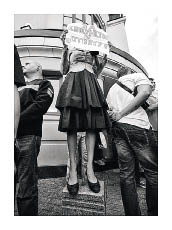 |
| Despite will become a corpus delicti. Moscow, 2012 |
The path to sin
Since the law is probably agreed with the Russian Orthodox Church and even most likely was written by her order, it reflects a curious shift in church ideology. Traditionally, the church condemned any strong emotion aimed at others, and not the Lord. Many times, a fragment from the Book of Genesis (4, 5–7) was commented on: “Cain was very upset and drooped his face. And the Lord said Cain: why are you upset? And why did your face droop? If you do good, do you raise your face? And if you do not do good, then sin lies at the door; He attracts you to himself, but you dominate him. " Affect takes a person from God, subordinates him to the worldly and thereby reveals the way to sin, and in the case of Cain - to violence. Cain's “grief” is the beginning of his fall from God. The condemnation of this kind of emotions in Christianity has deep roots.
A ban on passion
Among the existing options for anthropology of religion, there is one that pays special attention to emotions and violence. This is the teaching of Rene Girard*.
| *Rene Girard is a French philosopher, a culturologist, author of the concept of “fundamental anthropology”, developing the problems of sacrifice as an act underlying culture and society. |
Girard believed that a religious phenomenon arises in direct connection with a certain type of emotions that he defined as a mimetical desire, that is, the desire to take possession of what the other entails. As a result of the collective struggle for the object of desires in society, differences disappear and violence reigned. Religion is an attempt to control violence, the cause of which a certain being is declared - a person or an animal. This creature is ritually sacrificed, and the world is restored in society. The bloody ritual of the sacrifice underlying most ancient religions, according to Girar, creates sacredness and establishes the temporary unity of the community (through the blood of the victim that falls on its members). Christianity, being a direct continuation of this practice, is trying to go beyond the scope of sacrificial violence, preserving it only as a fundamental event. Christ declares himself the last victim to stop the shedding of blood. The ban on worldly passions, “feelings”, addressed not to God, but to people, are nothing more than Christian taboo of the very source of hostility and violence.
“ Now it’s not a priest in the temple, but the judge will sacrifice those who are sent to the aggressive affects of the parishioners ” an Reductive victim for him
The cessation of the rituals of sacrifice in the sociology of religion is often associated with the approval of a secular law, which replaces the redeeming sacrifice by the punishment of criminals. The law under discussion, protecting the “feelings of believers”, turns “sinful” emotions into a basis for criminal punishment. The church, of course, cannot resume the rituals of bloody sacrifices today. The state here offers its services. It is as if we are returning to those primary structures of the sacred, which the Girard described and which Christ tried to overcome. Now it’s not a priest in the temple, but the judge will sacrifice those who are sent to the aggressive affects of parishioners for him. Can't you cut them on the altar? Nothing, we will help you. In this political and theological context, the girls from Pussy Riot look like an atoning victim of the new paganism, with whom the ROC unknowingly flirts.
Photos: Vasily Shaposhnikov/Kommersant, RIA Novosti