
Translated material
Agony. Search for an alternative
In the opposition
 Agony. Search for an alternative
February 7, 2013 Lilia Shevtsova
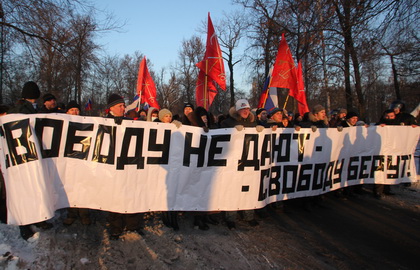
Saint Petersburg. December 15, 2012. Participants in the protest "Marsh of Freedom"
Russia does not have to repeat the way to the free society through which other countries went. It should not be hoped for automatism of previous logic. So, let's say, it is already clear that the Spanish transformation “from above”, which became a model for leaving Latin America and some countries of Eastern Europe, is impossible, first of all, due to the discrediting of the Russian ruling class and the ideas of modernization “from above”. In the world there was no precedent of the transformation of a half -pushed nuclear power that begins to return to the role of “unique civilization”. What does the readiness of the ruling team restrain changes at all costs. Not a single authoritarian regime in the previous half a century had the opportunity to use foreign policy as actively as a compensator of narrowing of domestic resources in order to protect the status quo. Moreover, we are talking about involving the West in the process of supporting this status quo! So Russia will have to look for its exit from the civilizational impasse, into which we continue to insistently delve into.
Nevertheless, there are prerequisites and transformation mechanisms that we should take into account. And which, in one way or another, apparently will work in Russia. In any case, their accounting will reduce the time and flour of our experiments.
So what from world experience can we come in handy? Here is the first axiom of movement to freedom, confirmed in various societies. The engine and the driving force of transformation have always and everywhere intellectuals. It was they who formed ideas, tactics and strategy. They gave emotions and passion to public protest. They carried these ideas to other social layers. If intellectuals are sleeping, and even more so serve as a regime, if they are not ready to build opposition structures and go to the people, you can forget about changes. Russian experience, I think, confirms this axiom.
With the intellectual and strategic core of protest is clear. But what layer of society can become the social basis of the democratic movement? A variety of social groups became such force - from young officers and students to small businesses, middle city layers and religious groups, formed around individual churches. By the way, about the role of the church in the protest movement. This is a special topic and, I hope, we will raise it. There was not a single successful democratic transformation of the new time, wherever the church play an important, and sometimes decisive role. Since the Protestant countries in most cases were already democracies, the Catholic Church had to play a revolutionary role. Already in the late 60s. From the institute that supports the state (though not everywhere), the Catholic Church moved to activities to support a free society, in some countries, becoming a decisive factor in leaving authoritarianism and dictatorship.
What was the most effective way to combat authoritarianism? Firstly, the recognition of its illegitimacy with wide strata of society, and secondly, the commitment of the opposition to the principle of non-violence. The introduction of these two principles into the protest “use” has become a guarantee of all democratic transformations of the 20th century. No less significant is the adoption by the opposition and the protest part of the society of another rule: free elections based on new constitutional rules of the game, which ensure political competition and replacement of power. In certain countries, specific release mechanisms from relative could vary. But the above principles were fundamental.
And now about how tactically the opposition acted in those countries where a successful peaceful transformation occurred. What did she pay attention to in her specific actions? First of all, on the formation of a general democratic front, i.e. The unification of all political forces that were ready to recognize the idea of the rule of law and political competition. The “front” could have different forms-we are talking about horizontal, umbrella mechanisms for the interaction of democratic forces, which temporarily postponed their contradictions on socio-economic issues. At the stage of release, the idea of freedom has always been the first task. Without this initial beginning, one could not take the next step.
At the same time, the opposition was looking for dissatisfied within the authorities and, above all, among the military. All that was needed is that the military and the police simply do not defend the regime and remain in the barracks. But the success of such a search always depended on how influential the opposition was and what support it had in society.
Everywhere (like ours) the question was the question of which means of combating the regime is preferable - participation in protest promotions or in legal political activity and, above all in the elections. World experience speaks of a curious trend. If the ruling regimes were still stable, then the participation of the opposition in the elections ended with the fact that the power replayed it, using it for its own legitimation. Therefore, at this stage, the opposition preferred to boycott the elections, as it was in Poland, South Africa, in the Philippines, Pakistan, Nicaragua. But as the regimes and their ability to control the results of the elections are weakened, the opposition began to take part in the elections, and this participation in some cases became decisive for the peaceful departure of authoritarianism.
Oppositionists argued about how often and with what slogans to go to protest promotions (marches, demonstrations and rallies - a universal form of protest). Let's say in 1989. In some cities of the GDR, peaceful rallies took place every week. In Chile, the opposition arranged monthly protests. In other countries, rallies and marches were arranged for a particular reason - the anniversary of resistance or protest against the next violence of power. Protest promotions pursued several goals: to make the process of people going out into the street by a public ritual, to wean society from fear of power and to mobilize the protest minority ready to resist. However, the task of preventing violence was never solved anywhere - both from the police and from the radical part of the opposition.
World experience also suggests that in order for the protest wave to not leading to the emergence of an even more repressive regime, the opposition from the very beginning should reflect on how to consolidate democracy, i.e. How to create new rules of the game that would prevent the restoration of personalist power. And here in the center of fierce disputes the question is: how to maintain state continuity, avoid legal vacuum and move on to a new order without violence? Where this process was relatively peacefully, the opposition managed to use the old parliament that has lost legitimacy to form the legitimacy of the new system. So in Spain and Poland the former parliaments approved the laws that allowed to hold free elections and elect a new parliament (and even partially change the old constitution in Poland). To use the old rules of the game and the authoritarian constitutional mechanism in order to go to democracy are the highest political aerobatics. Yes, for many oppositionists this method of farewell to the past caused rejection, they wanted to start with a clean sheet. But as it turned out in the future, the legitimation of the new through the use of an illegitimate old one (in Spain it was a franchist mechanism of the authorities) is a controversial, but at the same time a gentle way of leaving the past. SIC: Everywhere the basis of the new system was the adoption of a new constitution, which summed up the past and created guarantees of a new political order.
Finally, the contacts of the opposition with the world public opinion, with the world press and with foreign human rights organizations were a way of international legitimization of its struggle against authoritarianism. In a number of countries, it was the world legitimation of the protest that helped get rid of authoritarian leaders and dictators (which was provided with asylum in other countries).
The problems that our opposition faces existed in all other countries that have already found a way out of an authoritarian impasse (now they have their own problems, but these are other problems). So everywhere inside the opposition was the struggle of moderate and radicals. Everywhere there was a discussion about the possibility and limits of cooperation with representatives of the authorities or the need to rejection. Everywhere there was a dispute about tactical means of combating the regime and the possibility (and expediency) of participation in the elections controlled by the authorities. Everywhere there was a search for sources of financing protest activities. Everywhere there was a threat of uncontrolled violence through the fault of both the authorities and opposition radicals. Everywhere there was a threat of intercepting the slogans of the opposition by representatives of the authorities for the purpose of their internal showdowns. But in the end, in the end, society and the opposition in many countries have nevertheless formed an alternative to compliance! There is no evidence that we will be less capable than others.