
Translated material
Engine of technological progress
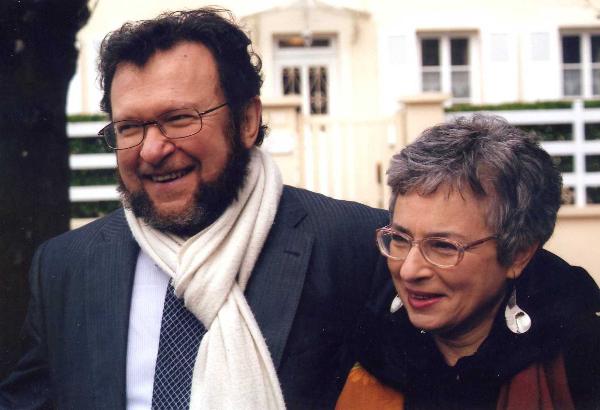 Dmitry and Irina Guzevich
Russian historians, the Guzevichi couple - Dmitry Yuryevich and Irina Davidovna , employees of the School of Higher Social Research in Paris, continue the story about A.A. Betancure and his role in the formation of the Russian Higher Technical School.
Irina Davidovna : The name Betanchar entered the annals of the history of technology, primarily thanks to his first, short trip to England, because there he became famous as an industrial spy that stole James Watt by a secret of double -acting steam engine ...
Did he bring him to his homeland?
And: no, to France, and handed over to his friend, the French mechanics of the Perry, for implementation. A year later, on this basis, the first steam mill on the mainland, arranged by Perry in Paris, on the Lebyazhy Island, acted.
Dmitry Yuryevich: In addition, Betanchar betrayed the device of a double -acting steam machine, publicly knowing the scientific community about him.
Betankur became famous as an industrial spy, which stole the secret of a double -acting steam engine from James Watt.And: This is an absolutely spy story around which there is a lot of literature, and each country-Spain, England, France-interprets it, of course, in its own way. But the fact is a fact: it was a universal engine that was in a terrible secret, since Bolton in Birmingham and Watt collaborated with it had a huge income.
Betankur revealed this secret. As it turned out later, he was not the only one, there were other people who came and tried to do something, but he advanced beyond all. He looked at this car from afar and understood the principle of action ... Then he presented its description to the Academy of Sciences, made the current model, published the results and the British remained with nothing. He traveled in the fall of 1788, and opened for the public in 1789. less than five years after the invention of Watt’s double -acting machine.
Betancourt, as we recall, lives in Paris at this time?
And: Yes, and is engaged in the creation of a collection of machines. Actually, he needs a steam engine for this collection. Himself, personally, Betancurk did not introduce a steam car. It is characteristic of the mentality of the state, corps engineer - it was important for him to make a report at the academy, to gain success, applause, promotion, an increase in salary. The introduction, the income from entrepreneurial ventures was not particularly interested in him. Yes, and he, he must say, was worthless: all his personal industrial initiatives regularly suffered collapse ...
And Watt, on the contrary, worried income - from sales of cars. Of course, a very tense situation arose - by the way, it is well documented. Note that not only Betankur followed Watt, but also vice versa. In the archive of Bolton and Watt, we found copies translated into English from the handwritten materials of the Betancer experiment on the elasticity of vapors.
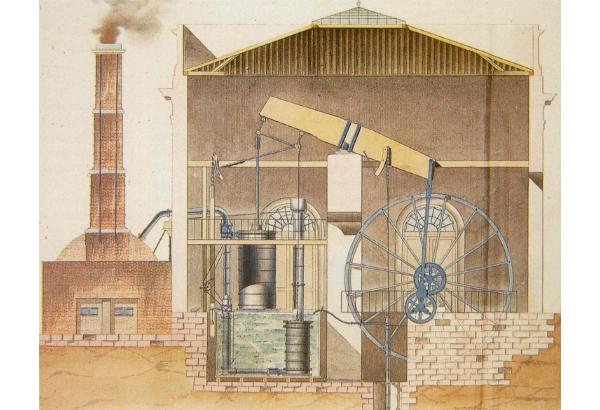 Double -act
Although Betankur is known primarily in connection with the action of solving the secret of Watt, it was by no means the only “spy feats” in his list. In the same way, he “took” and revealed a number of other industrial inventions for the general public. Just a double -acting machine overshadowed everything else in importance ...
It is also interesting that for him it was not a feat at all - he just needed this car for the office, he drove, looked and made it. And the car’s office was not preserved - it died pretty quickly. Napoleon entered Madrid in 1808, the Buen-Retiro Palace was destroyed, and the collection mainly died. And what was left of her was sprayed. There is only a catalog.
Correctly I understand that Irina just managed to restore the virtual cabinet of cars in the computer by the catalog - did you manage to find prototypes on which Betankur made cars for the office? And that the percent of seventy drawings are now restored?
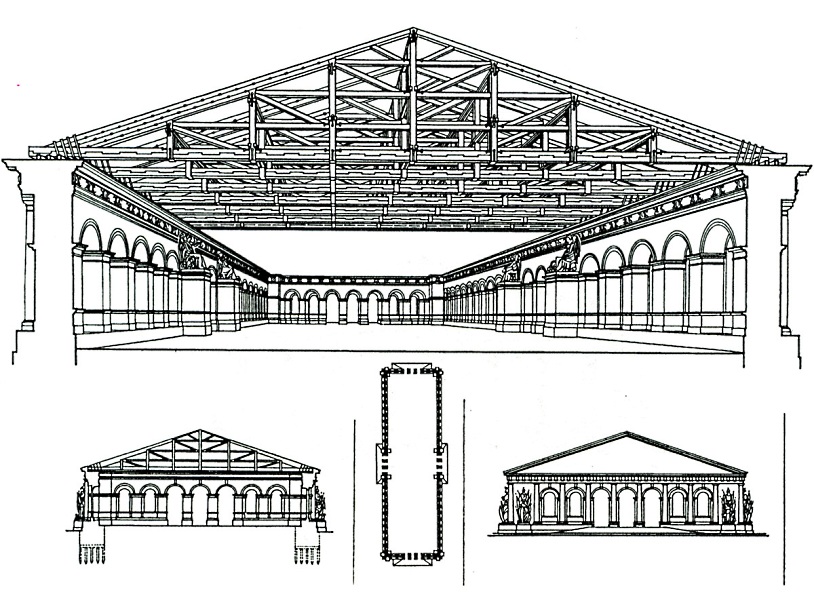
And: in fact, the office is the engineering credo of Betancer. The collection itself, the catalog, as well as the preface to the catalog is a reflection of how he saw the state of technology and engineering at that time. In modern terminology, we can characterize this perception as a transitional-from an engineer of the Enlightenment, with its syncretical consciousness, which is based on the enlightenment idea of the unity of all sciences, to a mathematics with a narrow specialization. Still, Betankur was not the last-he was an educational engineer. But he achieved a lot. He made a dizzying career in Spain, he was at the origins of the Spanish corps of bridges and channels, he created a school of bridges and channels in Madrid. School - sounds very loud. For all the years that he taught there, there were from three to five students - but they were!
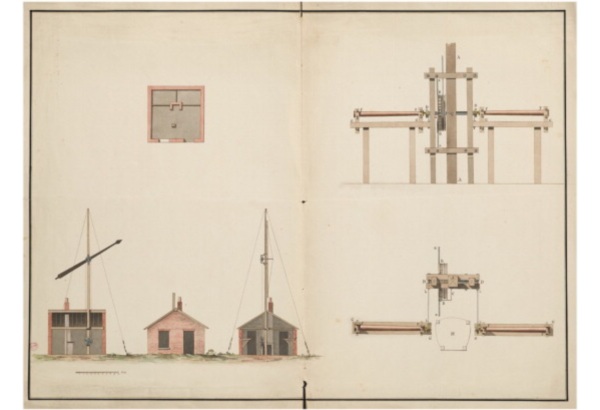 Optical telegraph Betancer/Brega
So it was up to 1807-1808, when Betankur “matured” to leave Spain. Before that, he simply, say, was excommunicated - but he always returned later to Madrid. He lived for three years in England, constantly drove to France, where he pierced the optical telegraph created with Brege - a more perfect model than with a chapp. But he has already begun to build his system. And the Betancura/Brege model, who was more protected from errors, more simple and did not require such training of telegraphists, was not adopted in the end ... At the same time, the telegraph of Betancer/Brege was a significant product and in the direct and figurative sense of the word-he symbolized typically Spanish utilitarianism, taking into account the absence of competent technicians in the country, it was necessary to create something very simple, affordable.
The telegraph of Betancer/Brege was a significant product - he symbolized typically Spanish utilitarianism, taking into account the absence of competent technicians in the country.D: However, it turned out that the moment was lost and creating this system is still more expensive than developing the chapping system. But, of course, all this was resolved extremely conflict.
In general, in 1807 he ended up in France, where in passing he and Lanz wrote a course of machines, which, in principle, glorified both. In fact, it was a work that determined the birth of the theory of machines and mechanisms. Then, in 1807 - from December to April or May 1808 - he went to Russia, was accepted by Alexander I for royal service and then returned to his family. And he finally returned to Russia in the fall of 1808 - with his wife, son and three daughters, for some time turned without any special things, and then he was determined to reform in the department of roads. And in the course of preparing these reforms, it was decided to create an institute for the preparation of traffic engineers. This was the result of the work of the Secret Commission, which met in Pavlovsk, chaired by Prince of Oldenburg, a young man who had just married to Ekaterina Pavlovna and “ inherited ” the transport department, which was previously subordinate to Chancellor Count Rumyantsev.
How were Betancer's own projects carried out? What about him, simple grateful descendants, we know: the Moscow arena, now in his original dosage destroyed by Luzhkov, the rise of the Alexandrian pillar in an hour with a small from the position of “lying ” to the position of “standing quietly ” the lifting of the columns of the Isaac's Cathedral with the help of a tree and someone else's mother-what else?
D: Petersburg. Squares of St. Petersburg, layout of St. Petersburg. Their grateful descendants know. And this is the result of the work of the so -called “Hydraulic Committee”: “The Committee for the Construction of Hydraulic Work in St. Petersburg and touched by the places” created under the leadership of Betancer in 1816. And there were ordinary members all the famous architects who are considered to be the creators of the Ampir Petersburg - Rossi, Stasov, Montferrand, Modyui and others, K. tone, young Shtakenschneider, Bazin, Gottman and so on, were simple drawers there. That is, it was huge, speaking by the current words, a design institution in the field of urban development. Betankurkur - at the head, the creator and chairman. And without the signature of Betancer (and after his death - Bazen), none of the projects could be implemented. And the created projects are in a certain sense the fruit of the collective creativity of the members of the committee, which later entrusted the decision with the architects. And this architect put his signature as a person who completed the design of this decision. And the construction is usually attributed to this architect.
The St. Petersburg "Hydraulic Committee" - it was a huge project institute in the field of urban development. Betankour - stood in his chapter, being creatures and chairman. And without the signature of Betancer (and after his death - Bazen), none of the projects could be implemented.That is, the Isaac's Cathedral is not quite Montferrand?
D: Isaac's Cathedral - in realities - this is the fruit of the work of a good dozen architects and engineers, and not assistants to the architect, but responsible designers. Moreover, half of them are opponents of Montferrand. And the genius of this person was that he managed to accumulate all this.
But he himself was a good draftsman?
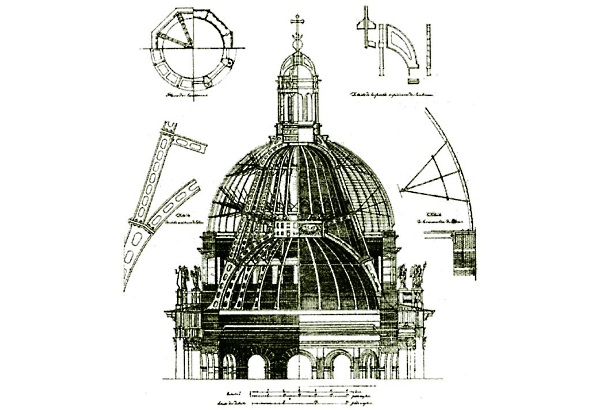 Dome of the Isaacievsky Cathedral, project of Montferrand (1838)
D: Yes, the drawer. But if he built on his first project, the cathedral would have collapsed. And the objections of Modyui, an architect from the committee, allowed Montferrand not to get out of a pile of fragments of the cathedral, but from under a pile of papers written - this is much easier, not so painful. As a result, the cathedral was created. Another organization, which was created in 1820, was created by Betancurk - a commission of projects and estimates; It sounds boring, but it was thanks to the activities of this organization that Russia almost did not know the disasters of engineering structures through the fault of design engineers. Due to the fault of the contractors who put the wrong materials-there were, but because of the mistakes of the project-no, never! Through this commission, projects of all engineering structures were carried out by construction in Russia. Its function was to check reliability and strength.
What is now called technical supervision ...
D: And they began to create the first normative literature. All normative literature in Russia goes back to this commission. This expert organization is also the brainchild of Betancer. So his merits as the organizer are much more significant than his own engineering, inventive activity.
And yet-some other his own engineering work ...
D: A number of bridges: the first bridge across the Neva’s sleeves is the Kamennoostrovsky, the paper bridge over the paper channel in Yekateringof, the restructuring of the Isaac's bridge, the restructuring of the Tula weapons factory, the ensemble of the Nizhny Novgorod Fair, the construction of the expedition of the procurement of state securities (that which is now Goznak - L.U.) - here he himself developed technology, almost neither no technology. Banknot design. And many others.
Betankur accepted Russian citizenship?
D: No. He did not really learn Russian. Moreover, it seems that he played the role of the technical resident of Spain in Russia. He sent materials to Spain ...
And: for example, working with Tula arms factories, he sent information about the latest weapons to Spain. Like a true patriot. But these are trifles. In fact, he was all at the same time - this is amazing, this is a paradox of personality. And he was not alone - it is quite characteristic of the era.
D: Say, his follower and Extract Bazin received money in Russia and France, was, in fact, in two services at the same time ...