
Translated material
Forward, in the seventies
How to return relations between Moscow and Washington "to a normal rut"
At the February meeting in Munich, Sergei Lavrov and Joseph Bayden agreed to return the relationship of Moscow and Washington “to normal rut”. But rather, deja vu awaits them
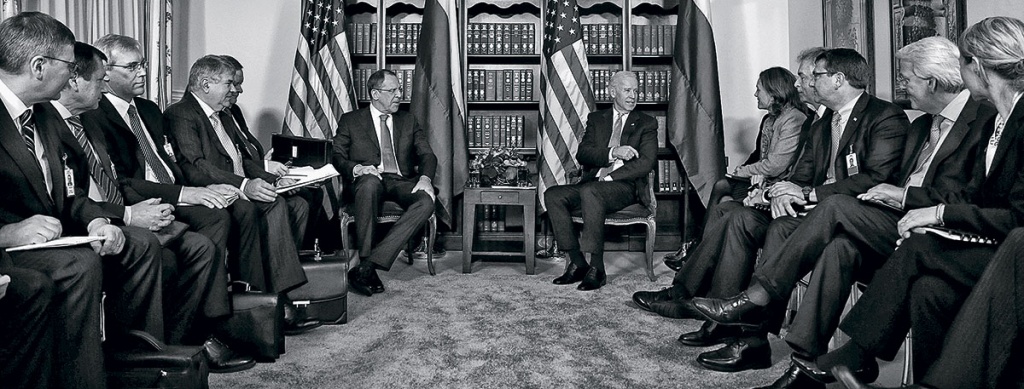
Munich. February 2. Meeting of Russian and American delegations
At the Munich Security Conference-2013, Vice President Joseph Biden spoke at the same Bayerischer Hof hotel, where he announced a new course in relations with Russia four years ago, which Hillary Clinton's Secretary of State Later in Geneva invited S. Lavrov to call “Reset” (Reset). Well-known words were poured from the audience, which was in many ways in 2009, well-known words were poured from the rostrum: “trust”, “partnership”, “cooperation” ... But they were now perceived in a completely different way.
The beginning of the game
Biden is an experienced politician. Like John Kerry, who had just become the 68th US Secretary of State. But to establish a constructive dialogue between the two countries in conditions when almost the entire foreign and domestic policy of one of them is built on antagonism in relation to the other - such a burden becomes unbearable even for the most talented diplomat.
Even in his past, the presidency (let's recall the speech in Munich on February 10, 2007) Vladimir Putin unequivocally defined the United States as the main enemy of Russia. The enemy of not only striving to weaken its international positions, but also supporting the “fifth column” within the country in order to change the political regime. The final chords of a long anti-American anthem were heard in Putin's speech at a rally in Luzhniki on February 23, 2012.
The four -year -old, from 2009 to 2012, the game of "good and evil investigators" with the location of Dmitry Medvedev changed the style, but not the essence of Russia -Ssha. All the so-called steps towards Washington within the framework of the “rebooting” primarily corresponded to the interests of Moscow itself, whether it is the need to reduce the obsolete Russian nuclear arsenal (START-3 agreement), the danger of the Islamist “Earth” in Central Asia (NATO transit in Afghanistan) or dislike of Iran’s excessive progress on the way to nuclear weapons (support of anti -Iranian sanctions in the UN Security Council).
The Kremlin received a priceless gift from the “rebooting”: international legitimization. For four years, the White House actually acted as a PR agent of official Moscow, representing the Locumsteps of Medvedev as a reformer and (borrowing the famous phrase Margaret Tatcher about Mikhail Gorbachev) "a person with whom you can deal." The Administration of Barack Obama, and in March last year, also not only admitted the service, but also publicly congratulated him on the victory in the presidential election, which the OSCE (where, among other things, included the United States) appreciated as not complies with democratic standards.
However, the US administration tried to help the Kremlin the most active, torpedoing the adoption by the Congress of the “Magnitsky Law”, which provides for personal visa and banking sanctions against Russian officials involved in corruption and human rights violations. The political will of American legislators (from both parties) eventually outweighed the political will of the White House, and the “Magnitsky Law” became the US Federal Law.
The moment of truth
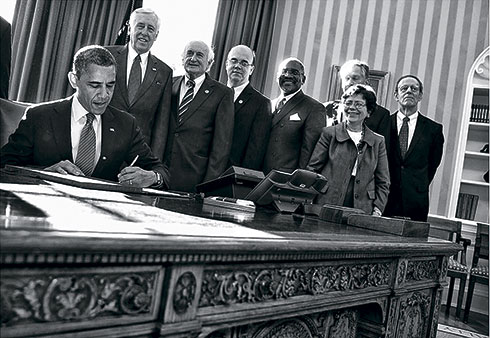
The return of the Putin style to the Kremlin and the tightening of rhetoric in relation to “external enemies” predetermined the end of the “reboot”. It is important to understand that the “reboot” ended at the initiative of the Russian side - the US administration would be glad to continue cooperation. The labels of “foreign agents” for NPOs, the demonstrative expulsion of the US agency for international development - USAID from Russia in the fall of last year, and with it two influential NGOs (national democratic and international republican institutions), plus the sharp “twisting of nuts” in domestic politics did not leave Washington's choice. For all the readiness to show flexibility in matters of human rights, officials from the White House and the State Department still have to look back at Congress and public opinion. That's exactly why Barack Obama on December 14, 2012 signed the Magnitsky Law. The formal exit of the American side from the bilateral working group on civil society issues in the Russian-American presidential commission (previously known as “Group of Surkov-Makfol”) on January 25, 2013 became a statement of obvious fact: disagreements of the parties in human rights became insurmountable. Moscow, jealous of the principle of “reciprocity”, hastened to withdraw from an agreement on cooperation with the United States in the fight against crime and drug trafficking - this happened on January 30. In Washington, Demarsha was treated without much interest, except for the duty-diplomatic “regret”.
"
What else will Putin come up with if we tighten the sanctions against his officials - threatening to set fire to the nursing home?
"
Events milestone for Russian-American relations occurred before the New Year, namely December 26, 2012. The real “answer to Kerzon”, who opened his eyes to the nature of the present Russian government, even to those American politicians who still supported the principles of “restart”, was the adoption of the State Duma on that day of the so -called “law of Dima Yakovlev” - in response to personal sanctions against corrupt officials and human rights violators, the Russian state forbade US citizens to adopt Russian orphans. This decision was a real shock for the inhabitants of the Capitol, it would seem, already accustomed to any news from Moscow.
It is clear that America, like any other country, has the right to independently decide who to let go and whom to not let in their territory. It is also clear that Russia from the point of view of international law is absolutely sovereign in making a decision on whether to allow or not to find a new family abroad or not to its orphans. The question is not that. The question is exclusively in moral compliance. How rhetorically the author of these lines asked the high -ranking employee of the Capitol Hill apparatus: “What else will Putin come up with if we tighten the sanctions against his officials - he will threaten to set fire to the nursing home?”
Deja vu
At the Munich Conference in February 2013, Vice President Biden promised to “continue to look for opportunities for the partnership of the United States and Russia”, calling, as an example, a further reduction in nuclear weapons. It is this foreign policy relic of the Cold War that it seems that it will become the main theme of the American-Russian agenda for the coming years. Deja vu in the style of the seventies: Congress requires the liberation of the Soviet political prisoners, the White House is conducting nuclear negotiations with the Kremlin. In the absence of force majeure situations requiring unification in the face of a common threat, prerequisites for a change in dynamics are not expected. At least before the change of administration in the White House or the regime in the Kremlin - no matter what happens earlier.
Photos: AP Photo, Reuters