
Translated material
Crazy tea party
In the gallery "Ark" the exhibition "Sweet Life" was opened
“Sweet life” is an exhibition project, at first glance pleasant in every way: everyone loves sweets. The Vologda and Tver Regional Picture Gallery, the capital's State Museum V.V. Mayakovsky, Museum of Society "Memorial", Academy of Culinary Arts "Exclusive", as well as collectors, galleries and artists. What, in fact, are we talking about?
Sergey Safonov
“Sweet life” is an exhibition project, at first glance pleasant in every way: everyone loves sweets. The Vologda and Tver Regional Picture Gallery, the capital's State Museum V.V. Mayakovsky, Museum of Society "Memorial", Academy of Culinary Arts "Exclusive", as well as collectors, galleries and artists. What, in fact, are we talking about? Firstly, about the sugar and its derivatives, abundantly present in the domestic art of the last century. Revolutions, wars, camps and other circumstances seemed to have not implied an excess of glucose in the everyday life of our compatriots - but, as it turned out in the process of working on the exhibition, the topic of sweetness was inevitably present on canvases and drawings even in the most difficult years.
Secondly, the word "sweet" has many meanings. It can describe the taste of food and taste aesthetic, have positive and negative values. We can hear how someone had a “hard time”, and the work of painting, on the contrary, is “sweet”. Immersion in the theme Taili for curators is a lot of discoveries, and not only purely art. It turned out, for example, that in opposed mines installed in the water near the shore, traffic jams from ... pressed sugar are often used as a fuse. Water opens access to sugar traffic jam, it is rapidly dissolving, and the mine rises on a military platoon.
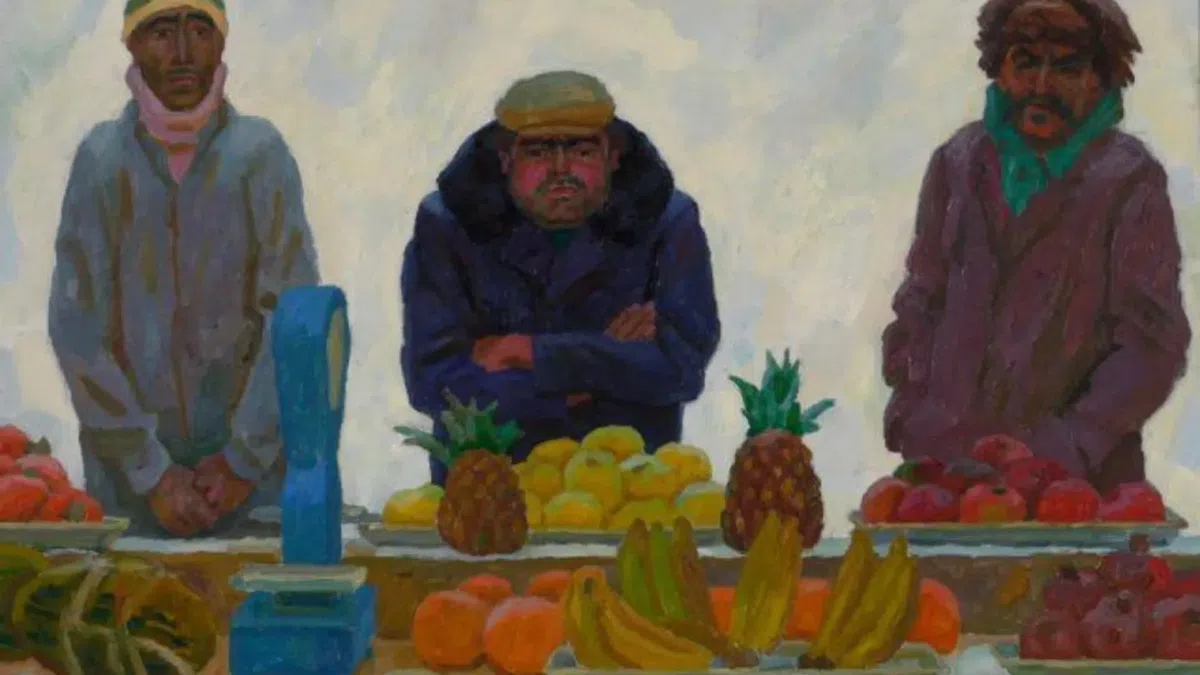
The resulting exposition is partly a parody of the patriarchal genre of the thematic exhibition. In one corner - tea and feasts with samovars, from the large -format canvas of Yuri Kugach “On Saturday” (1964) to “still life with a kettle” (2012), made of metal and natural stone by the young artist Alexei Zhuchkov. In the other, gingerbread cookies and cakes, in the range from the “still life with a vase and a pretzel”, written in the 1920s by the author of the legendary picture “Universities” Konstantin Istomin, to a series of the three recent hills of the Petersburger Alexander Florensky. The third contains fruit desserts, the most familiar to the viewer of the genre of “glucose -containing” images - from “still life with dahlias and fruits” (1915-1916) Ilya Mashkov to the grotesque genre picture of Karl Friedman “Southern Fruits” (1993).
Of course, the topic of table setting is not forgotten. The most diverse tables are breaking in the picture of Alexander Makovsky “Easter table” (1915-1916), in the pre-ore “Pirushka” (1958) Alevtina Vlasova, on the gigantic canvas of Peter Konchalovsky “on the lawn” (1954) ... The revolutionary side of such Soviet well-being-the chamber watercolors of the Alekseya Snoli in 1934 to Solovki Wangenheim; Shortly before the creator of the Unified Hydrometeorological Service of the USSR. He sketched not only fruits in long -existing greenhouses of the Solovetsky monastery, but also modest cloudberries and lingonberries, saving the scientist in the camp of scurvy. Other exhibits from the Memorial collection, such as the camp tea utensils or camp needlework (one of the exhibits - manually banged julia Daniel), also significantly expanded the semantic boundaries of the phrase “Sweet Life”.
All kinds of items and collections complement the exposition. The heirs of the artist Ivan Efimov and in the Favors-Shakhovsky family, not only wooden forms for the manufacture of gingerbread, but even gingerbread castings of the 1920s have been preserved. The art critic Larisa Kashuk has long been collecting postcards of the first half of the twentieth century, the main sweetness of which is Kitch as the embodiment of a dream of a beautiful life. And, of course, the “sweet life” could not do without the extensive collection of sugar of Moscow artist Yevgenia Dvoskinina, brought from different cities of Europe and not only. Still, sugar is not only a “white death”, but also a way to maintain memories of the “sweet life” with which it was once lucky to come into contact ...