
Translated material
How the shrine was defiled
The non -working Egyptian, who, at the end of the New Year's festive marathon, in a state of intoxication, urinated directly into the eternal flame on the alley of the heroes of the city of Volgograd (never renamed Stalingrad, contrary to the cries of the progressive public), was planted under the castle. Thus ended the story of the incomprehensible defileties of the “bodies of the dead” from the unemployed guest of the famous city on the Volga. The fact that the Egyptian, who escaped to the Russian hinterland from Tahrir's horrors, did not understand very well what he was doing is quite likely. But the “value burn”, which his behavior inflicted on Russian society, is quite tangible. Passers -by rushed at a defiler with fists, but he was not a mistake, so that a new one was added to the article on the “abuse of the bodies of the dead”.
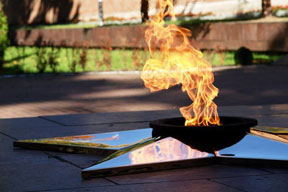 Eternal Flame on the Heroes Alley
It is not known whether the Egyptian inoperative has long lived in the city on the Volga and whether he managed to get acquainted with the Soviet ritual of veneration of eternal lights, but to refer to the need to choose a less noticeable place. It will be quite reasonable to assume that in his behavior a certain religious and plenipotentiary meaning is hidden: Islam, as you know, was poorly treated with Zoroastrian veneration of fire, considering it “scarc”, bad and abominance in the eyes of God. However, the religious conscience of this resident of the distant Misra will remain a mystery to us. Whether he was a zealousist (which prevents the fact of intoxication) or simply did not realize the cultural and religious meaning of the Soviet ritual-it is incomprehensible. But the conflict is evident and valuables are offended. The Egyptian did not see the front line and crossed it, did not see the border of the sacred, The shrines of folk memory , for such a border passes through culture, and stepped on the shrine.
Another story with an insult to the values, this time national, occurred in Azerbaijan, where the country's folk writer Akram Ailisli was under the fire of criticism and was almost accused of national betrayal after his novel “Stone Dreams” was printed in his native Turkic in Baku. In the novel, heroes without any sympathy speak of the killings of Armenians at the end of the twentieth century. Moreover, the deputies betrayed the book of Ailisy to symbolic burning, and the people's writer himself was deprived of the title of people's and even proposed to check for a mental illness and a genetic code. What if he is a secret Armenian?
 Akram Ailisley
There is another burn in front of us, more difficult to arrange. The Hekatomba, erected during the Karabakh conflict, was attached to the mythology of absolute negative on both sides, but in Azerbaijan it turned out that the abandonment of this one -way mythology is fraught with loss from society and the people. Mythological villains (for example, Armenians) cannot be protected. Let us recall the story of an Azerbaijani officer who killed his Armenian colleague in Hungary in a dream. He, as you know, returned home a hero. As the hero, Ossetian returned home, stabbed the Swiss air traffic controller, guilty of his daughter's death.
The past associated with the mass death of people cements the attitude of their descendants to real or collective culprits with the help of mythological glue and winding emotions around hatred for the enemy. Hatred is an instant feeling and is easy to lose. G.S. Pomerantz said that the Germans were very hated during the war, but when they had an attack in Stalingrad, he no longer felt that hatred, and when they took the first line of fortifications, the prisoners of the Germans were completely treated to cigarettes.
To hate the enemy, he must be dehumanized. And this is the reverse side of the process. Ailisli ended up at the forefront and began to treat the enemy cigarettes while the mass of his fellow tribesmen still fled, panting from rabies, to the trenches already taken. Writer He defiled the shrine of hatred .
Actually, this is the task of cultural leaders - to signal the end of the attack and even the end of the war. When the war stops in literature or cinema, it goes into the stage of the relic. Behind Okudzhava and Astafyev, a rethinking of the Great Patriotic War began. Instead of schemes, dramatic conflicts appeared, and instead of dehumanized Fritz - living people. To do this, you need a dialogue, pronouncing values, the establishment of scales.
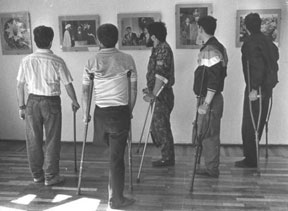 Veterans of Karabakh
In order to translate the relevant into history, it must be humanized back. The undividedness of the stranger is negative, but it can be revealed as human and social value through the language, and wider through culture. The Egyptian from Volgograd can be shown the border and he will understand or enter into a dispute, protecting his understanding. But it will already be a dialogue. The writers and politicians, stigmatizing Ailisli, can only be done - to change the mythological series of culture. Thinking with binary oppositions always leads to the fact that there is a desire to kill the enemy, destroy him. But society is more complicated than it seems, because it consists of people. Yesterday's enemy may be tomorrow.
Valinated burns are the most conflicting field, and only the complication of cultural series can give them the nature of creative conflicts instead of triggers of hysteria of self -destruction. Where the shadow of dehumanization in the name of the struggle is visible, a new round of hatred is inevitable, which, like a whirlpool, involves more and more objects. The shrine of hatred is Baal, which constantly requires new sacrifices. But did not Moses go to the Sinai to destroy this idol?