Date
Author
Александра Вагнер; Юрий Векслер
Source

Preserved copy
Translated material
Time as money
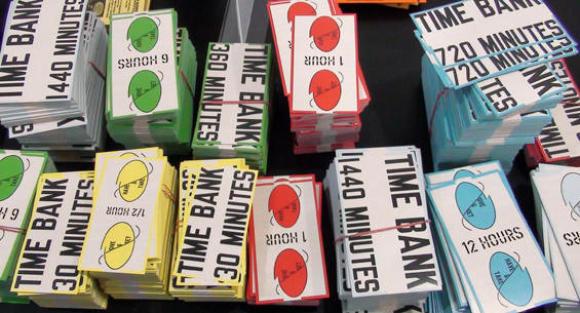
The economic crisis forces to seek and create alternative financial systems when virtual units of information measurements or time spent on labor serve as money
If on Sunday to get to the city market in a small Greek town of hair , then on the price tags you can’t see the usual euro. Instead, there is another currency - that . One is equal to one euro, but it is not possible to buy it in the exchange point. Thus, you can only earn: selling crafts, farm products or old clothes, as well as offering different services - yoga, English, piano game courses. The money earned in this way is spent on other goods and services offered. About 800 hair residents use this alternative financial system. Formally, they do not consider the money, since existing commodity relations are more reminiscent of a barter common in Europe before the appearance of money.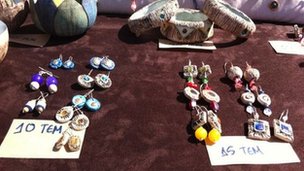
The emergence of currencies in the circulation in parallel with the official currency of the state forced the European Central Bank to conduct a study of the banknotes , which are paid by the EU citizens.
This document states that the occurrence of a large number of alternative monetary systems, which is observed in recent years, is associated with the massive spread of access to the Internet and an increase in the popularity of social networks. Along with currencies by type of those that you can pay even in a regular store, there are completely virtual monetary units that circulate exclusively on the Internet. But even the virtual currency allows you to purchase real goods and services that offer online. On the Internet, most often we are talking about currencies that can be purchased for really existing money - dollars or euros, as, for example, Facebook offers. At the same time, there are currencies that can be earned in the virtual world and subsequently exchange for real money. For example, Linden Dollars (L $) pay in the virtual world of Second Life for services and goods that are sold and provided in this world far from reality.
The study of existing alternative currencies was launched by the European Central Bank to find out if they pose a threat to the banking system. Official currencies, ”the document says, are controlled by state banks, and, as a rule, their cost reflects the real state of the economy of a particular country. But the existence of alternative currencies does not threaten economic stability, since few use them. The holders of alternative currencies are at risk, as they can lose their funds in case of the disappearance of the monetary system. There are also fears that scammers can use an alternative money system. But at the same time, there are still no significant violations related, for example, with Greek topics, has not been observed.
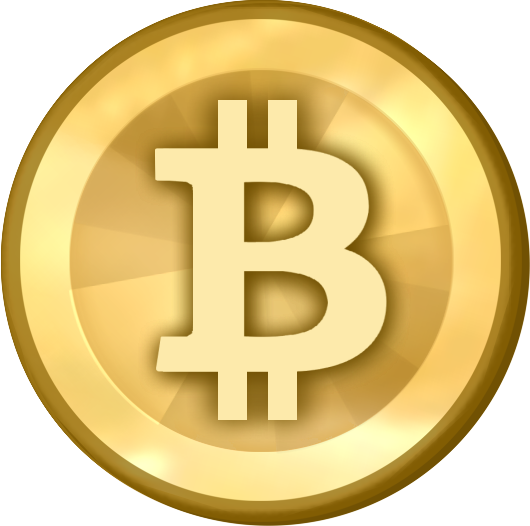
Virtual currencies acting exclusively on the Internet are more risk, which get new "depositors" much faster than those currencies that circulate locally. The most famous online package that can be paid for real goods and services on the network is Bitcoin (BTC). Even charitable organizations accept these virtual money, since Bitcoin can be purchased and sold on the exchange: many online traders exchange it even for rubles, not to mention dollars or euros.
The time spent on this or that work is equalized by the work of all people, regardless of qualifications, so the repair of a bicycle, walking the dog and the design of the site can be the same. This idea is not new. Long before, in the "capital" of Karl Marx, passages appeared that the cost of human labor is a measure of assessing the value of goods, this was written by the English philosopher and socialist Robert Owen, whose ideas picked up
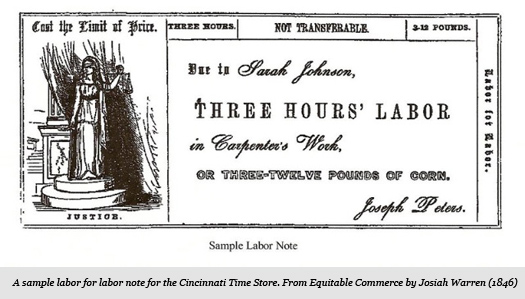
The ideas of Warren also inspired members of one of the many British public organizations that collaborates with volunteers. The time spent on the aid of housework at home, to give a lecture for sick adolescents or people with mental illness, can be presented free of charge. In exchange, volunteers (as a rule, these are young people) receive the necessary practice, without which it is very difficult to find a workplace.
Volunteering and solidarity underlie the ideas of the German architect and economist Margrit Kennedy, who wrote several books on an alternative economy. Kennedy herself lives in a small environmental
Reference: The Swedish Bank Jak Medlemsbank is a cooperative. JAK is an abbreviation from the Jord Arbete Kapital, or "Land and Labor Capital". According to 2008, the number of bank members was about 36 thousand people. All of them are owners who determine the policy and work of this financial institution. All the bank’s work is conducted outside the financial markets, therefore, in order to become a member, you need to make your savings. These funds are used to issue interest -free loans (only the amount to cover administrative expenses is charged from debtors). The bank members accumulated 97 million euros in 2008, of which 86 million were issued as loans.
Margrit Kennedy admits that at the moment the changes offered to her in Germany are contrary to the current legislation, but she believes that, if the necessary reforms are carried out, this would allow to issue interest -free loans. In his books, the German architect and economist proposes the introduction of regional currencies that would circulate along with the official currency of a particular state or monetary union. In her opinion, these funds would help to develop specific regions. Kennedy also proposes to introduce alternative currencies in the field of health and education. She claims that even central banks would not resist this, since in the case of a collapse of the main financial system, alternative systems would help people not lose their savings. In her opinion, the current system of interest with money always leads to a financial collapse: “Different forms of insurance and securities are depreciated. And this continues for the past five thousand years. Therefore, you have to forgive debts - there is no other way out - and it has been done all over again. This was done even in ancient Rome. And in the history of Argentina there was a case when the sand was depreciated by fifteen thousand citizens Buenos Aires alternative currency system spread throughout the country and helped to survive eight million people in a crisis situation. " Margrit Kennedy in his books offers other options for reforming the modern economic system. Some she draws from real life. In Brazil, for example, a special tax was introduced for the needs of education. 40 percent of the population of this country is under 15 years old, and the Brazilian government came to the conclusion that it cannot create and, most importantly, to finance a system that would give all representatives of this younger generation a good education. The solution was found during the privatization of the mobile network: from each telephone account, one percent was expelled to the special educational fund. During the year, it was possible to raise 1 billion dollars at the disposal of the Ministry of Education. How to dispose of this money was invented by economists who proposed introducing a special "educational currency" - in the form of vouchers. Vouchers would be issued to schoolchildren of primary schools, and they could pay them for additional lessons that high school students would give them. The chain led to the very top, to students of higher educational institutions, and students would spend the proceeds on educational needs. This idea, unfortunately, was not implemented, but this makes us think that if desired, we have the opportunity to create alternative economic relations between people, concludes Margrit Kennedy.