
Translated material
Will there be a free Wi-Fi in the Moscow Metro?
The nets spread
Will there be a free Wi-Fi in the Moscow Metro?
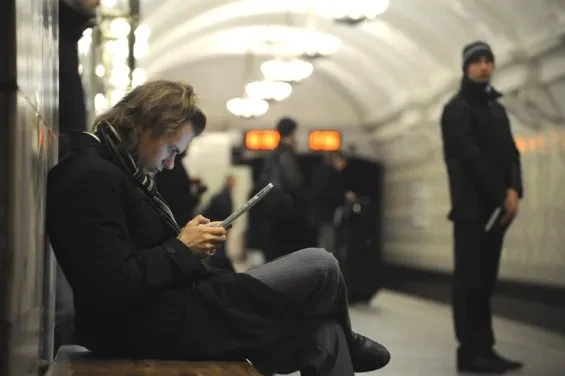
February began with a few unexpected news: the competition for creating a free Wi-Fi network in the Moscow subway failed due to the lack of applications. Representatives of the "Big Three" considered the conditions "economically unattractive." Later, a representative of the Moscow authorities said that the competition would take place anyway, because “no one has removed this task from us,” and the conditions are finalized in negotiations with operators. And it seems that none of the persons involved guessed to raise the question from this angle: and the operators of traditional cellular networks why all this is needed?
Imagine a crossing across the river. On it are “sitting” three competing carriers with boats and cut money from citizens who wanted to get to the opposite shore. And then representatives of the local administration come and are trying to force the same carriers to throw up and build a public bridge, which can be crossed quickly and free of charge. And then everyone around is surprised why this is not one of the carriers expressed a hot desire to participate in the project?
It is not for me that a comparison of free Wi-FIS networks by creating a public road network. It is clear that such construction is beneficial to everyone in general and to anyone separately, because you can’t cover the whole country with paid roads, and indirect profits will go to the wrong pocket from which the construction was financed. And the main driving force of road construction will then be the society itself in the person of authorities at different levels. They know this even in the USA, where they try to perform any event through individuals to the maximum and resort to the direct participation of the state with great reluctance.
If you return to a free Wi-Fi cover, then the main sponsor and initiator of this case in the United States is the municipal authorities, who at the same time have to overcome the resistance of traditional communication operators. In the 2000s, a discussion even flared up in the US courts, whether the municipality can be considered a “person” in the legislation on the connection and whether the state’s invasion of this market is a violation of the competition on competition. At the same time, part of the states nevertheless banned municipal networks, in the rest, far from all widely advertised projects are successful-so, in San Francisco, Earthlink, the main contractor of the ambitious project to cover the entire city of the Wi-Fi Pretense, left the project back in 2007 due to the fact that the investments were required more planned.
But in the same United States, a mechanism has developed itself in the involvement of private companies in building such networks: for example, Google is working on its main income from contextual advertising, that is, ultimately from how many users, having entered the Internet, they click in its search, occupying a leading place in the world. Apple is input from the sale of tablets and smartphones, that is, it is also extremely interested in the availability of Internet services. Microsoft Noperate entered the same row, buying a telephone Internet service Skype a couple of years ago. And if someone thinks that the reasons for the ban on Skype in countries such as China or Belarusian are exclusively political in nature, then he is mistaken: undoubtedly the main driving force of restrictions was the desire to protect their own communications operators from the competition, that is, to protect the area that is traditionally controlled by the state in these countries.
Therefore, in the United States, free Wi-Fi-Fi-building networks and finance not only municipalities. The same Googlev, the beginning of the year, opened such a network in the New York area-Chelsea and has long been trying to take part in other projects: in San Francisco, Philadelphia, in Florida. As for Russia, the representative of the Ait company Andrei Sinyachenko in the newspaper Vzglyad expressed the idea that “we have no one to benefit from the introduction of free Wi-Fi,” and I will allow myself to disagree with him. Otherwise, it is not clear why, for example, Mail.Ru recently nominated such a project, in cooperation with the company “Taska”, which announced the creation of 500 access points in Moscow as part of the ICQ Wi-Fi Free network. Since 2004, there has been a Yandex.Wi-Fi project, which is called the largest network of free wireless access points in Russia. About those for whom the proposal of a free Wi-Fi application has become just a way to increase the attractiveness of the main business-cafes, hotels or stations, you can not talk.
But of course, in order for the service to become mass and familiar, all this is not enough. For communication operators, this service is clearly disadvantageous: so, at the end of 2011, I discovered that according to the frequency fees approved by Roskomnadzor, the Moscow Wi-Fi network will cost him 800 million rubles annually, although income from it is much lower. Nothing will change and as a result of a revision of the payment procedure for the license undertaken by the Ministry of Communications after the performance of Dmitry Medvedev, who reproached the industry in low quality of services: for the provision of mobile communications, operators will pay for the fact of using the frequency band, and for Wi-Fi and Wi-Max, for each installed base station. As a result, the quality of mobile communications, according to the plan of officials, should increase, since operators will be able to install as many basic stations without additional payments as it is necessary to completely destroy blind areas. But on the Wi-Fi network, the reform will not have any influence, and in conditions when free services of such direct income are not brought, this will at least leave them within the framework of pure charity.
So it may be, Moscow officials who set out to “finalize the conditions in negotiations with operators”, were simply not addressed there?
The trouble is that the specifics of the legislation will not allow Internet companies that do not have a license in the field of communication, directly entering this market. Moreover, in domestic legislation, another characteristic hole was discovered, which is mentioned by the same Andrei Sinyachenko. Like copyright legislation, where free licenses are not able to squeeze in any way, the law on communication completely ignores the fact that someone can provide services for free. It turns out that the rental of external channels falls under the actions of the regulator, and the operator of the free network itself is generally not clear what norms must be guided.
But no one was going to forget one norm: of course, free, uncontrolled (that is, truly anonymous) access to the network from any place is a nightmare for all special services of the world, and for ours in particular. On February 7, at the “Safe Internet forum” on the background of optimistic reports about the truly gigantic work done by the consequences of a poorly produced law The topic that the notorious anonymity of users really prevents everyone from controlling the Internet space, has been about the “black lists”, somehow the second plan. Even in the rather fictitious form in which this anonymity is now present, when a person’s network is often easier to calculate than in a “ordinary” life.
And access through free wireless networks can not exacerbate this problem to extreme - if in the hotels you can, in principle, register everyone who wants to connect, then this is already problematic in McDonald's, and in the subway it is completely excluded. And representatives of power structures were not without reason raised this topic in their speeches: it seems that in public places we will have a “white” Internet, cleared of all illegal and obsceneity. But this could even be welcomed, the other side of the same business is alarming. It is difficult to doubt that there will be something in the Moscow metro metro, but just as it were, the need to register a passport was not attached to him simultaneously with the purchase of a ticket. And judging by the general mood of our authorities, it is to such a finale that everything moves.