
Translated material
Left of his own free will
Why Pope announced the renunciation of the throne
On February 11, a bomb exploded in the Vatican: the Pope Benedict XVI announced a voluntary renunciation of the throne - a decision that has not been analogues for the past 600 years. The conclave for the election of a new dad will gather no earlier than March 15. In the meantime, the question hung in the air with all its acuteness: why did he do this? The New Times sorted out possible motives
The preparation of the material was attended by: Alexey Bukalov, Vatican
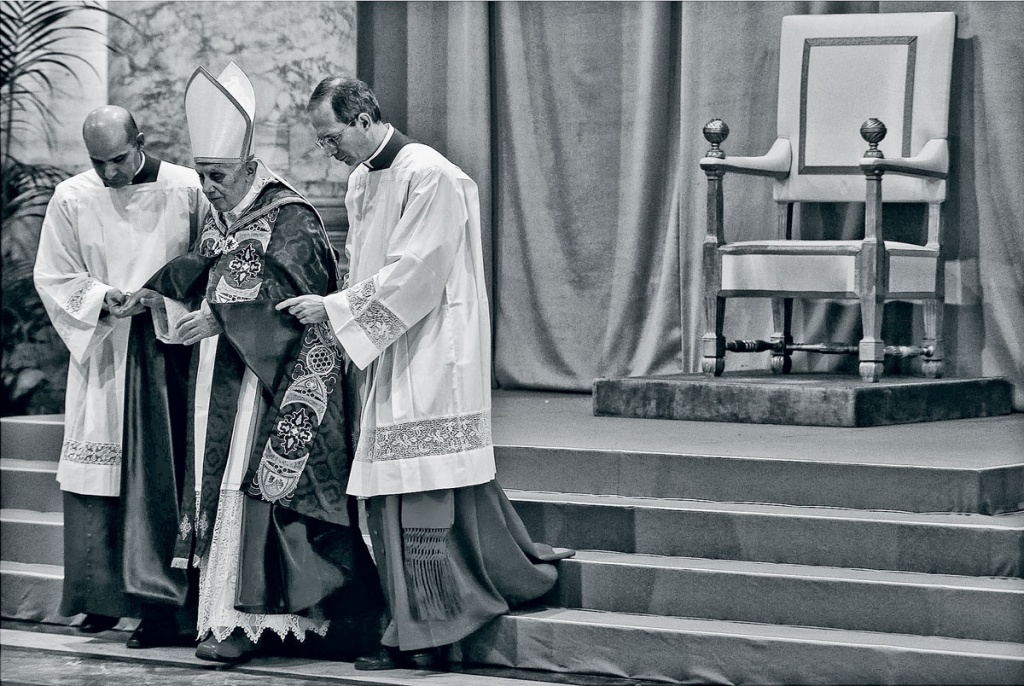
February 13. Papa Benedict XVI before the last Messa in the Basilica of St. Peter
Outwardly, everything looked calm and everyday. At noon, at the end of the routine ceremony of the consistory (session of the Cardinal College. - The New Times) in the Apostolic Palace Joseph Ratzinger in a calm measured voice said in Latin: “I called you to this consistory not only for the sake of three canonizations, but also to inform you of the decision of great importance to the church’s life. Having repeatedly experienced my conscience before God, I came to confidence that my strength, due to advanced age, is no longer enough for the proper fulfillment of St. Peter's ministry ... Therefore, well understanding the seriousness of this act, I say with complete freedom that I refuse to serve the Roman bishop, the successor of St. Peter, entrusted to me by the cardinals on April 19, 2005, so since February 28, 2013, with, with February 28, 2013. 20 hours, the Roman department, the throne of St. Peter, will be vacant ... "
Dad, who entered the latest history of the Vatican as one of the most implacable conservatives, made an extreme, even revolutionary gesture. Many Catholics read in him a call for changes and evidence of love for the church. Moreover, against this background, the harsh criticism from the mouth of Cardinal Stanislav Dzivish, Archbishop Krakow, who remembered the predecessor of Ratzinger: “Papa Voitil decided to stay on the papal throne until the end of his days, because he believed that“ they did not leave the cross. ” It turns out that the bodies inherent in the Polish pope, both in health and in illness, his German successor contrasted fragile bashfulness.
Of course, Ratzinger is right: “In the modern world, subject to rapid changes and exciting issues of great importance,” needs not only moral, but also physical energy to “control the boat of St. Peter”. Of course, age - 86 years - makes itself felt: three months ago, the holy father was replaced by a pacemaker. But - Benedict XVI is not sick. Therefore, much more complex reasons pushed him to an unprecedented renunciation of absolute power over the institute, for two thousand years of which only six more dads left the throne during his lifetime.
The foresight of reforms?
In fact, Ratzinger's gesture changes the history of the church. “I don’t know what the consequences for the doctrine will be, but the departure of the pope has become the spark from which the fire of the Roman Curia reform can flare up, and it is inevitable,” the bishop, who worked for many years in the State Secretariat of the Vatican, noted in a conversation with The New Times. And he added: - Undoubtedly, Ratzinger made a choice, whose spiritual arguments are unknown, but this step will affect the political structure of the Vatican. It requires an update - to leave behind friction, conspiracies and scandals of recent years. ”
A high -ranking prelate knows firsthand how the Secretary of State works - the department of Cardinal Tarchizio Burton, one of the most powerful people in the Vatican, whom many called the “real dad”. Recently, rumors multiplied: Berton, loving power for the sake of power itself, in some ways crushed a soft and shy dad, who preferred the Pauls of Theology to palace.
“Perhaps Ratzinger granted excessive freedom of action to those who were destroyed by“ church careerism, ”which he himself condemned,” the interlocutor of the magazine continues. According to him, "someone (surrounded by dad) took positions and high-ranking chairs that were not intended for him, and someone began to counteract these ambitions with all possible means." Now Ratzinger’s departure “Relieved the score and ruined the holiday for those who wanted to continue to refuel”, concluded Prolate.
However, it is so well known: in 2013, the Papal State and, in general, the Roman Catholic Church entered in a protracted systemic crisis. The war between the groups, with all the tricks, conspiracies and a double game came out in all its glory thanks to the Vatileaks scandal that flared up in early 2012 (see The NEW Times No. 7 of 02.27.2012). The papers leaked outside the office of George Gensvain - the archbishop and the old personal secretary of Benedict XVI - due to the fault of the valet of Pope Paolo Gabriele, who dragged the paper chef with a “confidential” chief, showed the whole world that “mud”, against which Ratcienger rebelled, still cardinal. In essence, Ratzinger from the very beginning was not easy on the throne. His predecessor John Paul II from many problems saved popularity, Slavic charisma and personal charm. The German Ratzinger, who was 78 at the time of the election (at the age of 80) and who was largely considered as an “intermediate figure”, failed to escape from the “palace wars”. Starting with the sudden and unexpected removal of Monsignor, Carlo Maria Vigano, whom the Holy Father appointed in 2009 to a leading position in the central apparatus of the Vatican, where he controlled contracts, repair work and deliveries. Vigano had a reputation for one of the main fighters with corruption and moral unscrupulousness in the Vatican apparatus, about which he notified the dad in his official correspondence. In September 2012, Vigano was unexpectedly sent-against his will-away from the Vatican-to Washington to the post of apostolic nuncio. To whom did the actions of the archbishop annoyed? Whose vices and damage could they expose? It is known that Vigano, among others, accused the head of the Vatican Bank of Ettore Gottie Tedeski of corruption. However, indirectly his accusations were directed against Tarchizio Berton.
Once by Berton, Secretary of State was a favorite of the pope-he set him next to him when, being a prefect, he headed the Congregation of the Vera doctrine, and then appointed him the head of the oldest and most important department of the Roman curia. Subsequently, Berton repeatedly resigned under pressure from scandals. Benedict XVI has not been dissatisfied with the behavior of his Secretary of State more than once or twice. Nevertheless, each time he refused to deprive Berton of his power. Why? “Having done this, he would give in to a hostile group, thereby putting the church in a weak and vulnerable position,” explains the prelate, the interlocutor of the magazine.
The ill -fated safe
| *On February 15, German lawyer Ernst von Freiberg ** was appointed by the new head of the Vatican bank in 1982. In 1982, the head of the bank Roberto Kalvi was found under the bridge in London, and in 1987 the Roman prosecutor's office issued an arrest warrant of the then head of the Archbishop of Martsinkus. |
In the Vatican intrigue, a muddy backstage struggle, frontality and personal envy, the same Bank of the Vatican plays a key role, the official name of which is the Institute of Religious Affairs (IOR), created in 1942 to manage assets belonging to religious associations. Ior is the safe of the Holy See. After the scandalous resignation in May 2012, the banker Gottie Tedeski safe was left without the owner*.
The Vatican, which is not a member of the European Union, never shone with financial transparency and for a long time remained immune to international standards regarding the confrontation of offshore zones and the illegal circulation of capital. So far from the fact that scandals flashed around the ior for decades. In the 1980s, Ior was involved in the scandal around the bursting Banco Ambrosiano **. In 2009, the investigators of the Italian prosecutor’s office were interested in several accounts opened by the largest bank of Italy-Unicredit: € 60 million passed through them. In 2010, the Rome prosecutor's office confiscated € 23 million from the Vatican Bank, suspecting it to wash money. But this did not shook the positions of the Holy See: the Vatican still does not intend to report to anyone to report for his financial transactions. But why is the question. Either the Roman Catholic Church thus defends its sovereignty, enshrined in the 1929 Lateran agreements, or it really has something to hide.
Meanwhile, in January 2013, a new scandal flared up - around Monte Dei Paschi di Siena. As it turned out, after four current accounts opened to the Ior, part of the money received as a result of a dubious transaction, during which the Siena bank bought Banco Antonveneta, could be transferred. The ends, as always, went into the water ...
And then the resignation broke out. What was it? Many heard: the conservative Ratzinger, a supporter of the return of the Mass in Latin and the gloomy defender of the purity of the doctrine, shouted: “Enough!” He shouted to those who twisted intrigues around him for years and scroll through the money. "Enough! It's time to change everything ” - this was not the true meaning of his shocking gesture. Dad sacrificed himself, but not in order to wash his hands, but for the sake of the reform of the whole Curia. Indeed, with the departure of the pontiff, the entire Vatican elite automatically changes, including Berton.
Late for 200 years
Only scandals and conspiracies behind the walls of the city-state prompted the dad to leave? Of course not. Undoubtedly, moral challenges played their role in this decision, with the answer to which the modern church was “late for 200 years”, as Cardinal Maria Martini said several months ago in a dying interview, bioetics, recognition of civilian and, above all, the same-sex marriages, the assumption to church sacraments of divorced people, a vow of heel, women-priests. All these issues got out of the control of the Vatican, which, in the words of Benedict XVI, was remote from the "quick" course of the world. And here we need a dad who will be younger and closer to the secular world, while Joseph Ratzinger of thorny reality has always preferred books and theological thoughts.
Change of Vathican milestones: how it will be
Pope Benedict XVI will remain on the throne until 20.00 Italian time on February 28. Then, as a former pope (an expression that in itself throws into a trembling), he will shut up in the Mother Eclese monastery inside the Vatican. And in March, 117 cardinals, locked in the Sistine Chapel, will have to choose a new successor to St. Peter. And only a few hundred meters from them will be a former pontiff, absorbed in prayer and guarded by sisters: Ratzinger himself cannot take part in the Conclave, because formally he is no longer a cardinal, moreover, he has been overcome for more than eighty years - the age threshold has already been overcome. But can he indirectly affect its results?
To choose a new dad, you need two -thirds of the votes of the college of the cardinals, which will lead the same Tarchizio Berton as Camerlengo - the Locumines of the Holy See. If, after 34 votes over the Sistine Chapel, the white club of smoke still does not rise - as a sign of the election of the pope, the second round will be held between the two candidates who gained the maximum number of votes. But in order to be chosen, one of them will still have to gain a qualified majority of votes.
Many people hope for the election of African or South American pope: Africa leads among the lands of the Earth in the number of Catholics: in Europe there are only 200 million out of 1.2 billion around the world. However, in the Conclave, the dominant position is occupied by European cardinals (60 out of 117), 28 among them are Italians. The main question: will the cardinals of the Apennine Peninsula be able to overcome internal conflicts in order to reach the consent of a single candidate and return to the throne of St. Peter the Italian after a thirty -five -year break? Or will the church finally be ready for the dad who came from afar and who will be easier to change the atmosphere in the palaces of the Vatican?
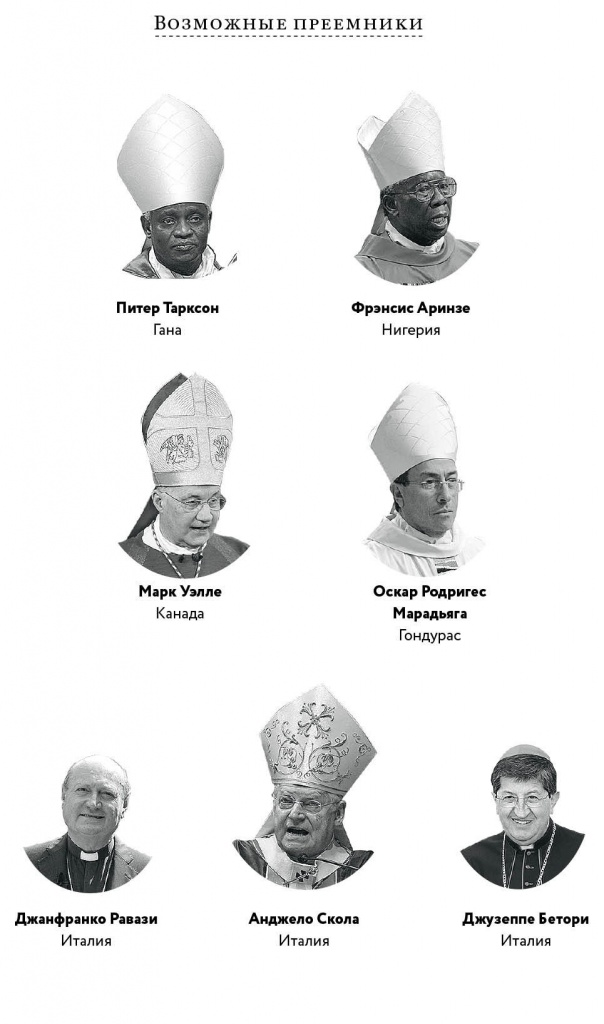
Among the favorites are the names of the cardinal from Ghana Peter Tarkson, Nigerian Francis Arrinsis, Canadian Mark Welle and Hondurazets Oscar Rodriguez Maradyaga. The Italians also have great chances: Gianfranko Ravazi, Angelo Scholy and Giuseppe Concrete. The problem is that the logic of the dad’s election remains in many ways mysterious and uncertain and there is little prognosis.
Photos: AP Photo, Reuters