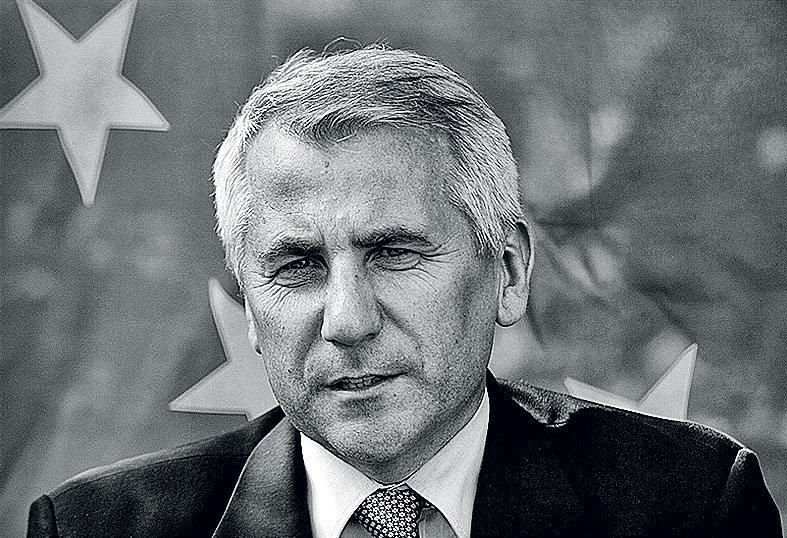
The new representative of the European Union in Russia was appointed ex-head of the Lithuanian Foreign Ministry, Vigaudas Ushaskas. Kremlin “punished” his country “punished” the highest gas in Europe. What Lithuania answered and what is happening there today - Russian opposition politician shares fresh impressions
“Do you want to go to the store? You will buy yourself a good inexpensive plaid, ”the taxi driver instructs on the road from the airport. “Otherwise, you will replace it at night.” Here you are not Russia, we have a warmth expensive. ”
In Vilnius there was a cold winter: with a wet Baltic climate, 13-15 degrees of frost - almost a natural disaster. Heating in houses is very weak, and people are saved as they can.
Gas disputes
*Lithuania pays 1578 litas (€ 457) for 1000 cubic meters - this is the highest tariff for the country - EU member.
Heat is really expensive here even by European standards. Lithuania pays an average of 15–20 % more expensive for Russian gas than neighboring Latvia and Estonia*. Local politicians, when you start a conversation with them about such a high cost, refer to a “historical hostility” in relations between official Moscow and Vilnius. But there is a simpler explanation: in May 2012, Lithuania started the restructuring of her gas farm in accordance with the EU energy chart, which prescribes the diversification of gas distribution ( the so-called “third EU Energy Power”.-The New Times ). And then Gazprom once again raised the price of gas, simultaneously accusing Lithuania of violating the basic agreements.
In early October last year, Vilnius filed a lawsuit in Stockholm arbitration for € 1.5 billion - it was the amount of Vilnius, Lithuania overpaid Gazprom for gas over the past eight years. But while the court is the case, you have to fork out - Gazprom has not yet been found a serious alternative to the Gazprom **.
** After the elections in Lithuania in October 2012, in which the opposition won, Moscow sent Vilnius a signal of readiness to settle a gas dispute. At the beginning of the year, a meeting was held by the deputy chairman of Gazprom Alexander Medvedev with Lithuania Energy Minister Yaroslav Neverovich.
One way or another, all Lithuanian politicians converge in one thing: gas expenses are too heavy on the national budget - every year the government hardly makes ends meet, finishing up the national budget.
| | | --- | | | | At an external temperature of –20 °, a resident of Vilnius Vitas Ratkeavichus, like many others, is saved by wood heating |
Worse than the neighbors
In terms of living standards, Lithuania lags behind its Baltic neighbors, not to mention the countries of Central Europe. In 2009, the republic extremely experienced the global economic crisis, having lost almost 15 % of GDP. Only significant financial injections of the European Union reanimate the economy. “We live worse than all neighbors, although we work no worse and even more conscientiously than some of them, we master the EU subsidies,” said one deputy of the Sejm, asking not to indicate his name. But he also agrees: in the pit in which the country ended up in 2009, when the main segments of the market fell by 20–40 %, the massive help of Brussels was the issue of the life and death of the national budget.
Lithuania did not fully recover from the shock. Today, the average salary in Lithuania is about € 630, almost a third less than, for example, in Estonia. Elderly people also do not burn: pensions barely reach € 230. At the same time, public utilities eat approximately a third of the citizen's monthly income with the usual level of earnings.
It was especially difficult for the Lithuanians in 2010, when unemployment increased sharply after the crisis, covering almost 18 % of the able -bodied population. In recent years, its level has been reduced sequentially, but still exceeds the average European EU indicator. (As of the end of 2012, 9.6 %. - The New Times.) Increasingly, citizens pack their suitcases and seek a better life abroad, the benefit of the borders with Europe are open. Over the years of independence, the population of small Lithuania has declined by almost 7 %*.
* According to the last census conducted in May 2011, a little more than 3.05 million people live in Lithuania, while in 1990-almost 3.6 million.
In many respects, due to a difficult economic situation, the current government declares a course to mitigate relations with Russia. The coalition of four parties that won the October elections, led by Social Democrats, is trying to build a pragmatic dialogue with the Kremlin, abandoning political rhetoric and focusing on economic interests. “Lithuanian-Russian relations need“ rebooting ”. We must not look into the past, but into the future, ”the Prime Minister Algirdas Butkevichus proclaimed as soon as he took office. In particular, he promised to find a compromise with Moscow regarding the Lithuanian compensation requirements over the years of the Soviet occupation - this Demarch Vilnius causes special irritation in the Kremlin.
Social Democrats are trying to inspire society: “pragmatic loyalty” against Russia will turn into a mass of economic benefits for Lithuania, including a decrease in gas prices, the resumption of operation of the Druzhba oil pipeline **, the growth of the interest of Russian carriers in the port in Klaipeda. The opponents of the authorities, however, met these promises with skepticism - the foreign policy ambitions of the government are built from scratch, they say.
* * The supply of Russian oil to Lithuania for the Druzhba oil pipeline was discontinued in August 2006 due to the accident in one of the sites. However, experts consider this a formal reason, but the real is the refusal of Lithuania to transfer to the control of Moscow NPZ MAZEIKIU NAFTA.
“Well, what kind of“ reboot ”can we have (with Russia)? - One of the opposition deputies is burning on the sidelines of the parliament. - The Americans also wanted to “reboot”, but it all ended with “overload” and a new exacerbation. You can’t flirt with Putin, he perceives it as weakness. ”
Soft war
Of course, of course, not from a good life, “rebooting” in the government. As an alternative to Russian gas, the authorities consider atomic energy. But in the conditions of a political system, accustomed to reckoning with public opinion, there is little power “Wishlist” alone: the prospect of building nuclear power plants in Wisaginas causes dissatisfaction with the population, almost 65 % of citizens spoke out against this idea in a recent referendum.
However, even if the society supported this project, the search for investments on its implementation would take a lot of time. So far, the issue of dismantling the Ignalin NPP, closed and mothballed in 2009 has not yet been resolved. Vilnius does not have his money, and the European Union is ready to allocate only part of the funds necessary for the completion of work. In addition, ecologists who sharply criticize the very idea of developing atomic energy in the republic have intensified in Lithuania. Representatives of the conservative camp, however, suspect that this criticism is generously paid by the Russian embassy.
In general, the Kremlin’s policy in the Baltic countries is annoying both local opposition and the establishment - they are all concerned about the “soft information war”, which means propaganda aimed at criticizing the European Union and inciting nostalgia for the USSR.
One of the city officials told the author about the demonstrative neglect of Lithuania by the Russian embassy, which staged a noisy celebration of the old New Year in Vilnius on January 13, on the day of the national trawl on Lithuania’s independence defenders in 1991. “No one asks them to tie black ribbons on the flags. But could it be at least without firework? " He says.
"
The Vilnius official says that the Russian embassy arranged a noisy celebration of the old New Year in Vilnius on January 13, on the day of national mourning for Lithuanian Independence Defenders
“However, the Kremlin propaganda does not particularly act on the young generation: the emigration to the west of the continent found the record scale primarily among educated and qualified Lithuanians under the age of 35.“ Are you “Eurovision”? ”Asks the author of Jovit, a student of the Vilnius Art Academy.“ I saw how much Ireland gives us all our points for a long time? Already there. "
But older people, it seems, really nostalgic for Soviet times. An elderly hoppy man in a restaurant, having heard Russian speech, suggested drinking with him "for Putin and for the Russian Empire." I politely refused.
"We will connect"
Despite the caution of the Butkyavichy cabinet, Lithuania still allows itself to attack the Kremlin. In January, the Republican prosecutor’s office after Switzerland blocked the bank accounts of the defendants in the Magnitsky List. According to law enforcement agencies, funds stolen by officials from the Russian budget were divided in the accounts of several companies, after which part of the funds returned to the original account and transferred to the new recipient. The investigation, apparently, will last several months. The Lithuanian deputy of the European Parliament Leonidas Donskis directly urged Europe to show political will and draw up black lists of investigators and judges responsible for the death of the Hermitage Capital lawyer in the Moscow pre -trial detention center.
However, the interlocutors in Vilnius immediately make it clear that Lithuania will not be expected to be expected. “Corruptions from Russia feel here at home, and it is annoying. But we are a small country, dependent on Russian gas, and we will not be the first to climb into the rampage, ”explains an employee of the Lithuanian diplomatic department. However, according to him, "if one of the big players in the European Union begins to seriously raise the" Magnitsky Law ", then we will definitely connect."
But even if we exclude the topic of the “Magnitsky Law”, there were enough reasons for dissatisfaction with Lithuania in the Kremlin. A year ago, an educational seminar was organized in Vilnius, in which Russian opposition and civilian activists took part. The event aroused a lively interest of the Russian special services that organized external observation of its participants and recorded what was happening on hidden video cameras. Later, these shootings were used in the film “Anatomy of Protest” shown on the NTV channel (The New Times wrote about this in No. 35–36 of October 29, 2012 ).
"
"Are you" Eurovision "are you watching? - asks the author of Jovit, a student of the Vilnius Art Academy. - I saw how much the same Ireland gives us when voting? All of ours have long been there "
“I am amazed at all this!” The teacher of the Vilnius Institute of International Relations Vitas Yurkonis, the organizer of that seminar, is indignant about the crafts. “The Russian television created me the image of a special forces-head, which teaches the Russian opposition militants, how to fight the police and seize power. It was flattered, of course, but the seminar was dedicated to the election, and only everyone has it.” The participants of the seminar are nevertheless searches organized by the employees of the Investigative Committee in the framework of the criminal case on the preparation of riots in Russia.
At the same time, Lithuania became a haven for Russian public organizations working on foreign grants. After they were declared “foreign agents” in accordance with the new Law on NPOs, it became almost impossible to work in Russia.
In particular, Russian employees of Moscow representative offices of the International Republican Institute and the National Democratic Institute moved to Vilnius. In the evenings, they discuss news with colleagues from the Belarusian NGOs in a cafe who moved here from Minsk ten years ago. They have something to talk about ...

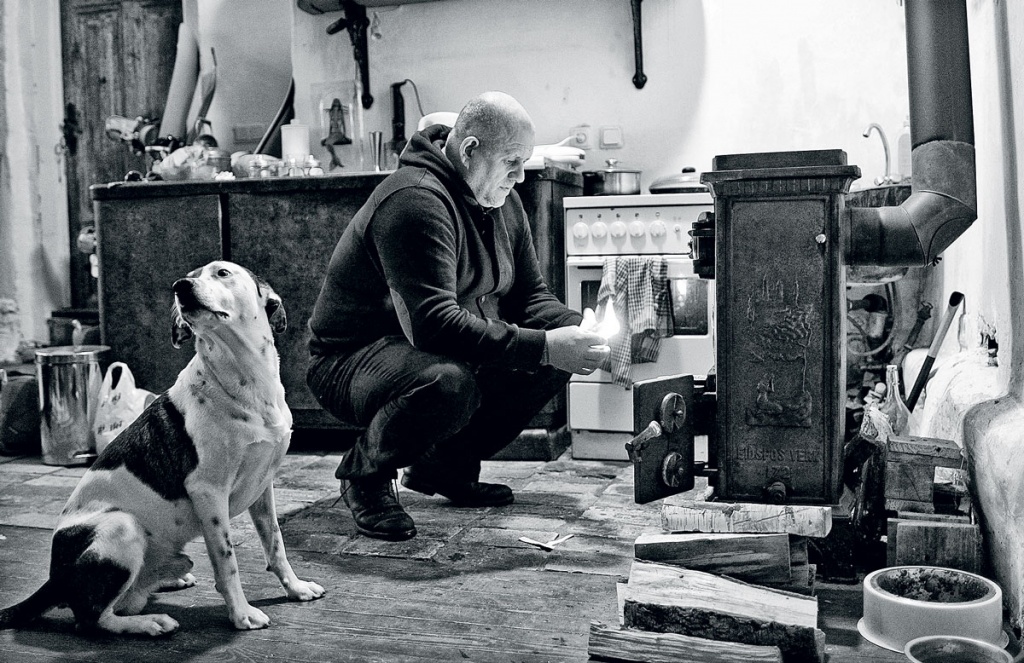 | | At an external temperature of –20 °, a resident of Vilnius Vitas Ratkeavichus, like many others, is saved by wood heating |