
Translated material
Puticians
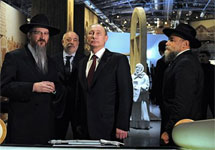
President Vladimir Putin proposed placing Schneerson's library at the Jewish Center for Tolerance in Moscow. Thus, according to the head of state, it will be possible to provide access to the collection to everyone, Interfax reports . At the same time, Putin called the transfer of the US library impossible. “Unfortunately, I can only state that the discussion on this problem has reached such a confrontation plane associated with the adoption of, in my opinion, unlawful decisions in the courts of another country,” he complained.
Schneerson’s library is called a collection of Jewish books and manuscripts, which has been collected from the 18th century. It has about 12 thousand books and 50 thousand rare documents, including 381 manuscripts. During the First World War, when the Lubavichy found themselves in the zone of hostilities, Rabbi Joseph Schneerson transported part of the library to Moscow, where he entrusted its storage to Persitz and Polyakov’s book warehouse. With the advent of the Bolsheviks in Russia, the Schneerson’s meeting was nationalized as the decree of the Council of People's Commissars of November 26, 1918 demanded. About 25 thousand pages of manuscripts were confiscated by the Nazis in Poland, and then captured by the Red Army and transported to Moscow.
Since the late 1980s, the American Hasid community "Khabad Lyubavich" has achieved from the USSR, and then from Russia the return of the collection. According to some reports, the first President of Russia Boris Yeltsin once promised James Baker, Secretary of State in the administration of George Bush Sr., to return the documents sacred to them to Hasidam.
In 2010, the American court ordered Russia to transfer the Schneerson library to the Hasida community, and on January 16, 2013 he decided that Russia should pay a fine of 50 thousand dollars a day for failure to fulfill this verdict.
On the same day, US Secretary of State Hillary Clinton promised to maintain an “honest and fair” resolution of claims regarding art objects plundered during the Second World War. However, she did not comment on the court decision. "The State Department does not express any point of view on any current judicial dispute," she said.
On January 17, the Foreign Ministry expressed indignation by a court decision, calling it "absolutely unlawful and provocative." The verdict itself, demanding to convey Schneerson's library Hasidam, was characterized as "odious." The ministry promised a tough response if sanctions were imposed against Russia. "The Schneerson collection has historically formed in our country, represents the national treasure of the entire Russian people and, as the state property of the Russian Federation, uses jurisdictional immunities," the Foreign Ministry said.
On January 23, the head of the Foreign Ministry of the Foreign Department, Sergei Lavrov, said that Russia intends through the court to seek the return of books transferred to the American Hasids for a while. "The Hasids, by the way, received several books from this library from this library for temporary use for a couple of months even more than 10 years ago. But they have not yet been returned. This should also be done by the subject of the trial," the minister said. Earlier, during a press conference, he noted that Moscow is tuned to the development of relations with the United States and coordination of actions in the international arena, but will continue to respond to unfriendly steps from Washington.
On February 8, the Ministry of Foreign Affairs recommended the Ministry of Culture and the Russian State Library to take actions in court from the US Congress library for seven books from the Schneerson collection. These publications were transferred to the RSB in 1994 for temporary use within the framework of the inter -binding subscription. According to estimates, as a result, the size of the Russian fine may exceed the American.
According to the plan of the Ministry of Foreign Affairs, the RSB will file a lawsuit in the Russian court on the return of books and paying a fine and penalties for violation of the deadlines. In case of non -fulfillment by the American side of the court decision as a security measure, it will be possible to demand the arrest of American state property not protected by immunity. Thus, the Russian answer will be almost symmetrical in relation to US actions.
As explained by the Deputy Director of the RSB, Alexander Samarin, we are talking about seven books in Hebrew. “The books are not unique, but valuable and quite rare. In library practice, it was not accepted to transmit through the inter -binding subscription of the 19th century - it was an act of goodwill,” he said. In 2000, according to him, representatives of the Khasid community proposed the RSB to exchange these books for others. However, the library considered the proposed options unequal and abandoned the exchange.