
Translated material
Bulgarian electric crisis
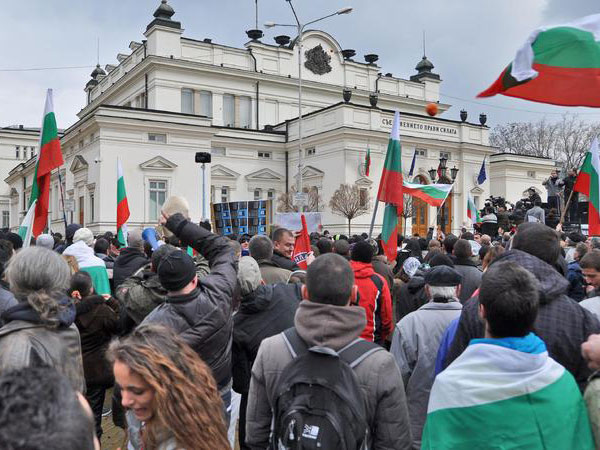
Mass protests that took place in the capital of Bulgaria last days did not initially attract close attention of the foreign press. The rallies began on the streets and squares of the city a week ago, and on February 17, tens of thousands of protesters arrived in Sofia from different cities of the country in order to demand the resignation of the Boyko Borisov government, the leader of the party “Citizens for the European Development of Bulgaria” (coat of arms). No one assumed that their requirement would be fulfilled by the Cabinet of Ministers so quickly.
The catalyst for public discontent was the increase in electricity prices, but, apparently, this fact was only the “last straw” for the country's population, tired of protracted economic stagnation.
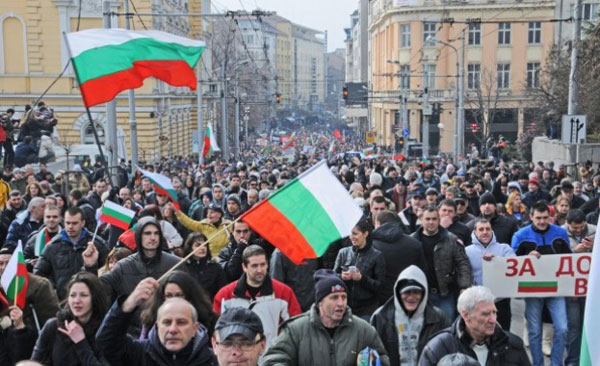 Protests in Sofia. Photo: Cross.bg
On the night of February 19-20, at least 14 protesters were injured in clashes with the police, and 25 participants in the rally were arrested. Protest shares were also held in other cities of Bulgaria. Local media are full of photographs of bloodied demonstrators. In addition, there were reports that in Velikovynovo and Varna two men made acts of self-immolation: one of them died, the other was taken to the hospital With burns 80% of the body.
 Photo: frognews.bg
The situation was aggravated by the fact that on February 18, the country marks the anniversary of the death of Vasil Levski , the hero of the national liberation movement of the 19th century, which for the people became a symbol of the struggle against Turkish rule. Participants in rallies burned receipts to pay for electricity, called for “free Bulgaria” from the power of the “mafia and corrupt officials” and again make the country “holy and free”.
But even against the backdrop of these events, the Bulgarian press calls the resignation of the government unexpected. Prime Minister Boyko Borisov said this decision was made by him in connection with the loss of confidence in the population. “Power is awarded to us by the people, today we return it back. During these four years, we did everything that depended on us. I cannot see the Orlov bridge bloodied. Each drop of blood is a shame for us, ”the prime minister said at a meeting of the parliament, where he came with almost all members of the Cabinet of Ministers. Bulgarian deputies will have to vote on the resignation of the Cabinet of Ministers this Thursday.
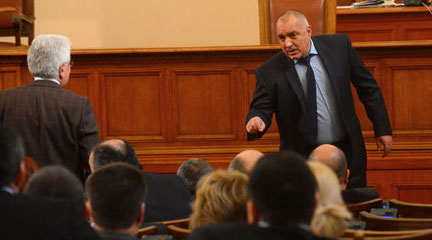 Boyko Borisov. Photo: Julia Lazarova/dnevnik.bg
On February 18, the head of the government probably hoped to solve the problem with “low blood”: he accepted the resignation of Simeon Dyankov - Deputy Prime Minister and Minister of Finance of Bulgaria. Borisov said that the head of the Ministry of Finance did a lot to increase the “financial discipline” of the country, but could not cope with the increase in electricity prices and ensure the proper increase in the welfare of citizens.
In addition, on February 19, the prime minister withdrew the license from the Czech company CEZ, which managed a significant part of the Bulgarian electric networks, and also proposed reducing the tariff by 8%. However, he could not reassure the streets.
The political and economic reforms that have been continuing in Bulgaria since 1989 led to a serious rapprochement between the country with the Western powers: the country entered NATO in 2004 U, and became a member of the European Union in 2007. At the same time, these shifts did not lead to a serious improvement in the economic situation and the growth of the well -being of the population.
Boyko Borisov, a charismatic politician, an athlete, seriously engaged in eastern martial arts, worked as a bodyguard of Todor Zhivkov , General Secretary of the Central Committee of the Bulgarian Communist Party, and Simeon Sakskourggot , the former king (1943-1946) and Prime Minister of Bulgaria (2001-2005). In the government, ex-monarch Borisov held the position of general secretary of the Ministry of Internal Affairs. In 2006, he won the election of the mayor of Sofia and at the same time headed the party "Citizens for the European Development of Bulgaria." In the 2009 elections, the party received most places in parliament and was able to form its own government.
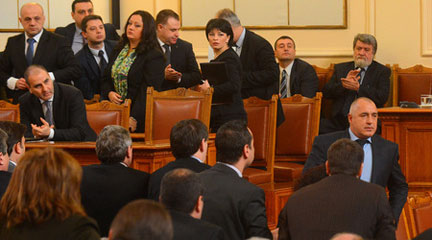 Government resignation. Photo: Julia Lazarova/dnevnik.bg
The coat of arms went to the polls under the slogan of increasing the welfare of the population, criticizing opponents for “lobbying interests” of large business. However, despite the statements of the “stabilization of the economy” of the country, similar charges were soon brought forward to the new prime minister.
Bulgaria to this day remains one of the poorest EU members. GDP growth in 2012 amounted to less than 1 %, although the country's government promised an increase in this indicator at 1.2 %. The purchasing power of the population reaches only 30% of the average European level. The economic state of the country is the main reason that Bulgaria has not yet switched to the euro and continues to use the national currency - Leo.
Experts clearly made it clear that the cause of mass performances of the last ten days is the poverty of the population. So, the former German ambassador to Bulgaria Klaus Shramayer in an interview with Deutsche Welle emphasized that electricity prices were not crucial in the context of recent events. According to him, with minimal external debt, economic growth in the country is extremely slow. In addition, Shramayer criticized Borko Borisov himself, calling him a demagogue, rapidly losing popularity.
I expressed a similar position in an interview The Financial Times and the head of the Bulgarian representative office of the European Council on International Relations Dimitar Bekhev. “A high poverty level is the main cause of protest shares. Electricity accounts are just a catalyst. The emblem, of course, improved the indicators of financial stability thanks to the activities of Dyankov, but Budget revenues are not growing. The people are convinced that the government seeks to observe the interests of oligarchic groups. This determines the explosion of anger, which was supported by representatives of the middle class, owners of small businesses and individual entrepreneurs - the country's GDP ridge, ”he concluded.