
Translated material
Waltz with a bear
"Evgeny Onegin" on the stage of the Vakhtangov Theater
Rimas Tuminas again admitted to the love of Russian classics
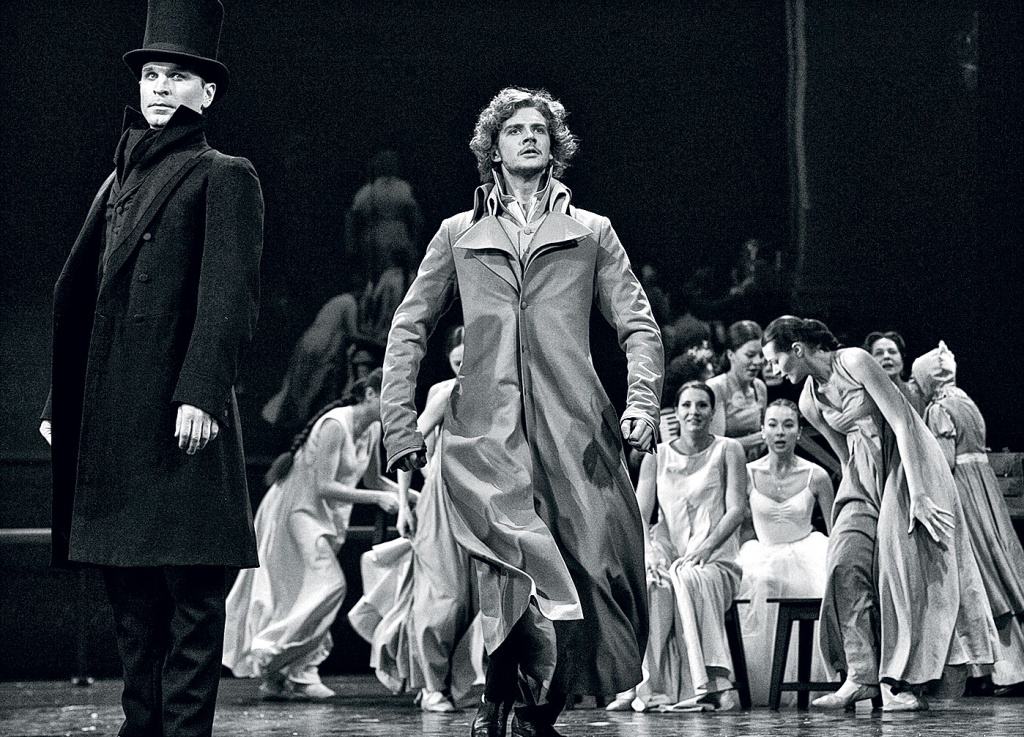
Onegin (Victor Dobronravov) and Lensky (Vasily Simonov): Way to a duel
The melody of the “ancient French song”, known to everyone who in childhood learned to play the piano, turns into a lullaby, then into a bell ringing, then into a bouncing mazurka, then into a crazy tragic waltz. A blizzard will circle under this music, and a carriage with lanterns will be bogged down in the snow, and there will be a ball, and name -it -day, and champagne, and an arrogant young man in a high cylinder and black frock coat will majestically pass along the ballet machine, stepping through the girls falling to his feet.
The performance is similar to a dream, in which the heroes break up into parts and connect again, in which the nightmare is adjacent to sweet erotic dreams, in which a cheerful bunny with a torn ear will cross the road stuck in the snow a carriage, and a scarecrow will be spinning in a waltz with Tatyana Larina. It seems that Tuminas composed his “Onegin” playfully - so many lightness, irony and light sadness in it.
Drafts and sketches
The program is sealed in the envelope, small cards dotted with small Pushkin handwriting, spined by female heads and male profiles fall out of the envelope. When you are looking for the name of the performer - the feeling that you are sorting out the Pushkin drafts, you touch the secret of writing. This extraordinary sense of ownership of the masterpiece does not leave throughout the performance, the performance of the ESCOMS, as if before the final edition of the novel itself, and we only read its sketches.
Here, many characters have not yet gained their real appearance, a whole nature, and the author mentally compares them with his imagination, as if wondering: he? Not the one? Therefore, there are two Onegins - Victor Dobronravov, indifferent, with obvious spiritual failure, not inclined to reflection, and Sergey Makovetsky, broken, devastated, repentant, wise. Two Lenansky - like two profiles on one coin: enthusiastic, flying, victorious (Oleg Makarov) and the other - defenseless, almost incorporeal, with a bad foreboding in the eyes (Vasily Simonov). There is another hero that is not planned by Pushkin - retired hussar, which is given to both the author’s retreats and parts of other people's monologues. And from this polyphony, the main active character is suddenly born, in which the features of Onegin, and Lensky, and Pushkin himself are guessed. Vladimir Vdovichenkov had to be the hardest - collecting his non -existent hero by pieces, like a scattered puzzle. And in the end, his hussar became simply the male core of this performance, the very hero of my novel. Vdovichenkov seems to be playing, arguing the feelings to which the heroes only touch and, burning, run away from them.
Lyudmila Maksakova, who got the roles of a nanny and a dancer, a similar task. Thin, like an arrow, fast and light, in a black transparent ballet pack, with a huge whip in elegant hands - the dance workshop spokes in magnificent French and sets the tone for all the rapid action, turning it into real phantasmagoria.
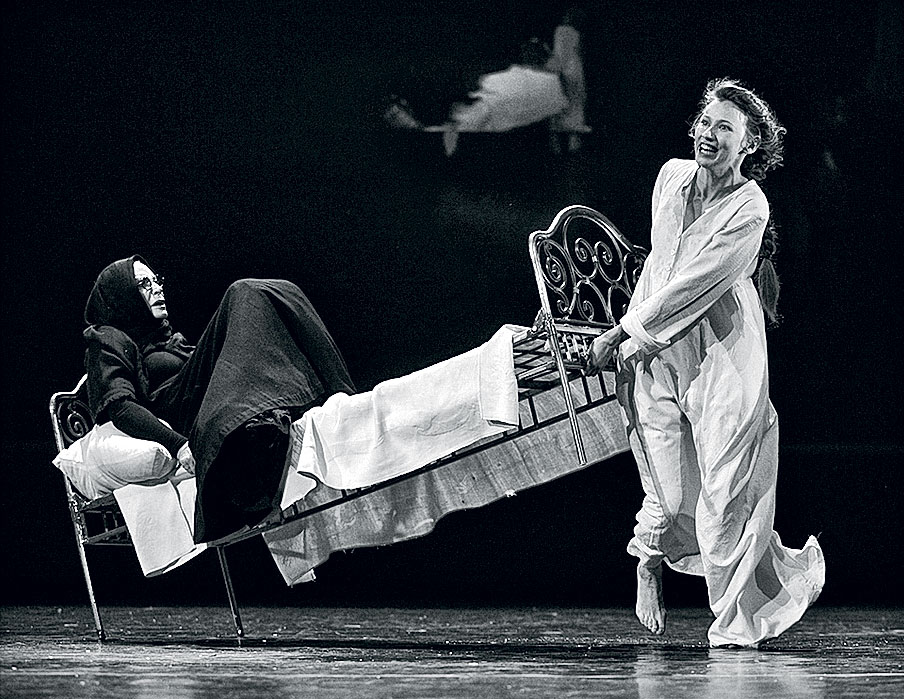
Love not only inspires, but also gives a remarkable force: Tatyana (Wilma Kutavichyut) trusts her feelings Nanny (Lyudmila Maksakova)
Stop, a moment
Despite the fact that Rimas Tuminas, according to the poster, is the author of the idea and the author of the literary composition, and the director, the “Onegin” would not have been possible without years a proven artistic and setting team: artist Adomas Yatsovskis, composer Faustas Latenas, choreographer Angelica Kholina, artist of Maya Shavdatuashvili, author of costumes Maria Danilova.
Adomas Yatsovskis begins his performance before the appearance of the heroes. This is the case when the hall applauds the artist. A huge muddy, tightening with its curved reflections, the mirror on the whole backdrop, in which bizarre figures move, the light of the Epiphany candle is floating ... A ballet machine, along which a Frenchwoman with a whip paces and shouts on a flock of girls who have come down into a flock. Old piano. Old buffet. The bed is the abode of girlish suffering and tears, on which Tatyana is rushing about in love delirium, then falls asleep on the knees of the nanny, then jumps up, struck by a nightmare. The garden shop, where Onegin rejected Tatyana's love, turns into a cross, into a curse and does not let Tatyana let go of herself. So with this bench she rummages throughout the scene, humiliated, broken by humiliation.
Many scenes want to save in memory as beautiful paintings. Here are the girls in white silk Caps hover over the scene on the swing, and one of them, Tatyana, jumps to the ground, like a knocked bird, into the arms of her gray -haired husband. Here is the defenseless thin body of the Dead Lensky freezes under the raging white snow, the naked almost boyish back, a hand hanging along the body, like Christ removed from the cross.
Here the carriage with the Larinsky household was stuck in the snow steppe, the coachman with a gun peels into the darkness and in horror sees a merrily bouncing bunny in a white ballet pack. The bunny sniffs a numb coachman and, in order to finish it off completely, arranges a small striptease, indecently hugging the long muzzle of the gun, and to top it kisses the unfortunate man right on the lips. A long shameless kiss. And heses away, giggling. What was it? Dream?
Only in a dream in Tatyana’s bedroom can a night fairy appear with a thin magic wand in her hands and, peering into the darkness, tighten in a low breast voice: “And Tatyana’s wonderful dream is dreaming ...” The brilliant Julia Borisova performs this monologue as a prayer, and, as if hearing, the heavens respond to her with a unique voice of Smoktunovsky - a great actor enters into a great actor - a great actor enters into a great actor. Dialogue with a great actress.
And in this performance, Tuminas does not part with his favorite old people, for whom he put his previous work “Pier”. Galina Konovalova, an artist, whose age is scary to pronounce, he does not correspond to her mood, appearance and temper, plays a small episode in Onegin - an elderly Moscow cousin of the Larins. And again - ruffles, curls, a huge white bow on a hat, heels and crumbly crystal laughter.
In the play I want to stay, as in a magical dream: a world built by the authors, a nimble, fragile, inaudible - attracts, like a “town in a snuffbox”, like figures from a musical box. It seems that there, in this blizzard, in these flying lines and in this waltz - there is real happiness. Which was so possible ...
Photos: RIA Novosti, ITAR-TASS