
Translated material
"After the crisis, the economy became different"
The head of Deutsche Bank in Russia Pavel Teplukhin - about what happened to investment banks, who paid debts that led to a world financial crisis, and why in the 21st century it was not required for this
| | | --- | | 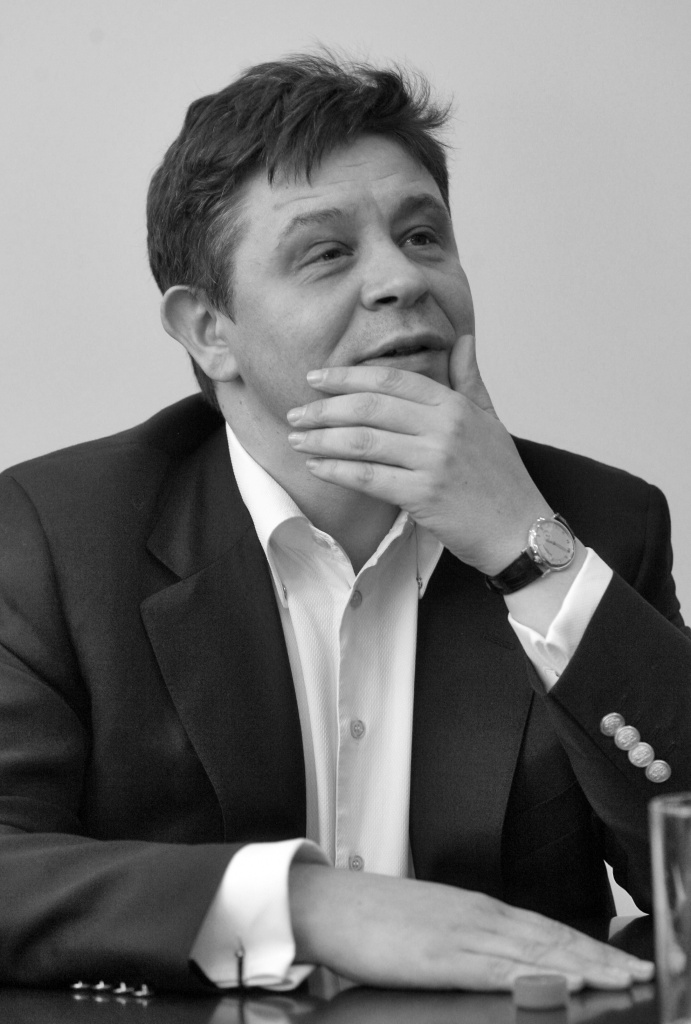 | | A graduate of the Faculty of Economics of Moscow State University and the London School of Economics, the candidate of sciences and economics master Pavel Teplukhin was one of the founding fathers of the Troika Dialogue investment company: now, as Teplukhin claims, such investment institutions have gone into history. |
For almost four years, the word “crisis” dominated the world financial news. In 2008, he thundered: bankruptcy, the collapse of indices, a nightmare and horror. In 2011, the Standard & Poor's first reduces the US sovereign credit rating, economist Nuriel Rubini, who received the title of Prophet for predicting the crisis, promises the collapse of the eurozone. In the first half of 2011, everyone is waiting for W-the second wave of problems and bankruptcy of southern Europe. In 2013, indices and economic growth figures crawled up, Davos is optimistic, Brussels states that the Eurozone was saved, in Germany they stopped talking about a recession. True, the economic statistics of the last month of France are slightly upset, and Rubini scares again, but he is no longer in the headings. Is the crisis ended?
| * Cumulative index of 500 American companies with the largest capitalization |
If you look at the S&P-index* or in general at the American stock index, then the crisis as such is already behind. We are already in historical maximums. If we look at the Russian stock index, then it is still minus 30% of our pre-crisis levels. If you look deeper, then some of our companies still show minus 90%, but others are far in the plus. So everywhere in different ways. But one thing is obvious: after the crisis, the world economy became different. And many business models have gone the past.
What, for example?
My native, traditional, investment-banking business has undergone serious changes. The one that existed before the crisis is no longer. It simply is not like a class either in America or in Russia. Goldman Sachs received a banking license, Bank of America bought Merrill Lynch, Lehman Brothers went bankrupt at the very beginning of the crisis - and these were the pillars in the investment business market. In Russia, exactly the same thing: the Three Dialogue, which was a brokerage office for 20 years, and which I, together with others, was bought by Sberbank, VTB Capital became part of VTB, Renaissance in its previous incarnation, in short, a model of an independent investment bank outside the commercial bank in addition, it is now history.
Why?
A completely different business model arose-CIB: Corporate Investment Banking. Previously, the whole financial world was shared by the types of financial products offered. Separately there were commercial banks, which were usually regulated by central banks. Separately there were investment banks, which, as a rule, were regulated by securities commissions. Separately - the insurance market, separately - the commodity market, which had their own regulators.
After the crisis, they decided: this is wrong, let's arrange the entire financial world by clients. Corporate clients will be separate, and we will offer them all types of services, including a loan, deposits and plus another access to capital markets, and plus another access to commodity markets. Separately, retail banks that will work with a retail client, and they, in turn, offer the entire product line, including the stock market, deposits and loans. Separately, state and infrastructure banks that work exclusively with other banks like a national clearing center, exchange. This is a special class of financial institutions.
The whole financial world has now been cut by the client. Corporate investors have market researchers, analysts, can involve expensive economists in consultations - and, accordingly, evaluate risks. And retail investors do not have this, so they do not need to plug a complex and risky investment product, for them a set of products is limited.
For example, those banks engaged in retail cannot engage in derivatives: secondary papers can only be offered by those banks that work exclusively with corporate clients.
Okay, but it was simply possible to prohibit investment banks to work with retail customers. Why did they completely die?
They have not died, just now they still need a banking balance - that is, the availability of serious capital. Previously, an investment bank or a brokerage office, as a Troika, came to the corporation and said: let's release bonds, that is, you will take money in the market and you feel good - you will have free funds, and we will benefit from the sale of these papers. And the corporations said: Come on! And now they require what is called Bridge-Finance in our language, that is, a temporary loan that will subsequently be converted into bonds. Investment banks did not have such a financial pillow, and commercial banks have or should.
Air wholesale and retail
And what happened to the derivatives market, when one security was produced on another, the third on the second, fourth, fifth, and as a result was a bargaining with air?
I would not describe this market in such black and white colors: they traded not only with air-they traded in quite informative things. A large number of derivatives still remains, only more close attention, new requirements, the new procedure for reserving funds, more stringent rules, more close supervision-what is recorded in Basel III*.
| *"Basel III" - a document of the Basel Committee on Banking Supervision, approved in 2010-2011. The main goal of the Basel III agreement is to improve the quality of risk management in banking, which, in turn, should strengthen the stability of the financial system as a whole. The transition to rules, among which the most important - the sufficiency of banking capital was planned since January 2013, but European countries have not yet been able to agree on the transition procedure. Russian banks, as required by the Central Bank of the Russian Federation, will switch to new rules in October 2013. |
But the banks themselves are no longer eager to engage in derivatives - a continuous headache, costs and risks are high, plus under them you need to reserve large funds. Therefore, many closed these products and thereby released a large number of assets laid for them.
And debts, say, on a secondary mortgage - where did they go?
Something just wrote off-there was air and became air, but only more without packaging. Few people noticed this. The speculators, they lost, it hurts them, but no one loves and does not regret them. Some things have written off because it was real losses, and it will never be restored again. And there is the middle part of these debts, which used to be difficult to pack, now without packaging, but has not gone anywhere. These debts can be seen firstly - for example, in California. I spent several weeks in the Silicon Valley and there I came across a cottage village. I talked with the locals. I ask: there was a crisis, you probably had a mortgage, as now? They answer: “In principle, nothing has changed. Only now we do not pay anything. ” I ask: how is it? They explained to me that they hired a local meticulous lawyer, he rummaged in the documents, and when the bank began to demand to pay on mortgage debts or to free at home, they said to the bank: “We are law -abiding people, we will immediately move, present us with a power of attorney for your authority from the owner. Or let the owner of the house come - we will talk to him. ”
And it turned out: neither the power of attorney from the owner or the owner can predict. Because when mortgages were issued, they were grouped by the bank with several packages, on which a bond was produced literally after 3-4 months. They scored 100 million, saved it, released a bond for $ 100 million. The one who bought this bond has the right to demand a return of collateral, that is, real estate. But after the release of these bonds, new financial designers came, who took the California bond, they added to it the same, but already released on the security of real estate in Texas, then the third, from Alaska, say. They all packed them together, then the packages were defeated by the quality of bonds: this mortgage was just given out - for another 20 years, risky paper - it was placed, say, 12% per annum, and under this bond a mortgage, for which they remained for five years, 15 years were paid regularly - it means that they will pay, we will pay off the bond - here we will give a small percentage, 2 % per annum. At the same time, a special company was created, which bought three bonds for $ 100 million each, and three more bonds were also produced for $ 100 million, but only debts were cut differently there: this bond with an urgency of three years, and this one with an urgency of eight years, and this one with an urgency of 12 years, so we will repap them. Those investors who want to get money faster, they bought a three -year bond, and those who were laid for a fateful period for 12 years. They placed some kind of bonds-which are shorter-to individuals, and some ended up in the Pension Fund, for example, Iceland. Some packages were reinforced by both the third and fourth time, that is, long chains of derivatives were created. It turned out a multi -storey Sentwitch: risky papers - Equity - were cut in one way and wrote off at the first default, the middle part - it is called mezzanine on bank slang - when the second default, and Senior, that is, the least risky papers - they are best protected. Then there was a crisis. And as a result, this house worth $ 2 million, standing on the ocean, is not clear to whom it belongs. Who is the owner? Who exactly? The bank that the first loan gave? He has long sold this loan in the form of a bond. The one who reproached? He also sold it too. Third? Fourth? In short, it is already impossible to trace this chain. And those people who still live in this house, under which they once took a loan of 2 million, say: enough to scare us. The owner will be, let it come up, we will talk with him. No owner? So no one needs it. But no, and goodbye.
That is, they do not pay either a mortgage or for rent? This is brilliant.
Yes, but formally, the house does not belong to them. After all, there is no owner, and they are also not the hosts, they also cannot use it in a number of operations, including laying it again or indicate as an inheritance. But no one forbids them to live in it.
Life of loan
It is known how many money candy wrappers were written off around the world?
I saw calculations - three trillion dollars. True, there is another arithmetic: assets are written off by 3 trillion. But this means that in the liabilities of the aggregate financial balance of the world, someone should delete three trillion. Who are these people?
And who?
Many banks went bankrupt, but in combination, as a rule, small banks went bankrupt. Of course, the speculators went bankrupt. But there are not very many of them in the total mass. I think that the main part of the blow was assumed by the states that took this money (raised taxes, compensated for their financial expenses) from future generations.
But there will be no war
In the XX century, financial crises ended much worse. The crisis of the beginning of the century is the First World War of 1914, the Great Depression of the late 1920s is the Second World War. No, no, yes, someone reminds that in Europe a great war, except for regional conflicts, there was no almost 70 years ...
Yes, but it was a completely different economy, where there was a gold standard or at least a fixed exchange rate between the main world currencies. And in that system there was no developed banking system in the current sense of the word.
And so the war was needed?
And therefore, a war was needed. Because it was necessary to reset the obligations of the state. The state reached the pen, he had to either go bankrupt through the crisis, that is, lose the war, or win the war. The status quo was impossible to support. In the current world, everything is much more elegant. Firstly, the obligations of the state can be stretched in time for 20 years ahead through the banking system, including through bonds, that is, through long-term loans that both individuals and other states buy. The second tool for preserving the status quo is a system of floating exchange courses. Say, you can devalue your currency three times. As happened after two wars described several times in several states: in Brazil, in Argentina, in Russia, now before our eyes in Ukraine. What does the devaluation of your currency mean? This is a zeroing or significant reduction in the external obligations of the state. Of course, this hits its population. But with it you can somehow calculate, including through the tax mechanism. To increase taxes or print more local currency, that is, to introduce an inflation tax that will eat all the obligations of the state to the population in exactly three years - which happened in the Soviet Union, by the way. In order to extinguish bonds in Soviet times, it was just necessary to have inflation, which, in fact, paid for all these bonds. Of course, these methods are unpleasant, but, of course, much better than the world war.
So there will be no war. But miracles are ahead: it will definitely not be boring.