
Translated material
History textbook: True or ideology?
President Putin suggested “thinking” about a single concept of school history textbooks. It seems that the authorities are few judicial persecution of the "disagreements". She intends to eradicate dissent in the heads of the younger generation
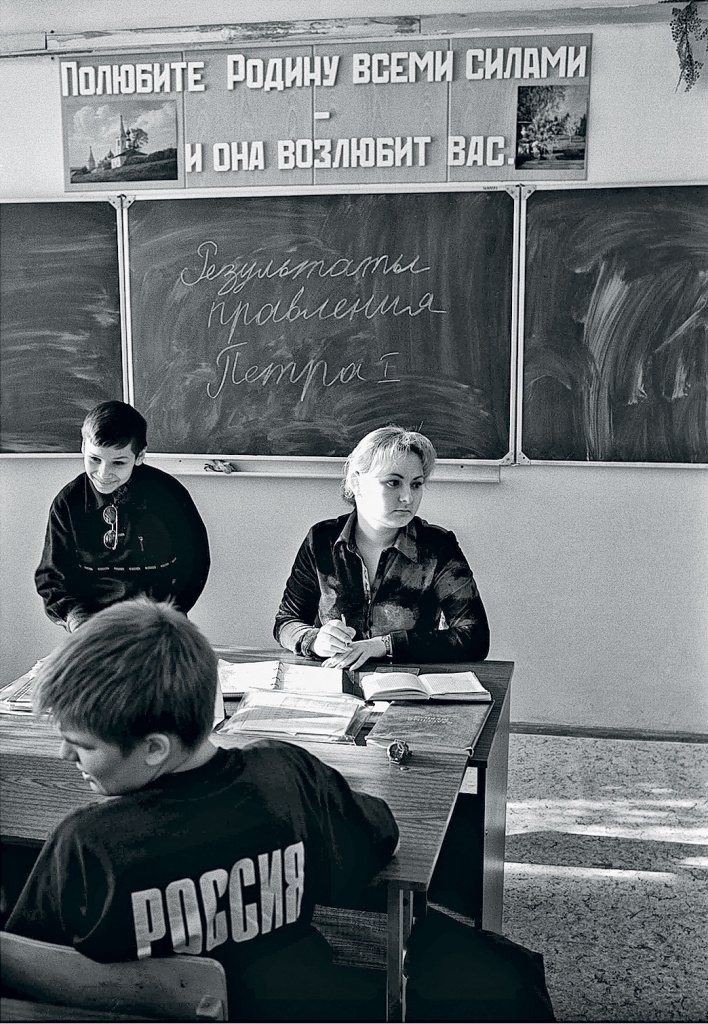
History lesson in Moscow School No. 1907
The statement that a single textbook is needed was made at a meeting of the Presidential Council on Interethnic Relations. Mr. Putin, apparently, is informed that different peoples of Russia have different concepts of history. Say, in Tataria, one idea of the Tatar-Mongolian IS and the accession of Kazan and Astrakhan to Moscow, and in Moscow another. The peoples of the North Caucasus have one assessment of the war between Shamil and the tsarist government, and the Russians have a different one.
Only facts
A single textbook implies one look at the whole past of Russia, starting with Rurik and ending with the Soviet and post -Soviet time. Moreover, Putin does not particularly hide the fact that we are talking not so much about history as about ideology. For example, he says: “If we are within the framework of a single state, we must cherish this and increase this force (that is, the power of a single state. - A.Z.). But this must be done by modern, thin, effective methods. ” So they say about ideology: subtly and effectively put certain ideas in the head.
It is noteworthy that in all this speech, Mr. Putin does not have a single word that there should be historical truth in the history textbook that there should be facts, they should be true and nothing important should be omitted. The absence of the presumption of truth is a characteristic feature of ideology, and this sits tightly in the heads of many of our people, and not even necessarily related to power. I had to hear many times many times: well, say, what to believe in history? And only facts must be believed. Everyone will make estimates on the basis of their moral guidelines.
For example, now we have a large set of facts, which says that Lenin received money from the German General Staff. Documents are published, books were written, there was no doubt left on this subject. This is a fact - it means that it should be in the textbook. Is it good that the future head of state made a revolution for German money, or badly is a question that the teacher can discuss with students.
Or, suppose, the Katyn murder. An absolutely indisputable fact confirmed by a mass of documents already transferred to the Polish side: Polish officers were shot in the spring of 1940 by personal order of Stalin and the Politburo. This cannot be silent in the history textbook. But is it possible to capture (not even captured, because there was no war) more than 20 thousand foreign citizens and kill without trial and investigation is a matter of moral assessment. Knowing the facts, people themselves must think.
Man and the state
When it comes to assessing historical events, it is natural to introduce a reference point. It is that the main goal of politics and the main value of the state is a person. The economy, the wealth of the country, and the state itself exist for humans - why else? When a person who wants to live honestly and with dignity is bad, it means that the state is bad. And when a person has every opportunity to prove himself freely in different areas of life, the state fulfills its main task. And if we talk about some kind of ideological foundation on which history is based, then this is precisely the value of a person.
This is not in the speech of Mr. Putin at all. It is important to reconcile all nations - for what? To create or save a powerful state. And Putin did not remember the pricelessness of man. Apparently, he was not taught this. And is it worth it to be surprised? After all, our state at different periods of its history brutally violated both the rights of individuals and the rights of entire human communities. A huge number of lives were destroyed both in the literal sense, and in the sense that people, even physically surviving, could not live further humanly, because the terror broke and those who themselves did not fall under this flywheel.
"
Vladimir Putin: “Perhaps it is worth thinking about the unified textbooks of the history of Russia for high school, designed for different ages, but built within the framework of a single concept, within the framework of a single logic of continuous Russian history, the relationship of all its stages, respect for all pages of our past”
"
Many peoples faced this. And here's the question: how to relate to the crimes of their people in the past? Cultural nations answer unequivocally: honestly, critically, opening the whole unsightly picture of their mistakes and crimes. So the Germans did in relation to the Holocaust. You can, of course, say that they were forced, they are the losing side. But no one forced the Americans to expose their crimes against blacks and Indians. No one forces England to repent now for the fact that in its colonies there was slavery in the 18th - beginning of the 19th century. However, they show this, because it is through the name of crimes that crimes of crimes are cleansing both their own soul and relations with other peoples.
What does Mr. Putin offer? In fact - do not mention, forget the bad, talk only about positive moments in interethnic relations. In fact, an honest textbook should be built on two things: on the absolute immutability of the fact and on an objective, and not one -way approach to events. This does not worsen relations between peoples, on the contrary, improves them. And the silence of facts in the era of the Internet is generally impossible.
In a little, free society will always be different points of view. Even religion recognizes this. After all, Christians have four gospels, Muslims have six hadiths, and the Jews have two heads of Talmud. The rejection of pluralism is a sign that Mr. Putin is gravitating, perhaps, without realizing it, to the totalitarian system of consciousness, to which, alas, after 70 years of Bolshevism, almost all of our society is prone.
That is worthy of respect
Mr. Putin says that it is necessary to show respect for all pages of our past. What does that mean? Is it possible to say that the German people should respect the Nazi period of their past? It seems to me that no. The ugly periods were full in Russian history. How, for example, can you respect serfdom? In my opinion, this is a shameful page of history. As well as the choice of the people in favor of the Bolsheviks during the Civil War, as the participation of millions of our citizens of all nationalities in terror-in the Red Terror of 1918-1921 and in the Great Terror of 1937–1938, and in the Holodomor, and in collectivization. Sympathy for the victims - yes, of course. Respect for heroes and wrestlers against evil - yes. But respect for everyone indiscriminately the pages of the past, especially for some elements of state policy - never.
The slogan: the fate of Russia was created by the unity of different peoples, traditions and cultures. When so, and when it is completely different, if you remember the conquest of, say, the North Caucasus and the eviction of 200 thousand indigenous residents to Turkey. And when the conquest of Siberia was by no means only bread-salt and mutual hugs. There were a lot of blood, cruelty, deception-I must say, on both sides, but still strong is always more to blame than weak.
The nation is not great because it hides the bad, but by the fact that it finds the strength to point out the bad in its past and change the minds for the better. Only an honest and critical attitude to the past can create a human future in our country - including in interethnic relations.
What they fought for
Two sad remarks. In Soviet times, both history teachers and scientists who wrote books had to hold their nose in the wind. Those who did not do this either, or by virtue of freedom, or by mistake, received very strongly on the head, often it was a ban on the profession and the inability to teach. And I am very afraid that if a single textbook is introduced again, it will be a textbook for an ideological assessment of the activities of teachers.
If we talk about her colleagues-historians, then the conclusions, of course, are early to draw, but, having participated in several debates, I saw that many accepted the failed as given. The case is done, you can’t get anywhere, there will be one textbook, the president said - forward. Now we must fight for who will write this textbook, because it is both money and influence on society. They say little that the very idea of a single textbook in our country is the brief smell of the “short course of the history of the CPSU (b)”. People are not ready to fight the stupidities of power, they are ready to serve. And this is the worst of all.
Photo: RIA Novosti