
Translated material
Sochans are tired of darkness
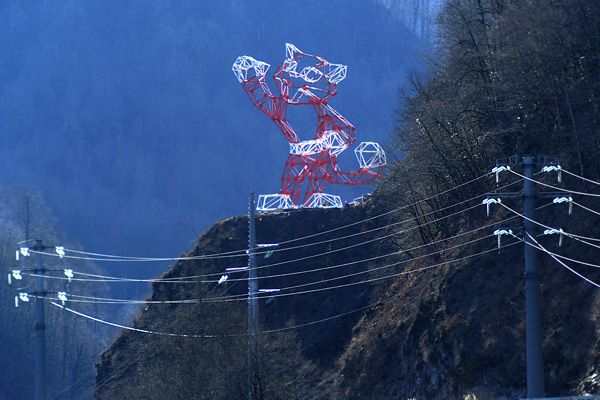 Photo: support of the power line in the form of a snow leopard near the road to Krasnaya Polyana. ITAR-TASS
Disconnecting of light in the winter Sochi is a phenomenon that has long been familiar to local residents. Blackauts usually happen in February, when wires are torn under the weight of snow, ice or fallen trees. The last time the mass disconnection of energy passed a year ago - almost six thousand inhabitants remained without light in all four regions of the resort, a total of about five hundred houses were de -energized. Large -scale accident? Yes. But local shutdowns in the city occur almost daily, and they became a real problem for the Sochi.
Messages of local media are similar to reports from the fronts. Daily Power Engineers warnings usually look like this : “On Monday, February 18, during the day the energy sector will be repaired in the Adler district. In connection with the work from 8:00 to 17:00, the energy supply of houses along the streets of Panfilov, the Rules, Gogol, Kuibyshev, Mendeleev, as well as the adler’s sanatorium, will be limited. Trinity, brick, factory, we remind that on the same day from 8:00 to 17:00 it is planned to turn off the power supply in the village of Veseloy, in the houses on the streets of the harvest, Mira, Tauride, Mimos, Violets, Camellia, Petrozavodskaya. "
The lights of the big city go out like a schedule, but it is not possible to get used to it in any way. Primorsky embankments are immersed in the darkness, the silence of the southern night fills the buzz of generators, they are habitually made on balconies. The snow has nothing to do with it. It is difficult to blame him, for example, at the end of July - it was then that last year the local power engineers received a record number of calls - more than three thousand people tried to find out what was happening.
Energy calls the reasons for different ones: sometimes shutdowns are justified by planned work to improve the energy supply of the city to the Olympics, and often complain about the transformer breakdowns or a cable break. Sometimes quite fantastic versions sound. Thus, the cause of the accident at the transformer station on Chebrikova Street, which occurred on December 13, 2012 and left the residents of the Vynovalnaya district of the city without light, the cat allegedly climbed to the station : according to the official version, closed the terminals, arranging a micro -explosion.
Sochi in exploding cats believe weakly. As in the Olympic 500 billion, which supposedly should go to improve urban infrastructure. “The city power supply is completely worn out,” said Publicpost Sochi Civil activist David Hakim. “It is especially felt in the fall, when they start to cold - people turn on the heaters, the load is growing, the area begins. They turn off the area here and there. How much will the disconnect, from several hours to a day. Calling Sochaenergo, is useless, it is useless. The line is constantly busy there. "
Hakim in his blog in the “Live Journal” leads statistics - where, when and how much electricity disconnect - by this information, local residents exchange Greetings.ru in the city social network. “Permanent shutdowns are half the case,” the activist explains. “I live in a private house, I specially bought a sensor - above 170 volts the voltage never rises.” Sochi mayor Anatoly Pakhomov, according to Khakim, is aware of the situation, but does nothing, preferring to “transfer arrows” to Kubanenergo, a company in which the Sochi energy networks are located.
The representative of Kubanenergo simply did not come to meet with the initiative group of Sochi. "The problem is not how to pump up the city with energy - for this there is a recently built Adler TPP, and under construction in Kudepast. The Kudepstinsky TPP is generally superfluous, people are rallying against its construction, they sit in the camp where the construction is going on. Its construction will not solve the problem at all, but only pollute the natural environment. The problem is how to distribute energy inside urban networks, when they are. worn to the limit, ”the activist believes. The connection between the intensive construction of the Olympic objects and the disconnects, in his opinion, if there is, is indirect: "Nobody was engaged in city networks, and in the conditions of such a wet climate, like ours, they need to be checked annually. Moreover, in the moments when such intensive development and energy consumption is growing day by day."
“The disconnection of electricity is not only a non -working lamp in your room, it is the lack of hot water and cold batteries in winter,” said PublicPost Civilian activist Irene Ilyenkova. In her house on Razdolnaya, the light was turned off daily, but recently corrected - they do this no more than twice a week. “The city administration shrugs and says that it cannot do anything. People are exhausted to the limit, now we are collecting signatures under the appeal to Vladimir Putin and the IOC, let them understand,” Ilyenkova said. So far, more than 400 people have left their signatures under the letter, whose scan has at the disposal of Publicpost.
According to the lawyer and part -time member of the initiative group of citizens Alexander Popkov, the claims are really preparing. "The city administration and" Kubanenergo ", uniting with law enforcement agencies, tell everyone dissatisfied: write claims, contact the courts and you will be happiness," he said.
“The problem is that the procedure for preparing such a lawsuit is so complicated that an ordinary layman is unlikely to be able to go from beginning to end. Let's start with the fact that you first need to prove that there were all these shutdowns and changes in voltage, to fix them,” Popkov explained. - "Local laboratories refuse to fix such cases, do not want to have a lawsuit with Kubanenergo, they depend on them." According to Popkov, while one resident of the city decided to go through this way, but for this she had to attract Rosstandart and the Stavropol laboratory independent of Kubanenergo. “This path is thorny and winding, often lawyers do not even want to take on such cases,” Popkov said. “Now we must prove that Kubanenergo is to blame, but we want to expand the situation so that we are no longer, but the city prosecutor acts in the interests of an indefinite circle of people, that is, consumers. It will be easier to prove damage to residents.” Answer the second question after "What to do?" - "Who is to blame?" - According to Popkov, an appeal to the Investigative Committee will help. “We think ourselves,” he added, “that the administration, which made the barbaric development of the city and the deterioration of the energy networks, is to blame for the charter of the city, the administration is responsible for the power supply. And“ Kubanenergo ”is not covered by the fact that it is a private company. Not private, the whole asset belongs to the state. The top managers on wild salaries are sitting there and nothing is done for the city, they say nothing for the city, they say nothing for the city. We are fairy tales. "
"Now there is a wild wave of indignation. The power engineers have to jump - and the cables are changing throughout the city, and they began to respond faster, and the generators quickly drag into the de -energized areas, and the brigades from other areas of the Krasnodar Territory pulled up, but these are only half measures. The networks are worn out, they simply do not pull out the whole mass of new buildings - the cables are out of place, - they outlined the situation Popkov.
At the time of writing the material, Publicpost failed to contact Kubanenergo. Whether the city will stand at the moments of peak Olympic loads - it is not yet clear: a month ago, at the opening of the Adler TPP, the governor of the Krasnodar Territory Alexander Tkachev admitted that the shutdown is associated with a large construction site and asked the Sochi to suffer another year. Prime Minister Dmitry Medvedev directly promised that by this time the problems of the resort with energy supply would be a thing of the past. “I think that the Olympics is just a very good reason to close this problem once and for all,” Medvedev said. Whether his promises are true, Sochi will be able to check in the next February.