
Translated material
The squad will build on the network
How to "clean" the Internet
The safe Internet (LBI) league launches in the spring an automated search engine of unlawful content. How the Internet is now being “cleaned up” and what threatens us - The New Times sorted out
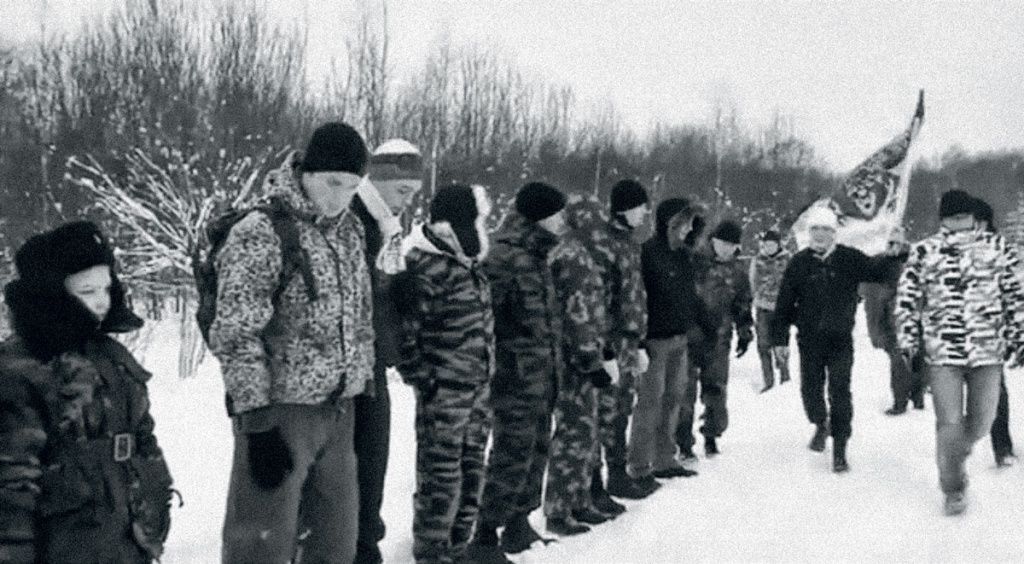
January 2012 Military Sports Games League of safe Internet on one of the abandoned bases in the Moscow Region
Boris Vorotilin, 39-year-old System Administrator of the Kama Polytechnic College in Naberezhnye Chelny, recently became the owner of a unique profession: he is Cyberdzhinnik. And it was like that. In January 2011, he read the news on the network about creating a safe Internet (LBI) league. "This is a job!" - thought Boris and sent an application for joining the league. The answer came almost immediately: in an electronic letter, the Executive Director of LBI himself Denis Davydov congratulated Vorotilin on the fact that he became the first citizen of the Russian Federation to receive the title of cyberjyskinnik.
Since then, Boris has been searching for the content prohibited by law-it takes him up to three hours a day: “I am introducing requests to the search engine:“ porn ”,“ children's porn ”, then translite, then in Russian in the English layout, using slanging words of pedophiles-these nonhumans learned to encrypt.” Vorotilin sends the addresses of sites with violations to the league website, where in the upper right corner there is a button “Report the dangerous content”. Then the message is checked by LBI experts and send it to the register of prohibited sites of Roskomnadzor. Whether to block the resource - they decide already in the department. Vorotilin does not receive money for his work: LBI is a project, although private, but non -profit and purely volunteer.
Project "Zone"
| *Cm. “Costs for Speed”, The New Times No. 23–24 of August 13, 2012 *Malofeev became a participant and another scandal. In early February, the Supreme Court of London refused the Russian State Bank of VTB to satisfy the claim against Marshal Capital, owned by Malofeev. The trial, which lasted for one and a half years, concerned the VTB of the RUSSAGROPROM company in 2007 of a loan of $ 225 million for the purchase of six dairy from the Nuthertek company. Soon, after VTB allocated funds, the loan stopped serving, and RAP announced a default for obligations. A second audit revealed that the real value of collateral assets in the form of dairy was multiplied. VTB considered that the entire fraudulent deal was originally organized by Malofeev, who took an active part in the negotiations on the issuance of a loan. |
He established the league in December 2010 “The Charity Fund of St. Vasily the Great”, created two years before the “Orthodox billionaire” and the largest minority of Rostelecom, Konstantin Malofeev. He also financed the project conceived with a noble purpose - to eradicate “dangerous content” on the Internet, namely child pornography, drug propaganda, call for suicide, illegal publication of personal data, as well as advertising alcohol products and malicious software (computer virus). Highlighting six content groups on its website, each of them prudently supplies a link to the corresponding prohibition article in the legislation. From the very beginning, the brainchild of Malofeev managed to enlist the support of a number of reputable government agencies - from Roskomnadzor to the FSKN and the Office "K" of the Ministry of Internal Affairs. In addition, the league, according to its executive director Denis Davydov, is supported by such large organizations as MTS, Vimpelcom, Google, Mail.ru and Kaspersky Laboratory. The authority of the project among the “Sovereign Services”, apparently, was not even shaken by a criminal case against Malofeev, instituted at the end of last year for bribing ten voters in the Smolensk region: the Orthodox oligarch ranked to deputies in the village of Znamenskoye Ugransky District in order to take a place in the Council of the Federation from the administration of the region*. Today, lby, as it is not without pride, informs her site, exists with the support of the Ministry of Communications, and her board of trustees is headed by the assistant to the President of the Russian Federation Igor Schechenlev.
However, over the two years of LBI, she managed to become famous not so much on the field of struggle against child pornography on the network, but with frank attempts to censor the content of sites: it was the League that developed scandalous Law No. 139 of the Federal Law-on the “black lists” of Internet sites ** and acted as an experiment called the “pure Internet zone” in the Kostroma region, where users were about to limit access to the network, opening only those opening up, opening only those Sites that LBI will consider it decent.
And although the Kostroma experiment, under the pressure of the public, failed, this failure of Lby activists did not bother at all. “Now we are working on a new project: most likely in the spring of this year, we will launch a search engine for unlawful content to automatically fill the Unified Register of prohibited sites of Roskomnadzor,” Valery Ponomarev, adviser to the Libi Executive Director Valery Ponomarev, told The New Times. And he clarified that the search engine is created just to help the same cybercurders, the first of which was Boris Vorotilin. After all, now, like him, you have to track the “dangerous” content manually.
The name is legion
About how exactly Cyberdrinniki “clean” the network, The New Times was told by the Saratov designer Svetlana Petelina, Libi coordinator in the Volga Federal District. She organizes the interaction of local combatants with the Department of the Ministry of Internal Affairs and the KO management, and also conducts operational and intelligence work: she searches for pedophilian resources on the Internet and is being implemented in these groups. Svetlana started tracking offenders five years ago, after she saw child pornography, accidentally opening a link with spam on the Odnoklassniki network. Petelina decided that law enforcement officers simply did not know that such videos are being distributed on the Internet, and decided to help them. But her initiative had no success: “I was considered a city crazy one. The head of the department “K” of the Main Directorate of the Ministry of Internal Affairs of the Saratov region suffered and blushed, like cancer, when I went to his office, and then asked me to miss me anymore. ”
Only one employee of the Saratov Directorate “K” reacted to her with understanding - Stanislav Schets. Petelina and ZVSOV managed to achieve a conditional or real term for seven pedophiles. Then Schetsov left for Moscow to head the Cyberdzhin project in the League, and Petelina joined one of the groups he created in Saratov and plunged into the work. Today, she already leads to dozens of planted pedophiles and remembers everyone by names. So, thanks to the operational developments of the Saratov Lby cell, it was possible to plant a 29-year-old resident of Balashov Dmitry Vopolev named Boss (he was found guilty of pornography trade), Konstantin Dazidinko, the counselor of the Rossiya District, went to prison for 15 years. Five pedophiles were caught in Belarus. Petelina was so carried away by her “hobby” that about a year ago she lost the main work of the designer in an advertising company: the employer did not like that a woman uses Skype and ICQ during working hours, corresponding with potential pedophiles. After that, Scheps arranged her in the league, knocking out a salary for her - as an exception.
How many activists devoted to the case, like Vorotilin and Petelin, is not known in the league. According to Kusov, "an active backbone is 1,500 people." But Valery Ponomarev calls a different figure - 400. In total, the forehead has up to 20 thousand participants: they automatically include everyone who reported illegal content through the league website more than once.
Over the past year, these volunteers sent 1545 reports on the promotion of drugs on the Internet to law enforcement agencies, 26 207 - about child pornography. How many queries have led to blocking sites - in the league do not say: the final report is not ready yet.
Social terror
 |
| 27-year-old political strategist Igor Mankushev, one of the creators of the ultra-right movement "Bright Rus'", now also a cyberc |
The league is interested not only online, but also life in real life. The offline raids have become a separate area of Libi: Over the past year, the volunteers conducted 319 such operations along with the K controllers. The 27-year-old political strategist, Muscovite Igor Mankushev, better known as one of the creators of the ultra-right youth movement "Bright Rus'", also consists in the cyberjext. Over the past year and a half, his team of 40 people has implemented 20 raids on “intimidation” of pedophiles: activists have been starting on social networks fake accounts of minor adolescents, correspond through them with potential pedophiles, then appoint a meeting and shoot those who came for a date, on the video. Then the “social terror” begins: videos from raids are laid out on popular resources like YouTube. “We are doing this because the state in this area cannot cope with its functions,” says Mangushev. He also claims that he does not receive money for work.
But not everyone is ready to work worriedly. Around the lby, numerous civilian associations of the most diverse are concentrated: the movement on the struggle “with debauchery, pornography, unlawful and antisocial information” “St. George Watch”, the movement “Stop! Bastards ”,“ Police of morals ”and others. The Coordinator of the St. Petersburg movement “Nabat”, calling himself “Brownie” (does not name his name), a 40-year-old security consultant and a former operative, told The New Times that his movement is trying to build relations with the League in the hope of financing: “Otherwise, a cost hobby turns out: body vestiges, walkie-talkie, and night vision devices.” Brownie activists not only track pedophiles, make photos and videos, but even shoot fingerprints. All data is transferred to the police.
But no matter how noble the goals of the cyberclasses, the “social terror” uncontrolled by the law has the opposite side. “If such an association of citizens begins to take on police functions, this is already outside the legal field. It's like distributing a weapon and sending the streets to the Cossacks, ”Anton Nosik said The New Times.
However, The New Times has already found a man who had a chance to encounter illegal actions by people who call themselves cybercurli. “Three months ago, I met a young man on Mamba.ru. This site blocks the pages of minor users, so I was sure that I was talking with a 19-year-old guy-this was written in his questionnaire, ”32-year-old Ivan D. told the magazine“ He appointed me a date, we met at the subway. He could have been given both 20 and 21. He offered to go through and led me to the deaf courtyard. From nowhere, six strong guys jumped out, behind, at the exit from the courtyard, there were three more. I was knocked down, took my bag, pulled out all my documents and a mobile phone, began to yell that I was a pedophile, since my companion was only 16. All this was shot by a girl with a camera. I finally pulled myself together and clearly told them that I was a homosexual, but I am not a pedophile. That the guy in the questionnaire indicated normal age. And what they do is illegal. ” The attackers quickly went back, the documents and the phone returned, having previously rewritten all the data, apologized. And they asked for money "to support the cybercrins."
“He gave a thousand - he was nervous, he was actually scared,” says Ivan. A day later, they called him. The person who refused to introduce himself politely asked “to provide financial support again,” otherwise “deeply compromising personnel” will appear on the network. Ivan in a harsh form refused: “Let them lay it out. There was nothing compromising there, and the fact that I am gay, my friends and colleagues know. ”
The struggle for the contract
What functions will be preserved among the cybercurders-vulture after the launch of the “black search engine”, which itself will track sites with illegal contents, is still unclear. For the right to develop a program by order of Libi, two dozen companies compete. The first contender was Ashmanov and Partners, but the PR director of the company Ksenia Ryzhkova told The New Times that there was no contract yet. According to the adviser to the Executive Director of LBI Valery Ponomarev, negotiations with Entensys are now negotiating. Its director Dmitry Kurashev confirmed the New Times this information and added that Entensys already has all the necessary technologies to launch the project, it remains only to configure the customer’s wishes. Entensys has a base of 500 million Russian and foreign sites categorized in 70 groups (online casinos, sites for children, etc.), as well as the technology for filtering content using morphological analysis. “Analysis of all sites of domain RU will be calculated by millions of rubles. But even the approximate cost can not be called, ”says Kurashev.
In turn, the head of the Kaspersky Laboratory Department, Andrei Yarny, told The New Times that he causes fear “the possibility of erroneous or excessive use of this tool”: “I would like the system to work with the“ presumption of innocence ”and react only to“ unambiguous evil ”.
Mediaxpert Anton Nosik believes that LBI initiative is another attempt to earn on an expensive project. According to him, instead of a separate system, it is enough to develop search queries for existing search engines to display lists of suspicious sites and give them to lawyers for examination. “If we are talking about a computer program that would be able to give a legally valid conclusion about the unlawful of content, this is far beyond the facet of mental health,” concludes Nosik.
Will the “black search engine” only help the cybercur or the program to the department of Roskomnadzor and it will receive state support? “I can only say that the system settings will change in accordance with changes in the legislation. For example, if we finally get to the point that all pornography will be prohibited in general, we will include it in the program for finding unlawful content, ”says Valery Ponomarev. “We create a“ machine ”, but you can do anything with it.”
Photos: YouTube.com screenshot from the site vk.com