
Translated material
Despicable paper
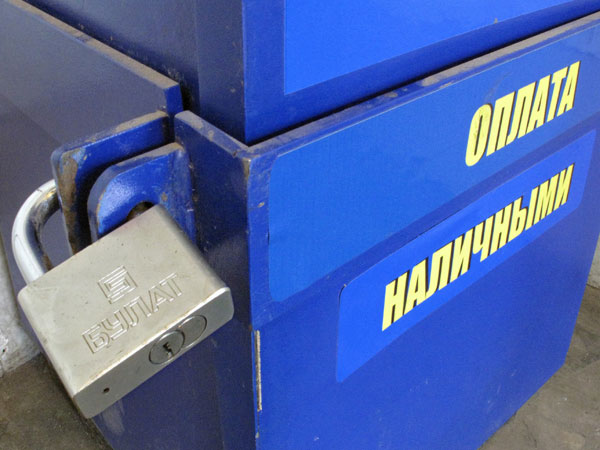
The Ministry of Finance proposed to ban over 300 thousand rubles in cash with cash in cash in cash. And since 2014, confident in the Ministry of Finance, it is necessary to set a restrictive bar at a level of 600 thousand. Finance Minister Anton Siluanov said that the corresponding bill has already been discussed in the office of ministers and will be submitted to the State Duma in the near future.
Siluanov explained that restrictions will reduce the volume of the shadow sector in the Russian economy and increase tax collection. The minister complained that today huge cash flows are not taken into account.
They talked about the fact to force the Russians to use plastic cards for a long time. In July 2011, the former Minister of Economics, and now the head of Sberbank German Gref wrote a letter to Prime Minister Vladimir Putin. He stated that economic growth in the country is inhibited by the slow development of the non -cash payment system. He is sure that due to large amounts of cash payments, Russia loses about one percent of GDP per year.
Herman Gref was immediately accused of unleading a “war with cash” not about the growth of Russia's GDP, but about the well -being of a Sberbank, which occupies a leading position in the market and, in case of mandatory distribution to the entire population of plastic cards, will win the more others.
However, the Ministry of Finance soon stood up for Herman Gref. It turned out that not only the banking system benefits from the development of non -cash payments. The large turnover of cash is the property of the “shadow economy”, with which it is quite difficult to collect taxes, and this is quite upset by the Ministry of Finance and the Federal Tax Service, which are responsible for filling the budget.
In March 2012, the Minister of Finance Anton Siluanov stated that his department was developing a bill that will limit cash. Already in May it was announced that the working group of the Ministry of Finance wrote the corresponding document. Then the ministry proposed limiting purchases for cash by 600 thousand rubles. It was planned to oblige all companies to transfer the salary of employees to plastic cards - the exception was made for small businesses with less than 35 employees and companies in hard -to -reach places. It was also supposed to oblige all stores to equip the cash desks with terminals for payment with plastic cards.
It seems that after coordination with other departments, the bill became even worse treated: instead of a bar of 600 thousand rubles, a restriction of 300 thousand appeared. Thus, notes the economic observer of Polit.ru Grigory Gritsenko, an attempt is made to receive additional revenues to the budget. “This will affect transactions with the purchase of apartments and cars and other transactions requiring registration. After all, income from their sale is also taxed by income tax. Now the schemes are used that allow you to underestimate the amount of the transaction. And in the event that they go through the bank, then it will be impossible to do it, ”Gritsenko believes.
The main problems are likely to arise in the secondary real estate market. Apartments in the secondary market are almost always sold for cash with “alternative transactions” - when a long chain is built from buyers and sellers and money moves from one person to another remaining in one bank cell. Even under a regular transaction, buyers often distribute money to different bank cells to transfer it to sellers to parts - after signing the contract, after receiving the papers on registration of the transaction, and so on, this is once again insured by the deal. Today, and so a significant part of the apartments is sold at a low cost - the fact is that the law allows not to pay taxes when selling an apartment for less than one million rubles. If the law on the limit of 300 thousand will be adopted, then we should expect a sharp drop in the declared housing prices.
Russia is far from the only country that decided to fight cash. As a rule, this is done with two goals. Firstly, the fight against corruption. If with “grassroots corruption” you can fight with police methods, then millions bribes are often so difficult to stop it that it is easier to limit expensive purchases. Secondly, the fight against “gray salaries”, because salary taxes make up a noticeable part of the budget of any developed state. A pleasant bonus for the monetary authorities is a reduction in cash in circulation, which means a reduction in the cost of the annual issue of billions of new banknotes to replace the dilapers.
“War with Cash” in different countries takes different forms. At first, as a rule, the state does not limit payments to paper money, but stimulates the use of plastic cards. For example, in Italy, Mexico and Brazil, the law obliges the corporation to transfer salary to cards, and a state is also received, which puts benefits and payments on bank accounts of the population.
Another way is to stimulate the regular use of bank cards. To do this, you need to work with communal and communication companies so that they accept non -cash payments, and, preferably, without a commission. In addition, all state institutions oblige cards - this is done in Brazil and Saudi Arabia.
Some, like the Russian Ministry of Finance, are fighting cash payments. Compared to other countries, 300 thousand rubles proposed by Anton Siluanov - or about 10 thousand dollars - it seems quite liberal. In Greece, it is forbidden to pay in cash if the purchase amount exceeds 1.5 thousand euros, and in Italy - only a thousand (about 60 and 40 thousand rubles, respectively). New rules for working with cash are also accepted - more strict collection, advanced cash registers, etc. In Russia, however, there is nowhere to advance in this area.
Some countries are discussing a complete refusal of cash outlets. In the United States and some European states, a law has been adopted, which allows stores not to accept cash. In Sweden, it is discussing an act that will generally withdraw from the appeal “cache” - there, already today, with the help of cash, only three percent of payments are made, while this indicator in the European Union is nine percent. One of the largest banks in the country-Swedbank-even calculated that due to the need to transport paper money, the bank became the culprit of 700 tons of carbon dioxide into the atmosphere.
In Russia, legal entities are not right to pay each other in cash if the purchase or service cost more than one hundred thousand rubles. According to the Ministry of Finance, today the share of such transactions does not exceed 25 percent.
Opponents of the War with Cash are also located. Arkady Trachuk, the head of Goznak - an organization that prints all Russian rubles - I am sure that it is premature to restrict cash walking. He believes that the service of the non -cash payments system, including “card” terminals, ATMs, etc., so far costs more than servicing a huge amount of cash. Trachuk is sure that he will reasonably limit the “cache” in five years.
The Russians are still in no hurry to refuse cash, although they use it less and less. So far, the total amount of cash in the country is approximately 13% of GDP, but this indicator is reduced every year. This is facilitated by large companies that transfer employees' salaries to their accounts, as well as retail. A few years ago, in stores, one of the largest Auchan chains in Russia, it was impossible to pay a plastic card. Then Visa cards began to be accepted, and then MasterCard. In Moscow and St. Petersburg, in almost all medium and even small stores there are terminals to pay with plastic cards, gradually they are increasingly appearing in regional capitals.
In the long term, most likely, Russia is waiting for the fate of Sweden - now some schoolchildren pay for lunch in the buffet with a plastic card, every year the volume of purchases through the Internet is growing - and they are almost never paid in cash. The question is how smooth it will happen, or even in this area the state will fight with the habits of its own citizens in order to get from them what they would have come to.