
Translated material
For great power
He passed for almost a year since Vladimir Putin again, for the third time, was elected President of Russia - time to evaluate the successes of the new/old president. And the Russians evaluate them in their own way.
As the Levada Center survey shows, the dynamics of these assessments is not that very large-Putin personally does not lose in the eyes of Russians and does not add. Those who believe that Putin during his reign brought the country more good than bad - 65 percent. In January 2012, a year earlier and even before the elections there were 66 percent. The difference is not just small - it is absent. The reverse point of view adheres to 18 percent of the respondents (a year ago - 15).
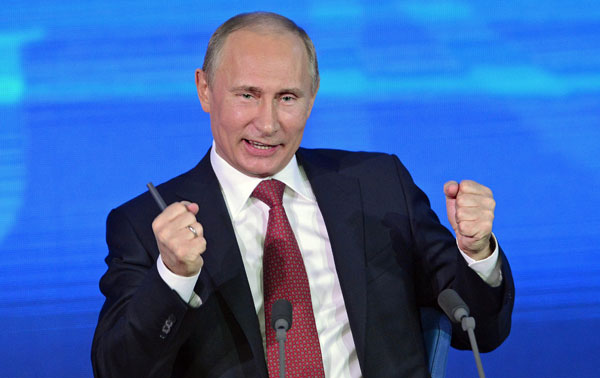 Photo: Dmitry Azarov/Kommersant
 As before, half of the Russians believes that the president is fully responsible for what is happening with the country, and that this is not his fault, but only the result of objective reasons, believes only 5 percent.
The successes and failures of Vladimir Putin are also evaluated at about the same level. The main success - Putin returned the country the status of a great power (as 36 percent of Russians believes). To increase salaries and pensions - 28 percent and here the main danger to the current president, since in 2010 43 percent seemed to be that Vladimir Putin succeeded. The number of those who do not consider it are growing - from 11 percent in 2010 to 23 in 2013 (it has grown up, however, the number of people who believe that Putin could not return the status of a great power for Russia - there were 20 percent against 13 in 2010).
The main failure and this is also unpleasant for the current government, from the point of view of Russians, is the inability to ensure the “fair distribution of income in the interests of all citizens”. The president who was supposed to succeed, as it was, remained at the level of statistical error - it was 5, it became 3.
In 2010, 31 percent of the respondents thought so, now there are already 43 such a request for the widely understood “justice” and property equality, thus, does not decrease, but is growing. The number of those who believe that Putin could not return the funds lost “during the reforms” is also growing - the number of supporters of this version increased from 26 to 36 percent. The number of Putin’s success in this matter, only five percent insisting on the success of Putin.
The voices of those who believe that Putin fulfills his election promises, and those who do not think so. 8 percent believes that it fulfills 39 - which is more fulfilled than not. The reverse point of view is popular with 28, respectively, 28 (“rather no”) and 8 (“certainly no”) percent of the respondents. Compared to the data of the Levada Center, received by the first period of Vladimir Putin, fresh surveys are not very inspired. In 2000-2001, about 60 percent believed that Putin was seeking to fulfill promises, as far as he was in his power.
This is understandable: according to polls, the main complaint of citizens to the president is that he is “connected with large capital” (in January 30 percent said and this indicator remains at this level from the second half of the 2000s) and “corrupt politicians” (28 percent-there is a fall in accordance with the level of the middle of the zero). Putin’s activity as president approves 65 percent of the respondents (in early 2011 there were a little more than 70 percent).
However, on the electoral rating of GDP, the claims of the Russians did not critically affect: how ready they were to vote for him in the 2000s, they would have voted now. In June 2012, 40 percent of citizens were immediately ready to vote for him, now-32. But the separation from the closest pursuer represented by Gennady Zyuganov is so great (Zyuganov’s support group of 8-10 percent), that there was no doubt: if Putin was again elected president, he would have become for them. And the unknown “candidate of Putin”, it must be assumed, would have gained the most.
There are a fall in the indicators, and the problems of the population (primarily in their own wallet) are completely reflected. In this situation, in the authorities as a whole and Putin himself, the temptation is great - to play the rating to the stop. Do the population like the status of a great power? It is necessary to actualize the external agenda, threaten the "arsonists of the war" and other "Washington regional committees." And do not affect the dubious topics of what Putin's government really made in a crisis. And there, you look, and oil with gas will grow up.