
Translated material
"Let us die calmly!"
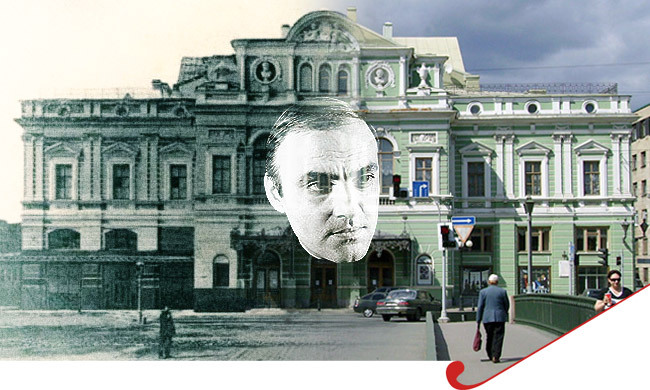
"Temur Chkheidze leaves the BDT."
"Temur Chkheidze is still heading the BDT."
"Temur Chkheidze leaves the BDT."
"The premiere of the performance took place in the BDT named after Tovstonogov ..."
"According to rumors, the post of artistic director of the BDT can be proposed by Oleg Basilashvili ..."
"... Svetlana Kryuchkova ..."
"... Rudolf Furmanov ..."
"... Konstantin Khabensky ..."
“The National Committee for the celebration of the 60th anniversary of Vladimir Putin invited the Minister of Culture of the Russian Federation to appoint the artistic director of the BDT Gerard Depardieu.”
“Temur Chkheidze announced the BDT troupe about his resignation using the St. Petersburg-Moscow-Tbilisi television.”
Which of the above is a sensation? Event? (Treakly not the premiere, this is clear.) Well, at least the news? So, besides the television? What should happen in the legendary theater, previously known as the temple of the Leningrad intelligentsia, so that the representatives of this intelligentsia are at least a second to start and stop nodding with the monotony of the melancholy donkey - “Well, yes, yes, this should be expected, but how can it be”? But, perhaps, it is necessary - in the bustle of the vulgar theatrical everyday life of the Tovstonogov BDT, it retains aristocratic equanimity, flaunts the nobility of the old hardening? It courageously serves as a high example of the Russian psychological theater, condescending - if not squeamish - passing one fashionable wave after another? Maybe the academic theater does not need any "events"?
Actually, the main event (strictly by school) in the BDT has already occurred. In 1989, George Tovstonogov died. Over the past twenty years (the first years for the entire St. Petersburg Theater were called the “post -reservoir decade”) in the BDT a lot of everything, including significant, substantial, but nothing fateful. As if a memorial service for the deceased Titan is still ongoing. Having inscribed on his banners “continuity and tradition” (well not “stability”, although the essence is the same), the BDT decided to participate in any battles (neither political nor aesthetic), but to sit peacefully in deep rear.
At first they sympathized with them (there was really a large, universal one), then timidly, “laughing at the other, twitching the eye,” admired the heroism of Kirill Lavrov and rejoiced at the appointment of Temur Chkheidze. Rather, like this: with enthusiasm and hope, they accepted the news that Temur Chkheidze, which was very appreciated by the Tovstonogov himself during his lifetime, was far from right away, but after the adherence to persuasion, he agreed to become the main director of the BDT (with the general artistic leadership of Kirill Lavrov), and then the theater artistic company. UV. It seems that I have not missed a single pirouette and curtsy. Because here it is subtle: you will miss “inspiration” there or “heroism” - and that’s it. The wrong plot. The latest history of the BDT, if you do not take into account the supra -sensitivity of the theater to the slightest doubt about the prohibitive height of his mission to protect the Tovstonogovsky heritage (no matter what bizarre and foreign interspersed there are subsequently included), simply does not exist.
The debut “insidiousness and love” Chkheidze was indeed planned even under Tovstonogov (and how!) Was indeed an impressive success. The geometry of the Mizaniscent, coupled with the dry elegance of the acting manner, inspired reverence for the directorial style. Several sensitive injections were inflicted on romanticism, a duel with Schiller was in earnest. The subsequent works of Temur Chkheidze in the BDT did not find such unconditional approval, although almost every of them was both serious and solid (Boris Godunov and Macbeth, for example). It’s not that “happiness turned away”, just the theater was accustomed to exist without caring about happiness. Only about rest, but about him - without fail. (About the will we are talking ahead.) Such emotional asceticism is generally contraindicated in theatrical art, but then they preferred not to think about it. When, after many years, Chkheidze, already in the status of a artistic director, will again decide to put in Schiller’s BDT - first Maria Stewart, then Don Carlos - all this will, of course, be “iconic” and not at all meaningless, but archaic even by the most sparing, academic, standards.
Maybe the academic theater does not need any "events"?
This is not to say that the theater did not try to cheer up somehow and even sink somewhat. The BDT was hardly possible to “change the fate” thanks to the arrival of Adolf Shapiro - but the scandal started in the troupe brought the director’s efforts to naught: the theater met the line of centuries in the belief that salvation was in the beneficial exits of the old “Tovstonogovsky guard”, preferably solo. The new century for the theater has not yet begun. Nonsense, will have time.
The "old guard" was melting before our eyes. The tragic motto “Let us die calmly!” Humanly caused deep sympathy, but soon finally took the place of the art program. The fate of the BDT was decided.
The alliance with Grigory Dityatkovsky did not really have: he was not alien to the academicism, although he was hearing him with a bit of poetic free -thinking. After the “Fedra”, the Strindberg “Father” and “Twelfth Night” (varying degrees of success), he made an offer, which the director ultimately considered it necessary to refuse, and he did not become the chief police of the theater. His subsequent performances on this stage were frank failures.
Not succumbing to the ridiculous provocations of enthusiasts trying to encourage the theater to radical actions, decisive acts, non -standard moves and even about horror! - To the invitation of young directors, the BDT became more and more careful. Choosing such a repertoire and such directors in which it would be guaranteed to "die calmly." Without options. They began to “suit” the BDT even when they did not think about it around. The predictions of further fate did not have to go far: the second law of thermodynamics in the theater, which set the Stopardovsky Arkady, was well known. In a closed system, entropy only accumulated.
The BDT no longer had artistic and administrative will to preserve significant performances in the repertoire (important from the point of view of dramaturgy or directing). The moment for the entire drama theater in the country was a difficult, the “spontaneous” composition of the auditorium could negate any attempts to a serious theater. By the way, he understood everything about the “Gostinodvors”) to resist this petty -bourgeois element (Tovstonogov), to insist on his strength or much desire, it seems, there was no special desire. The empty halls, diseases of the elderly leading artists, or simply not a comfortable way of existing in someone else's aesthetics (the experience of invitation and quickly oblivion of Georges Danden Jacques Lassal is very eloquent) forced to disappear from the Afisha “Fedra”, “Twelfth Night”, “Copenhagen”, “Forest”, “Costocum”, “A month in the village” and so on. And how much thin, optional, obviously non -viable performances came off the stage over the years, barely flickering!
They began to “suit” the BDT even when they did not think about it around.
It is interesting that Temur Chkheidze himself did not try to mislead anyone regarding his aesthetic and worldview priorities. It just so happened that either the main or side topic in its performances was the confrontation of youth and old age (unsuccessfully issued for maturity). Old age was originally right, youth - guilty. This topic sounded most of all in the St. Petersburg “Antigon”, but it was present in the “Salem sorceresses”, and in “Love under the Knocks”, and in the “House where Hearts break”, and, of course, in “Don Carlos”. Young rebels (and in the BDT, the very concept of youth is very extensible) did not have a single chance. They here a priori were considered lightweight and incapable of properly to serve the idea of "preserving heritage." Neither on the stage - nor in the reptent. The duel of the theater with Schiller (and in his face with all the “young people, later robbers”) and really turned out to be bloody: both duels received serious wounds.
Having stated when leaving that in the cooling of criticism and sponsors to the theater, he blames himself, Chkheidze was only partially right. Of course, who, if not art, is responsible for the state of affairs in the theater? But the theater brought to the line of the collapse of ritual campaigns about the “Tovstonogovsky traditions” (which have become the property of the great history - it is precisely history) - this is by no means an invention, not the initiative and not even the prerogative of the former leader of the theater. Inside and around the theater, its own “bondage of holy”, possibly not even amenable to personification, has long gathered. Some simple -minded viewers still thank the BDT for the performances of director Nikolai Pinigin, "highly rising the banner of the Tovstonogovsky Theater." Therefore, they do not see the particular difference between the great “philistines” and some wretched “night before Christmas” (with wild carols, goat and, naturally, rummaged into a Jew). But what is permitted by prostans should be unthinkable for professionals. Meanwhile, to pretend that in the BDT everything is still in order, the most sensitive and subtle experts in the Tovstonogovsky Theater tried.
At what point did the noble conservatism turn out to be self -Parardia, and the notorious “preservation of the Tovstonogovsky traditions” began to sound insulting in relation to the memory of the master? Not suddenly, of course. But exactly from the moment when “preservation” has become more important than development. When potential harmlessness began to be valued above. In candidates for the right to staging the BDT performance, it usually rummaged for so long (exploring everyone for aesthetic trustworthiness) that the time was irrevocably lost and or the potential candidate was already busy, or was Robert Sturua (who was steadily from St. Petersburg), or lost his creative form for a long time, or even by appearing and putting a couple of performances - he could no longer fundamentally take on a creative state Theater.
Above all, potential harmlessness began to be valued.
As a result, the directors were increasingly put in the BDT, whose surnames now no one will remember. It is no accident that the “legible bride” was eventually surrendered to the gentlemen of Pinigin and Maksimov (and - once - Yashin, for the rich experience of the Gogol Theater, apparently, was simply necessary to use). That is, directors who have ambitions, taste and talent in equal proportions. Which was the key to what in the BDT of that time called "harmony." All of them sooner or later disappeared from the theater. Leaving, however, after itself an extremely unpleasant trace - in the form of a rastrated and disoriented troupe, accustomed to working almost half -heartedly and consider provincial mediocrity by an artistic achievement. Is that “High BDT culture”, about the preservation of which, as the main achievement of Temur Chkheidze as a Khudruk post, it is now customary to say - let's pretend that this question is open.
They were kept to the point that the directors of Buben, Trostyanetskiy and Prikotenko were the light in the window of the Tovstonogovsky Theater. The director, of course, is the class above Pinigin with Maximov, but they are not able to save the BDT from protracted system depression in separately or all together. Buben and Trostyanetsky, straining all their creative forces, return the theater to the provincial aesthetics of the 70s of the last century, and relatively young Pokotenko is either frankly suppressed by the grand generation of masters (on the main stage), or is too relied on the professionalism of the next generation masters (such as the invited Ksenia Rappopport) and, it seems, does not care about the artistic integrity of the performance (at all. New BDT scene).
As a result, in the latest BDT performances (with inexplicable repertoire names), the artists play in a chopper-anteropriotic manner, on the stage they look at best confused, in the worst-suppressed, but honestly continue to play, exaggerate estimates and force the sound. The released Chkheidze is recently “Gronholm Method” from the output Pinigin performances is simply indistinguishable. The BDT continues to award by the Petersburg “golden sofits” (“Time of Women” by Trostyanetsky, late for forty years), the theater still hopes to enter the renovated building on Fontanka in time, the unknown young director puts an unknown modern play in the Kamennoostrovsky Theater (this is near the park, but terribly far from the theater routes)- No, all this does not violate the usual rest.
It could seem to have violated the departure of Temur Chkheidze and some excitement about a possible successor to his post. But also not-after all, everyone understands perfectly well that in the current situation (both political and intra-therapy), no one will go to a truly decisive step. And this means that whoever comes to the BDT as a new artistic director, he has to do the same: “To preserve the traditions of the great Tovstonogovsky Theater.” Now, together with all theatrical dust that has accumulated over the past twenty years. Although there is always a tiny chance that a real creative leader will come to the theater. Which will be able to extract at least a little healing penicillin from the “BDT culture”.