
Translated material
NTV is a short course
The new documentary of Vladimir Chernyshev “Stalin with us”, shown on NTV on the eve of the 60th anniversary of the death of the protagonist, is stylistically made according to the Pivovarian patterns: they try to put a historical person in the household context, to make it more abundantly using gaming inserts. Only the concept of Chernyshev is completely different. The author declares the intention to make a film that neither lovers of a “short course”, nor fans of the Khrushchev exposure of the “personality cult”. But he turned out to be an agitation under a new “brief course”, which, it seems, once again wants to create a power that has again been concerned about the creation of a single school history textbook.
Stalin in the film appears as the son of traditional, patriarchal Georgia, and therefore the zealot of conservative cultural and political values. He is also a supporter of the preservation and expansion of the empire, whose greatness he appreciated during the first link, when almost all of Russia had to drive. Since then, he has become a real Russian patriot. Stalin always dreamed of a house, family comfort, but he had to wander around prisons and links, while Lenin and future Stalinist opponents, these cosmopolitan revolutionaries, sipped beer in London in London. And after the revolution, Koba worked day and night for the good of the new Soviet state, again it was not to the family. And then Nadezhda Alliluyeva lifted him largely - she shot himself.
In this plot, Chernyshev focuses on the loneliness and suffering of Stalin, and explains the suicide of his second wife by the fact that she suffered from severe headaches. The author of the film does not even ask the question of why the wife of such a wonderful person suddenly ends with himself, and does not specify why Joseph and Nadezhda quarreled before her death (and, according to eyewitnesses, Stalin humiliated his wife in the presence of members of the Politburo and their wives, which provoked suicide). Chernyshev does not comment on the fact that Stalin destroyed almost all relatives of his first wife, Ekaterina Svanidze, mentioning only that they were repressed for old Trotskyist ties (which, by the way, did not have a spawn). What did the family members of Swanidze threaten Stalin's authorities? Perhaps the fact that they remembered not the great leader and teacher of the entire Soviet people, but the beginning revolutionary Kobu?
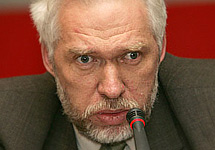
The main idea of the film is prompted by his scientific consultant - historian Yuri Zhukov (he acts as the main "talking head"). The viewer is inspired that Stalin wanted to do everything as best, but invariably stumbled upon the malicious resistance of the party apparatus. In particular, he really wanted to hold direct, equal, secret and, most importantly, alternative elections to the Supreme Soviet of the USSR in 1937. But the party nomenclature was frightened that she would not be chosen, protested, and Stalin was forced to retreat. But he took revenge on high-ranking front-line forensa-Classers, almost completely shooting them in 1937-1938.
In fact, Stalin spoke about the possibility of alternative elections only in an interview with an American journalist, intended mainly for external consumption. And even the newsletter to the places at the end of 1936, the samples of the ballots, in which there were several names of the candidates, did not mean at all that only one surname would not remain on the election day in the ballots. By the way, when on October 14, 1937, at a meeting of the Central Election Commission, three forms of real ballots were approved for the elections that took place on December 12, each proposed to delete all candidates except for which the voter votes. However, in each ballot, in the end there was the surname of just one candidate. After all, it was really nominated by several candidates, and only one was registered. Until the last moment, the voters were supported by the illusion that the elections could be alternative. So “Pravda” on November 21 wrote that there may be one or more candidates. The main thing, Stalin always said: it doesn’t matter how they vote, it is important who believes.
In fact, the Constitution of the USSR of 1936 was quite democratic in form. Only now no one was going to perform it either under Stalin or his successors. And since the beginning of the 30s there were no political discussions in the Politburo, staffed by the Stalinist appointments, who completely prevailed among the secretaries of the regional committees and republican Central Committee. So no front in party leadership simply could arise.
Stalin in the eyes of the author of the film is good because he was always far from the liberal circles, under whose influence the "city inhabitants of Petrograd" turned out to be, who in February 1917 committed a revolution and overthrew the king. That is exactly what it is said: city residents, and not the usual "workers and soldiers." This is more distinctly to be a parallel with the current "angry townspeople." Stalin’s historical merit is seen in the fact that he committed the turmoil of the revolution and the “dashing of the 20s” (also an expression from the film) with their elements of the NEP and the fractional struggle - and did this in order to restore the Great Empire. The opposition, who advocated the world revolution and cracking the party, opposed this, and received it according to merits. At the same time, it is forgotten that until 1925, Stalin declared his commitment to the world revolution and faith in her fast coming. Only the fight against Trotsky forced him to forget about the world revolution and in April 1925 at the XIV conference of the RCP (b) to talk about the possibility of building socialism in one country.
The opposition are represented in the film by people extremely low -sympathetic, which is not a sin to punish. At the same time, the author does not stop in falsifications. It is claimed, in particular, in the triumvirate of Stalin -Zinoviev -Kamenev, who actually ruled the country during the period of Lenin’s illness and in the first months after his death, the main role as if Zinoviev and Kamenev were played, and not Stalin at all, who, at all, was not eager for power and even resigned. At the same time, it was silent that it was Stalin Trotsky from the very beginning that he considered his main opponent, and Lenin wrote in a letter to the congress about the splitting party of the confrontation of Trotsky and Stalin, and not Trotsky and Zinoviev. All oppositionists are shown by swirling intriguers, and Zinoviev and Bukharin are also miserable underpants, inspired by their comrades. It is reported about Bukharin that Stalin in 1936 invited him to go on a business trip to Paris with his wife, hoping that he would remain in Europe, but Nikolai Ivanovich refused, as he hoped to have fun with Parisian girls without a wife. In fact, Bukharin did not even think about Bukharin’s trip with his young wife: a wife with a child, who was about to be born, remained as hostages. In 1934, when Larina married Bukharin, she was not 16, according to Chernyshev, but 20 years, so it is not worth blaming Nikolai Ivanovich of pedophilia. And when the repentant letters of Zinoviev and Bukharin from prison are cited in the film and Zinoviev is shown, hugging the ward boots, an unkind desire to see how gentlemen Chernyshev and Zhukov would behave if they began to lean against the wall.
When it comes to the murder of Kirov, one blunder is piercing on the other. It is claimed that Leonid Nikolaev shot Kirov once, and in the presence of a large number of people who went to a meeting with the second secretary of the Leningrad regional committee, and then tried to shoot himself, but unsuccessfully. In fact, Nikolaev shot twice, almost point blank, at the back of his head, and the corridor at that moment was empty, since the mentioned meeting had already begun. Then its participants ran out to the shots and twisted Nikolaev. He really tried to shoot himself, but Monter, who stood on a stepladder and repaired the wiring, turned to the shots, threw a screwdriver in Nikolaev and fell into his hand. The hand trembled, and the third shot went into the ceiling. Once again, the version stated that Nikolaev killed Kirov out of jealousy, since he was in connection with his wife, has no documentary evidence. On the contrary, she is completely refuted by the diary of Nikolaev, who does not mention jealousy anywhere, but directly claiming that she wants to kill Kirov in revenge for a refusal to remove an unjustly imposed reprimand from him (contrary to what was approved in the film, Nikolaev was not excluded from the party, which allowed him to penetrate Smolny on the party party). In addition, the terrorist did not immediately choose Kirov, considering the director of the Leningrad Histress, then the second secretary of the Leningrad regional committee, even Stalin himself as possible objects of attempt. It is unlikely that his wife slept with all these people. In addition, the prominent security officer Heinrich Lyushkov, who took an active part in the investigation of the murder of Kirov, and in 1938, who escaped to Japan, in his publications on this topic had never talked about jealousy as the motive of the murder, although he had no reason to take care of maintaining the bright moral appearance of Kirov.
The film is quoted by Nikolaev’s testimony of his ties with the Trotskyists and Zinovievites and is proposed to take them seriously, although the investigation found that Kirov’s killer did not participate in any oppositions. In the same way, Chernyshev admits that some crimes that were discussed at the large Moscow processes of the second half of the 30s, Stalin’s opponents really committed, although the falsified nature of these processes has long been proven.
When it comes to collectivization, the author of the film claims that, since in the late 20s the peasants refused to sell bread at fixed and clearly low prices, the crisis could only be resolved by violent means. Although, probably, if desired, it was just possible to raise purchase prices. Following the historian Viktor Zemskov, Chernyshev refuses to consider the victims of the famine of 1932-1933 the victims of Stalin’s policy and estimates their total number of only 1 million people, although it also gives higher figures of Ukrainian researchers-3.8 million dead in Ukraine. The film is not mentioned at all about the post-war hunger of 1946-1947, so as not to spoil the general benevolent picture of the post-war restoration of the country.
The total number of Stalin’s victims in the film is estimated at 10 million people - approximately 5% of the then population. The audience is suggested that this is a completely acceptable price for the creation of the Great Empire and Superpower: under Peter the Great, they say, they paid even more percentage. Meanwhile, Stalin is responsible for colossal losses in the Great Patriotic War. But about the victims of the war in the film not a word. Its origin is explained in the spirit of the Stalinist agitprop (Molotov -Ribbentrop Pact - our response to the Munich conspiracy). In general, all Stalinist excesses in the film are explained by the machinations of the Western powers. Like, due to the danger on their part, Stalin had to hastily carry out industrialization and brutally deal with the opposition. And after the war, the West imposed a cold war and arms race, and Stalin, who had already lost his former flair by old age, got involved in it, and as a result, exorbitant military expenses became one of the reasons for the collapse of the USSR. As another reason for the death of the Soviet Union, the author of the film calls the creation of the RSFSR Communist Party at Gorbachev, while Stalin at one time wisely stopped such an attempt, shooting Voznesensky and his comrades in the "Leningrad case".
It is completely deceitful that when Khrushchev in 1937, being the head of the Moscow party organization, sent the second largest shot list to the Politburo, he “shocked the leadership”. It is reliably known that Stalin has never expressed any discontent with an increase in “limits in the first category”: on the contrary, he and his henchmen in the Politburo almost always satisfied such requests, encouraging such an initiative from below.
One of Chernyshev’s main ideas is that Stalin, especially in recent years, could no longer control the state machine he created. And the author of the film attributes the main part of the unjustified repressions and other excesses to the account of this very machine, to the uncontrolled enthusiasm of the performers. So the "big terror" was as if born from the requirements of regional party secretaries, which made up the lists of "enemies of the people." At the same time, it is deliberately forgotten that at first there was order No. 00447 of the People's Commissar of Internal Affairs Yezhov of July 31, 1937 on the "operation on the repression of former fists, active anti -Soviet elements and criminals", pre -approved the Politburo. And then peppy reports from the places on the execution and overfulfillment of the established limits for executions went. The assertion that Stalin could not just stop terror and therefore Yezhov had to persuade Yezhov for a long time to resign from the post of People's Commissar of Internal Affairs, causes only a smile. Nobody Yezhov thought to persuade. Feeling that the circle around him is narrowing, Yezhov wrote a repentant letter to Stalin, which did not save him either from his resignation or from the subsequent execution, which, as reported in the film, occurred in 1939, but in fact on February 4, 1940. All published documents show that Stalin has always tightly controlled the course of repression and, if necessary, strengthened them or softened.
The reason and the assertion that the creation in 1950 was deprived of the Bureau of the Presidium of the Council of Ministers, which worked without Stalin, meant the actual departure of Stalin from the leadership of the country. In the best case, Stalin was ready to transfer some operational issues of economic management, but not to solve strategic issues. Stalin regularly met with the same members of the Bureau of the Presidium of the Government (they were the most part of the highest party leadership), only now, as a rule, not in the Kremlin office, but in his dachas. Stalin’s health in the last years of his life was really unimportant, and his performance has been significantly reduced. As a result, according to the unanimous evidence of the highest nomenclature ranks of that time, the Centrostop arose - a situation when the most important issues of foreign and domestic policy at the very top did not resolve for many months and the leaders of the lower level were at a loss. But this just proves that all the control threads were still converging to Stalin: his associates did not have the authority to solve fundamental issues and were forced to expect while the decrepit generalissimus would familiarize themselves with the papers and make this or that decision.
The general conclusion of the film is as follows: we owe all the good things that were in the Soviet Union. Under him, the atomic bomb was created, and the missile and space industry was launched, and the main deposits of oil and gas and other minerals were explored, and almost all the enterprises that now bring income were built, whether it was Norilskell or Magnitorsk. But nothing is said that, thanks to intelligence, the atomic bomb was simply copied with American, and in the field of rocket science under Stalin, the case was limited to attempts to reproduce the captured FAU-2. Oil and gas deposits in the east of the country were explored and mastered mainly with Stalin's successors. Of the large industrial enterprises built in the Stalin years, the majority collapsed along with the collapse of the USSR. Chernyshev assures that today we have exhausted the resource that Stalin provided us. Therefore, we need a person who would provide Russia with the same modernization breakthrough that was perfect under Stalin (only if possible without a large bloodshed). Well, who is this person, the audience must guess for themselves.