
Translated material
"Stalin died - there will be no wedding!"
The funeral of Generalissimus in the memoirs of Muscovites
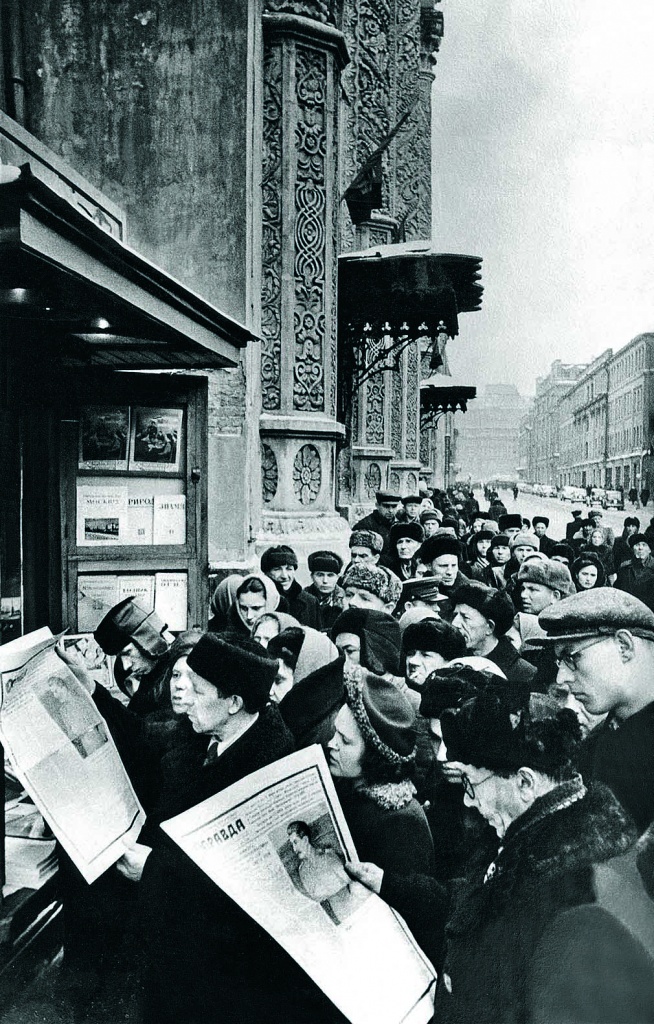
The queue for newspapers reporting the death of Stalin
On the 60th anniversary of Stalin’s death, the project “050353” was created, in which the memories of contemporaries of those events are published. The project is open - anyone can add their certificate ( 050353.ru ). The New Times publishes several texts collected by this project: how the country met the death of the “father of the peoples” and what happened during his funeral
"It seems that all the brakes refused"
Maria Pogrebova, born in 1931
There were no repressed in our family, but my mother had many arrested acquaintances, and she left no one, while it was possible, corresponded with everyone. And then it was clear that this could happen to anyone at any moment: after 1937 my mother had a gray strand / ... / in 1953 I was 21 years old, I studied at the university at the university. At first they announced the disease of Stalin, and in general, everything was already more or less clear. I remember this day well, because we then filed an application with the registry office - so by chance coincided.
There was no talk about the fact that, at last, thank God, we had no place at home, and this is that we all were appropriately configured.
Vsevolod Romanovich, my still future husband at that time, said that when it became known about the death of Stalin, his mother woke him up and said: “Stalin died - there will be no wedding!” / .../ How sincerely everyone cried - I do not know. Of course, people had a feeling of the end of something, the end of the era. “Stalin died - there will be no wedding” - from this many cried: it was completely incomprehensible what next.
My husband and I studied on the same course, both were quite correct Komsomol members. And at the university there was a conversation that you need to gather a group and organized to go to a funeral. Then we somehow were not going to go, and then announced that there were so many people who would be so far that there would be goodbye at night. And then we decided to go - interesting, because at night!
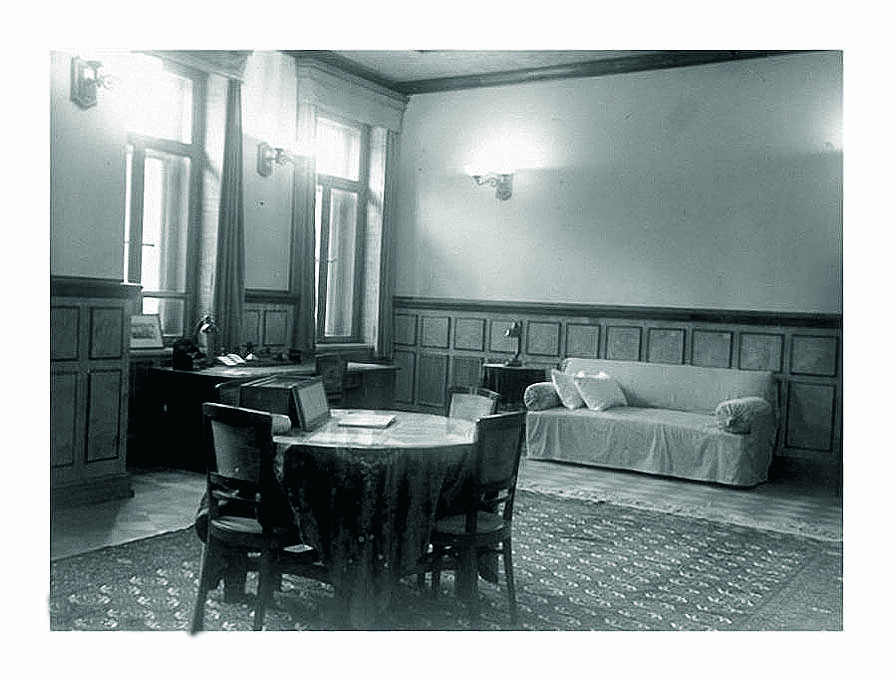 |
| Middle Cottage of Stalin. According to one version, he died on this couch |
This night I remember very well, this is a feeling of chaos that has come. I experienced this feeling twice in my life. The first time was famous on October 16, 1941, we were then in Moscow. And the second time - on the day of farewell to Stalin.
We left my groom's apartment in Koptelsky Lane. I remember that for some reason some sandwiches there were wrapped with them. We went down to the boulevard from Kostyansky Lane and went to the pipe - just where a terrible crush occurred in the end. When we joined this crowd, it was already night. It was a strange feeling from this crowd - they walked slowly, and many laughed, laughed. I remember there was an elderly couple, they were all indignant and said: “What is it!” I also remember how a tram suddenly drove past us, at night, it is not clear where he came from. Just like the Gumilev tram, he flew without stopping. There were also groups of hooligan teenagers who periodically attacked the queue. Their idea seemed like getting out and taking a place out of line, but in fact they obviously not needed it, but somehow I wanted to fight, or something. And men kept the defense. It is amazing that the police were not visible anywhere. There was a clear feeling of chaos, it seems that all the brakes refused - anything could be under Stalin, but this could not be.
So we walked, they got along the boulevard, and then we felt bored, and we went home. And very on time, because otherwise they would have got into the very crush.
The newspapers did not write about this, but that there was a crush and many people died - everyone knew /... /
It is interesting that after Stalin was buried, he was sharply stopped mentioning on the radio, in newspapers.
"Mom said" thank God "and continued to work"
Anastasia Baranovich-Polivanova, born in 1932
I then studied in the Spanish group of the Romano-German branch of the Filfak of Moscow State University. And for several days before March, our Spaniard-teacher and I, at each lesson, translated the ballot about the health of Stalin, which was printed in all newspapers. All, including the temperature and amount of protein in the urine, were translated right from the move from Russian to Spanish, just as for some time before that we translated the news from North Korea.
On March 6, I came, as usual, to classes, we were gathered for a mourning rally in a large communist audience in a new building of the old university, where there is now journalism department. What exactly was said - I do not remember. I saw in the corridor of the party organizer, who sobbed into a voice and could not stay on her feet, she was held under her arms. At the dean, under the glasses of a pince -nez or glasses, tears gleamed too.
The mourning rally did not last long, because the next lesson, as usual, took place at the philological faculty, that is, in the old university building. It was a seminar on Marxism. Although there was no class as such. I remember sitting a shocked teacher of Marxism, by the way, a very sweet person, and says: “If they were now asked that I have the most expensive? Daughter, of course. And tell me: give it back - and he will resurrect - I would agree. " /.../
After the university, I went to my mother and talked about the death of Stalin. Mom at this time printed on a typewriter. She crossed herself, answered “thank God” and continued to work.
All these days on the radio from the early morning they transmitted classical music. And the flags were visible in the city.
"
I can’t say that these were corpses, but these were crushed people. And at the end of the boulevard - a huge bunch of galosh
" " I began to make my way under the feet of people "
Ella Opinaya, born in 1935
I still remember how one day, sitting on my mother on my knees, I ask with mental pain: "Mommy, tell me who I love you or Comrade Stalin more?" I adored Stalin. And suddenly, when there were only a few months left before the final exams, they announced that he was sick. We walked, I remember, at school and cried. And then on the radio announced that Stalin had died.
The radio then never turned off completely, so we all learned from this small “plate”. At first, some classical music played, and then they reported the death of Stalin. For us it was just a tragedy. Dad, of course, did not cry and did not say anything. But I cried, mom and neighbor too. These were two party members who sobbing without drying, roaring roared. All covered grief, the greatest grief. How will the country live? How will we live without a leader, without Comrade Stalin? Well, how can we live without him?
We had a solemn line at our school. All students came from the first grade to the tenth. All teachers sobbed, we also sobbed. They stood on the ruler, and I could not move, and one girl from our class even fainted. Everyone began to give some oaths. First -graders swore that now they would only study “good” and “excellent”.
Parents did not go goodbye, but I went with the class. I didn’t say anything to my mother and dad - perhaps they would stop me. 22 people, organized - we did everything in an organized manner - we escaped from the lessons. We were very neat and diligent, Komsomovka pioneers, but we simply could not stand it. Even, as far as I remember, they missed the control in algebra. We decided that we must go.
We knew only one thing - farewell in the column hall of the House of Unions, and began to make their way there. Everywhere there was a cordon, and we did not know what route we did not know - we went to where we saw the clusters of people. I remember very well how we found ourselves on Lubyanka - there was an equestrian cordon, and we, as obsessed, climbed right under the horses. From Lubyanka they made their way to Kuznetsk, overcoming all the barriers. Somewhere we even passed the roofs. They jumped out almost to the very column hall, but a policeman approached us and ordered us to go to a pipe - in the tail of the line.
The queue was pushed from the Christmas Boulevard, there were more and more people. We were very hungry, and then there was some small bakery. We bought a paper bag with dryers and gnawed on the go. At some point, the crowd began to push, the river of people began to stagger, screams were heard.
We walked on the left side of the tube, where the boulevard was at home, and there was a boulevard on the right, and there were all cars, huge buses, trucks with the military. These houses, as a rule, had cellars, where people also huddled at that time, windows came out of these basements, and bars lay on top of the recesses. And we saw that the crowd was crushing so that these bars simply drove off, and people shouted to fail there. I was seized with wild fear that now I would fall there. I began to make my way under my feet and tried to get to the right side, which bordered with the boulevard.
It was no longer possible to raise a hand, it was only possible to stand with lowered. And now one of our girls had a bag with the remains of drying in their hands. She could not raise it and could no longer hold it. She released him. And this package - he did not fall. It is in front of my eyes. Such a miracle: this package did not fall. He hung and hung. He sagged in the air for some seconds, and then fell, and the crowd went through these dryers, and the sound was terrible, as if along the bones.
People all pushed and pushed, there was not enough air, no one could breathe. Wild screams, screams, fainting, people crawled. I understood only one thing - I need to get to the right side. And it so happened that I came up to this fence, where there were cars.
On that day, I had a jacket with a hare fur-my uncle was a rather important worker and received a jump in Lend-Lisa as a gift. And when I was already completely clicked on the pipe, I felt that everything was just split inside me! Blood flowed from the throat and flowed to this white jacket. There was a young guy, he held out his hand, grabbed my scruff of my scruff and threw it on a boulevard.
Then our girls also began to seep and go to the boulevard. No one reached the column hall and did not bury Stalin. I lay in the snow and I remember - everyone came up to me, and the question was most worried about us: “What to do? The jacket got dirty! " The spot was right by the heart, and everyone began to tear out the fur from this place, tried to clear this blood with snow. Then we learned that our familiar boy from a neighboring school died in this crowd.
A day later, we again ran to the pipe and saw the picture: it stood there, if I am not mistaken, two “student”, drawn by tarpaulin, and there was a crowd of people who were looking for galoshes. I also remembered this moment.
"
"Mommy, tell me who I love more - you or Comrade Stalin?" I adored Stalin
" " On each bench lies a pale man "
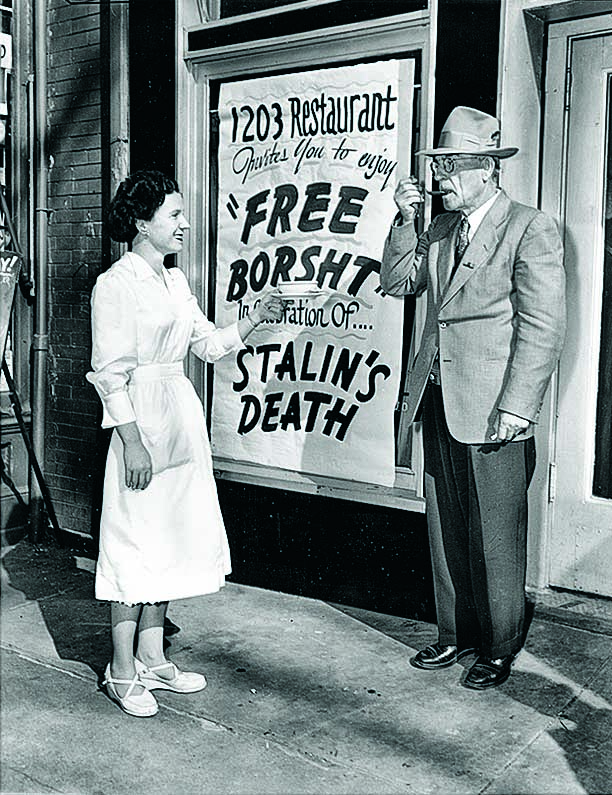 |
| A special action in a restaurant is a free plate of borsch on the occasion of Stalin's death. Washington. May 6, 1953 |
Irina Zolotarevskaya, born in 1934
One of the crashed memories: I go along the boulevards, and on each bench lies a pale man. I can’t say that these were corpses, but these were crushed people because the crush was big. And even at the end of the boulevard - a huge mountain of Kalosh. Now they have forgotten what galoshes are, and then they put them on shoes, and on felt boots, and this Mount Kalosh at the end of the boulevard was very remembered.
"His face seemed to me deadly evil"
Oleg Basilashvili, born in 1934
Mom and father, the news of the death of Stalin met outwardly calmly, and my grandmother began to sob insanely and lament. She was the wife of an architect, an honorary citizen of the city of Moscow, and the October Revolution deprived her grandmother of everything that she had, but Stalin was holy for her. I do not remember in the family of discussions of the death of Stalin.
I studied then in the second year of the studio of the Moscow Art Theater. Soon after the reports of the death of Stalin, students were gathered in the auditorium of the theater, artists performed, and I remember how Mikhail Nikolaevich Kedrov - at that time the artistic director of the Moscow Art Theater - sobbed and could not complete his speech, only pointed to the box in which Stalin was sitting on performances. At this mourning meeting, many closed their eyes with scarves, but I did not cry and even remembered the replica of the Pushkin character from Boris Godunov: “Everyone cry, we pay, brother, and we.”
The lines to the coffin stood crazy. My mother stood in line at the pure ponds, passed the Sretenka and began to go down to the pipe. There, her father found her, pulled out and led her home, and thus saved her, perhaps life. There was a monstrous crush on Trubnaya. Then they said that they found their heads in the square, people were pressed into the walls, one of the residents of the first floors of the houses opened the windows and dragged people to their apartments, but many were still killed-Stalin carried a huge number of victims with them. In the newspapers about the crush then they did not write anything, but everyone knew about it from each other.
And I joined the queue and ended up in the column hall of the House of Unions. There was no honorary guard at the coffin, in any case, I did not pay attention. I was struck that there was no special mourning atmosphere in the hall. It was very light, very dusty, and a huge number of wreaths stood along the walls. Stalin lay in a uniform with brilliant buttons. His face, which in the photographs was always so kind, seemed to me mortally evil.
My father, the director of the Polotebelsky Polytechnic Communication, was invited to the mourning of the party of the party to the mourning ceremony on March 9 to Red Square. Naturally, he stood not on the mausoleum, but on the opposite side - near the hum. Then he told me: “You know, Beria made a strange impression on me - the hat was pushed into my eyes, and the nozzle was wound above the nose. He looked like an American gangster in the cinema. " It was then that Beria shouted: "Who is not blind, he sees that on these sorrowful days ..."
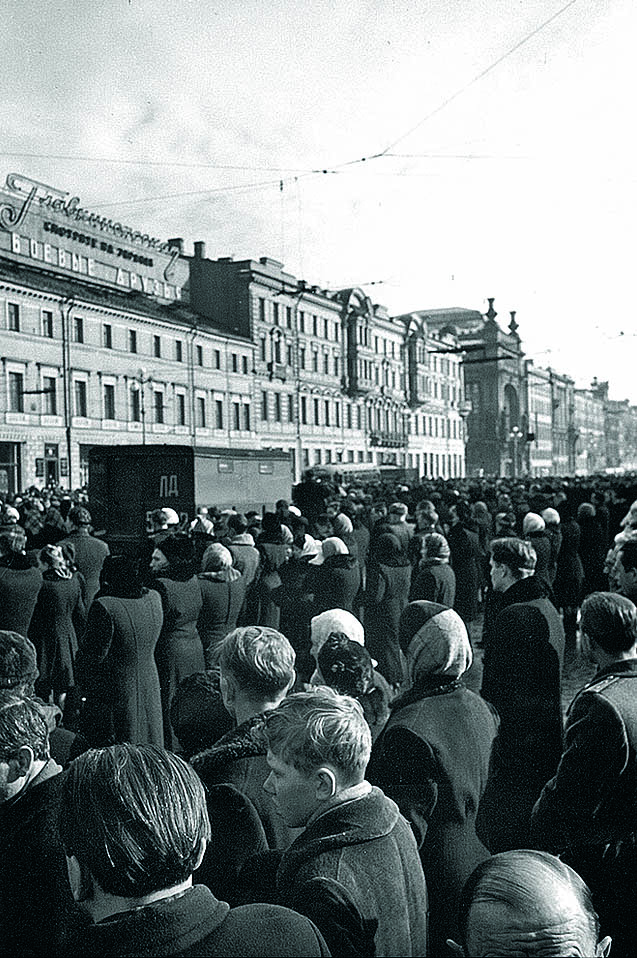 |
| Nevsky Prospekt. Farewell to Stalin. March 9, 1953 |
"And the public sobs began"
Natalia Starostina, born in 1942
I was 11 years old, and I did not even really know where my father was. No one said “your father is sitting,” and no one hid it particularly, but it was not clear what. And it suited me.
My mother and I wandered at the aunts at that time. The nanny has already died, my mother returned when I was five years old - she, thank God, gave a household article for a bribe to the guard. She wanted to convey some nominal clock, she was put on this matter. They registered her at the ball, the younger brother-he was a disabled warrior, had some opportunities.
We lived in him in a communal apartment on Bolshaya Georgian, then with the rods on the Begovaya, then by the Quaw, my beloved aunt, the sisters of his father, who had three husbands, all athletes. The first, Viktor Prokofiev, shot, the second, Palch Tikston, a Russian Englishman, was planted, and they were in exile with my father. And the third time she married Victor Dubinin. He was given an apartment on Sadovaya-Triumphal, two-room, but it was the impression that it was a palace. Moreover, he was not fundamentally in the party. This was the first person, even before the father who participated in the education of my anti -Sovietism. He listened to voices when no one had yet had a radio, called a bastard on Stalin, said that there was nothing worse than the Soviet structure and that he was ready to be unemployed a thousand times in the West. In addition, a terrible anti-Semite of some kind, I would say, a fascinating slope-he believed that the Jews made a revolution.
Mom was afraid to discuss these topics. Later, when the father returned and said: “One bastard ruined all nature (this is Michurin), and the other is all my life (this is Lenin),” my mother answered: “Talk, talk, you have already been imprisoned for your language, now you want it to be imprisoned, because she will go to school and tell everything there.”
What was Stalin for me? I knew that he was the main one, and saw a beautiful face in the portrait in the "native speech". Lenin seemed to me shamefully a freak, and this one! No KhoVtin was visible, no growth is visible, but only a glorious smile and soft squint of the eye. This white -toothed! In general, my friends and I chose who liked anyone. Molotov captivated us very much. The picture of Stalin and Molotov with children is just to die! There were some conversations that Stalin was sick, but out of my habit to shy away all the unpleasant I tried not to listen.
I learned about his death at home. Then I went to school, from Begovoy to Georgian. We came to school, and this public sobs began. I remember that we stand at our desk, and everyone sobs to insanity, starting from Marya Dmitrievna. Our class teacher Marya Dmitrievna Shustova-they said that she was from the family of merchants Shustov-she closes with a handkerchief, pronounces something sobbing, and everyone sobs. And I have a single tears. Not out of protest, but I generally have bad tears in such things. It is necessary to cry, it is indecent, when everyone is sobbing, but here there is some kind of stump. And then Marya Dmitrievna, I am so grateful to her, perfectly understood the situation and said: “Enough, girls, cry, this is weakness. Do you know who is actually experiencing the most? Natasha. She has what is called stone grief. " And everyone looks at me with respect.
The official part of the sobs is over, you can go home. And I had a friend Tanka Solovyova, such a funny beauty. And so Tanya and I leave the class and begin to laugh - we have a tantrum, we can’t stop, we are falling on each other from laughter, almost crawling at the wardrobe. Then the nanny sticks out and says: "Girls, go home from sin home."
"
They found their heads in the square, people were pressed into the walls. Stalin took with him a huge number of victims
" " Do you think Moscow will not be renamed to Stalin? "
Georgy Mirsky, born in 1926
At that time I was a graduate student at the Moscow Institute of Oriental Studies, I was 26 years old. We heard the news with my mother on the radio, my mother ran out into the corridor of our communal apartment, came across a neighbor and exclaimed: “Stalin died!” The neighbor clamped her mouth with her palm: "You are crazy!" - "Yes, they said on the radio!" - "No, what are you, silent!"
I immediately went to the institute, almost all students, most teachers and graduate students have already gathered there, everyone arrived voluntarily, spontaneously. A rally who performed a lot. The future famous television observer Farid Seyful-Mulukov says: "As I heard about this in the morning, it seemed that the sun had gone." He then asks me: “Do you think Moscow will not be renamed to Stalin”? I, as an editor of the Institute Wall Gazeta, write an article that begins: “On this rainy day ...” The secretary of the party committee corrects: “There is no need to handle the Central Committee of such words, no, cross out.” / .../ These few days after the death of Stalin, people walked like a bag of banged, I repeat, not because they loved the leader, but because Stalin was part of his life, constant and indispensable, with his death the main stone of existence fell, it became incomprehensible how to live on. Never for all those days I have not seen a single person who would look deeply experiencing, sobbing-not one----and-they! But everyone was confused.
But already in April, acting with lectures, I finished them not like before: “And the key to all our successes is that the inspirer and organizer of all our victories great Stalin leads us!” Now, instead of the last two words, I said others - the "Communist Party."
Photos: AP Photo, RSECFD/Rosinform, Photoxpress, Ap Photo