
Translated material
Alexey Muravyov: Stalin - in you and in me
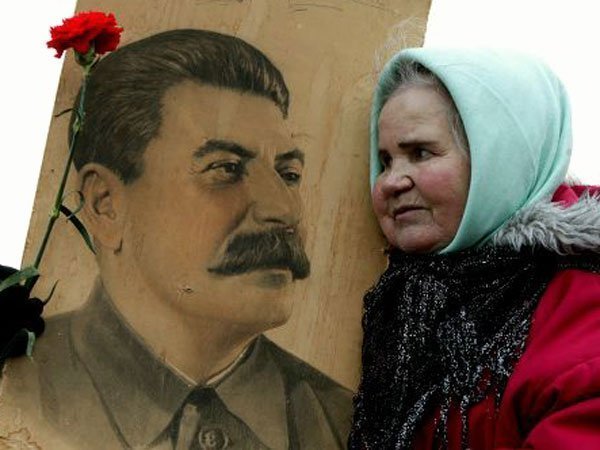
Alexey Muravyov 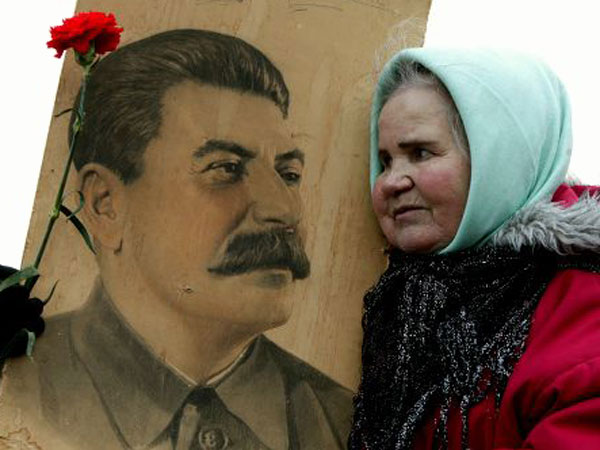 Portrait of the leader photo: kafanews.com
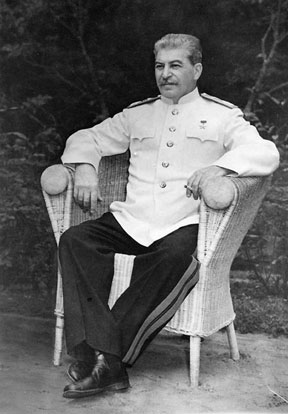 I.V. Stalin
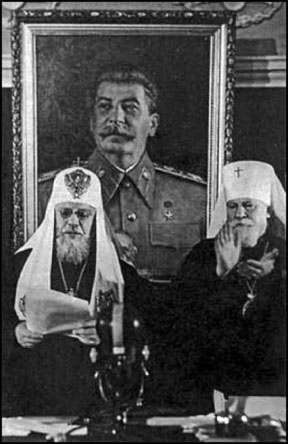 Patriarch Alexy I and Metropolitan Nikolai
 Portrait of the leader photo: kafanews.com
We were born in the Stalinist house to the sounds of Stalin's songs, went to the Stalinsky school and went to the Stalin University on the Stalin Metro. And it doesn’t matter that we, born in the 1960s, no longer found a little Ossetian with an ration with an osopa-erased face, which brought horror on some, and inspired others to manifest delight and labor enthusiasm. And the post -Stalin country did not, taking Kobu out of the Mausoleum less connected with him. Rather, the stray Leninism of the Khrushchev and Brezhnev eras was a spell, an attempt to free himself from the shadow of Stalin, who, according to the apt word, Leonid Blehera took away the future in the name of the present.
In the 70s, we repeated the mantras of the times of Trotsky and Lenin about a bright future, but there was only the present, only what we saw, sniffed, held in our hands. The fact that the head of the head and the warehouse was taken out of the back room, what was hung on the wall and placed on the shelf. Under Stalin, literature turned into waste paper, and with Brezhnev, the process became the opposite. Dumas and even Tsvetaeva were given to us for the waste paper, but in the absence of the future they were a decoration, wilted flowers on the grave of our future, sacrificed for the sake of today.
I.V. StalinStalin is inextricably linked with the grandeur and squalor of our country. He managed to format our story so much that she was lined up in a line going from Alexander Nevsky through Ivan the Terrible and Peter the Great to the Kremlin window, which, according to legend, does not go out even at night. There, the leader sat and thought about his people. It turns out that it is worth starting to talk about Great Russia, about a strong state, about great achievements, as we inevitably fall into the style of the Stalinist large project. It seems to me that our main problem is precisely this: we need to talk about a large project, and we can speak, it turns out, only in Stalin. And this depreciates everything. Stalin had to work with people as a mass, for which she had to be dehumanized. He sculpted in a large way, took his hand, took his leg, put someone else's side on the other side ... Stalinist Russia in core repressions squeezed, compressed until it was completely drunk. Russia was depopulated, the distance between people became too large, people stopped feeling their neighbors at an extended hand.
What is the Stalinist political ideal of the present, which sacrificed both the dark past and the “bright” future? How is it arranged from the vision current of its sacred component? What was this project? A simple answer is usually the wrong one, it says that the state of workers and peasants was built. But this is not true, if only in the sense that in Stalinist Russia, classes that began to form in Russia Romanovskaya gave way to classes. A huge city tax estate, the rural estate of Smerdov and Rabskoye - in camps and prisons. At the top of this pyramid is a layer of bosses at the stage of high instability due to constant rotation. What is motivated by all this colossus besides fear, crazy enthusiasm and a sense of duty?
The fact is that Stalin (and in this, no matter how difficult to accept, his greatness) correctly understood one important thing. No national undertaking in Russia can ignore the Constant “Third Rome”, both in its rhetorical and political form. You can call it differently, vertical goal-setting, eschatological self-awareness, the idea of “Byzantine success”, this does not play a big role. Stalin realized that from the whirlpool of utopian Marxism you can get out only for his own hair - for his own past and for different methods of awareness developed by the past. This understanding was intuitive and inconsistent.
He could not, of course, throw off the dilapidated web of the Marxist dogmas and continued to express himself in the Leninist language. But the language is difficult to teach politics, another language is the ability to adapt himself to a new structure, and Stalin is used to breaking structures for himself. One way or another, Stalin, frightened by the military enthusiasm of the people, took a step towards the “third Rome” - he introduced separate training and tried to introduce Latin in schools, ordered to recreate the “Byzantine Temporary” and even the Byzantine Institute in Istanbul, ordered Eisenstein his large patriotic films. The magazine and films remained, everything else sunk into oblivion.
Stalin did two more fatal affairs. One indirectly destroyed all his undertakings, and the second for a long time was inhibited by the revival of what was called “spirituality”. In the late 40s (more precisely since 1948), Stalin initiated articles about “theater critics”, “Bezrodny Cosmopolitans” and killer doctors. In other words, he stepped on the main Russian rakes, on which Romanovsky Russia with the “Union of the Russian People” and other patriotic initiatives came to the Jewish question. Izing Jews, turning negative energy to them was a traditional course . As Ossetians and partly Georgians, Stalin was not very sensitive to this personally, but his mind worked for sure. He tried to expand the cumulative energy of protest and the desire of the future in the usual direction. But this move, as we know, led to the intelligentsia awareness of its foreignity, and then after several subsequent links - to the emergence of sixties and a rather massive anti -Soviet movement.
Children of repressed cosmopolitans created a political culture of a radical alternative to the one in the direction of which Stalin took a step, and in his face - the Soviet state. This culture, unfortunately, makes us look at the third Rome as Stalinism, totalitarianism and repressive policemen to this day. This is not entirely true, but not the nuances. It is already almost difficult to pull out meanings from under the ruins of Stalinism, which clutched our political and cultural landscape. You have to literally recreate them, re -explaining again, embedding again into world culture.
And finally, about spirituality. The attitude of Stalin in the context of his “Russian Renaissance” to the church was not dual, as consumers of myths about the “secret Orthodoxy of the leader” believe. Wanting to create an anti-Watter, he quite cynically drawn to the bishops demoralized by repressions, heading the remnants of the imperial church, into a political adventure, the meaning of which was in instrumenting the church in the types of political utopia. In the recent film, Kravts and Belyakov “Stalin and the Third Rome”, this story is described in detail on the basis of chronic materials. Only the conclusion inspires doubt: Stalin wanted, but he did not succeed, but the Russian Orthodox Church Procedure.
Patriarch Alexy I and Metropolitan NikolaiThe trouble is that Orthodoxy did not prosper from the Stalinist embrace. A secondary symbiotic state-church phenomenon arose, which, like a return disease, repeated the errors of the synodal period, preventing the church from fulfilling its function within the framework of the global civilizational paradigm. This task G.S. Pomerantz formulated as a “return to the depths” of the entire believing people. Instead of this, the born Orthodox intelligentsia in Russia had to lose itself in the interweaving and contrasts of the sixties and seventies, to find meanings through Byzantium or the West separately from the people. And in this Stalin succeeded. His church project did not fulfill the great national task, being one of the offices of what Alexey Mikhailovich and Pyotr Alekseevich came up with. Wanting to revive the church in the name of a large political project, Stalin inflicted another blow to her, from which she could not recover from this time. Of course, the people and the intelligentsia exhibited the bearers of their religious values, Mikhail Novoselov, Ep. Gerontium Lakomkina, b. Luka of Voino-Yasenetsky, others, but their efforts were barely enough to maintain faith in a few. Therefore, Stalin, rather, damaged Orthodoxy than helped him.
The anniversary of death is usually celebrated by saints. Stalin's death was not the end of the righteous. Writing on the carpet near his bunk after a deadly injection made by one of his closest associates, he probably understood that the matter was dies. What has already died is pulling us back, and the fact that Stalin understood the intuitively ingenious instinct of politics remains for us as the constantly existing vertical orientation of our political culture. This culture is promising, its potential is not exhausted. But Stalin's projects and Stalinist mistakes here are not to help us.