
Translated material
The writer Boris Vasiliev died
* 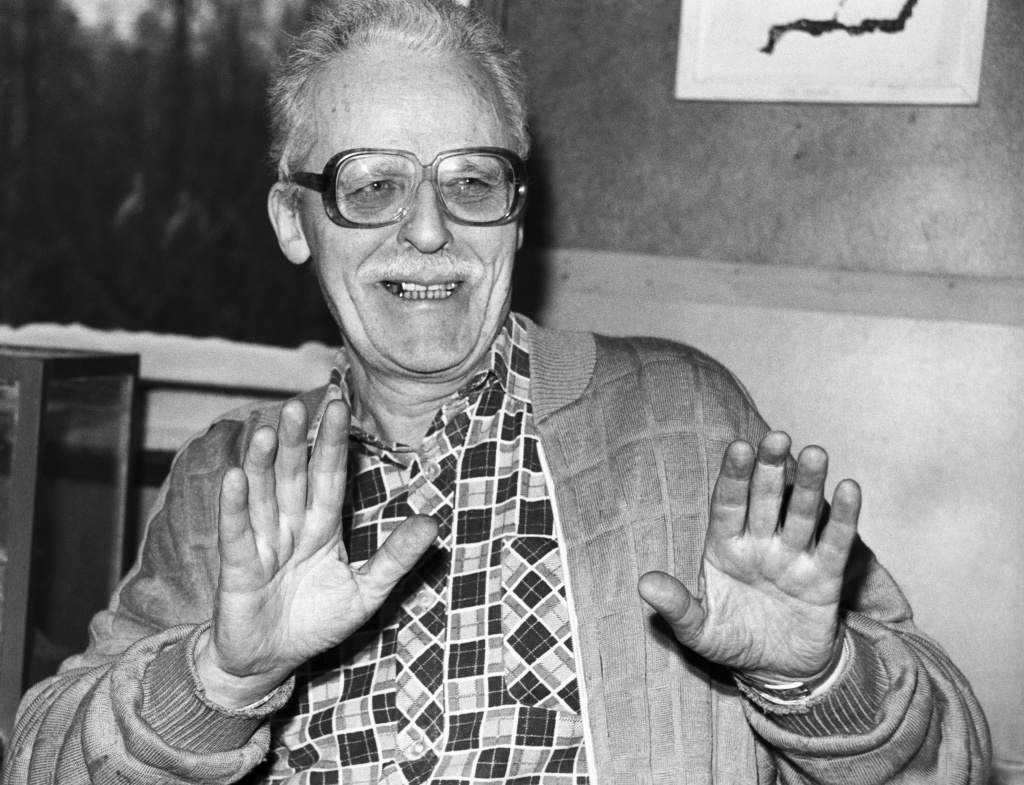 * At the 89th year of his life, the writer-Frontovik Boris Vasiliev, the author of more than thirty prose works, gained popular fame after the release of the debut novel “And the Rawn here is quiet” (1969). In 1974, his novel was released about the defenders of the Brest Fortress "The Lists were not listed." The theme of the generation, who was growing up at the end of the tragic 30s and carried the Great Patriotic War on his shoulders, was continued by him in the story tomorrow was war (1984). Boris Vasiliev is also the author of such resonant works as do not shoot white swans (1973), my horses are flying (1982), whose old man (1982). In 1971, according to the script of Boris Vasiliev, the popular television series officers (1971) was shot.
In the nineties and two thousand years, several novels by Boris Vasiliev from the history of Russia came out.
The New Times published an interview with the writer ( No. 46-47 of December 21, 2009 )
"The orders were covered by losses." The Great Patriotic War again became the arena of the ideological struggle. The victory of the people over fascism is used to justify Stalinism. Frontovik writer Boris Vasiliev told The New Times why he believes that the war is immoral to idealize the war
I'm already old. Old age is a sensation, not age. There is no courage, which was before. I used to write the chapter sometimes for a working day. And now - from the power of the page.
But you are printing a lot.
I work a lot. I forgot the weekend. I was taught by Boris Nikolaevich Poleva. He treated me well. I printed almost all of my early in his youth. And he told me: never put off your job. Every day go, like a miner - to the mine. Much will go to the dump, but at least a piece of ore will remain. I’m a tank test by profession. I never had any humanitarian education.
Genetic code
Is it right to say that the main experience that has formed your attitude is a military experience?
Given that I am a descendant of the military in many generations, then yes, of course. Say, my great -great -grandfather General Alekseev was the hero of the Battle of Borodino. His portrait is in the Hermitage in the gallery of the heroes of 1812. I believe that the code of genetic memory conveys something important to the heirs - a sense of danger, a sense of direction. Once at the front we were waiting for attacks. And I suddenly got up, and even under the light, not deafening, and under a probing artnalet ran into the next trench to his friend. And only I ran like that trench from which I left hit the bomb. This, from my point of view, worked intuition. I am generally lucky, pah-pah-pah.
And what else was you lucky?
I was lucky in the war. I was surrounded when our echelon was bombed, we were taken through Smolensk to the Western Front. We went out for a long time, starved, but managed to go into the Slonim. The luck is that I knew these places very well, because I lived there with my grandfather. My grandfather was a Kropotkinsky populist. I grew up with him, he taught me to read from the age of four so that I would not interfere with him. He himself read in the evenings. He sat in an armchair, smoked a pipe with a long, long forelock, and I sat below and only looked at the pictures. ... Grandfather had a huge library. He taught me to read historical books.
Since that time you have an interest in history?
As a child, I dreamed that I would be a historian. I thought to enter the historical institute. But then the war, and it was not up to history.
The war smells of corpses your military novels appeared at the moment when the “general” literature on the war began to prevail. Is this an accident or did you deliberately go against the current?
I deny the war as a means of resolving conflicts. I remember - the war smells. And it doesn’t smell anymore. No need to idealize. This is immoral. I enthusiastically read lieutenant prose, because it was my peers. And then he began to doubt the fullness of this picture. Because I understood the main thing - behind them are the army, rear ... But what is the one who does not have the rear? Men were born to die in battle, there is nothing to be done here. But at the front it was, I specifically checked 350 thousand women. How did they fight? And without the rear? So the "Zori" appeared. * * The story “And the Zori here is quiet ...”, which brought Boris Vasiliev wide fame, was published in the magazine “Youth” in No. 8 for 1969.
And how do you look at the current interpretation of the war in a heroic manner now?
This is completely wrong. It was written and written by people who did not fight, and if they fought, then for awards. The abundance of orders is completely exorbitant. Stalin was generous with the order. He covered the losses with them, we lost the most in the war. On the eve of the war, Stalin shot all talented people to the hell. And often the captains commanded the divisions. Hence the loss. Another thing that also interfered very much ... When the First World War began, the sovereign Emperor Nikolai Alexandrovich issued a decree on a dry law. And the army went into a sober battle. And in the second world drunk she went. But under the fly you can not fight. A sober eye is needed.
Do you feel about the command without great reverence?
With great respect, I relate to Rokossovsky, and this, one might say, is my idol. The only marshal in the world is twice. * * Konstantin Rokossovsky, Marshal of the USSR, in October 1949, at the request of the Polish government, he was appointed Minister of National Defense of the PNC, and he was awarded the title of Marshal of Poland. He died an order of magnitude less people. Most of all people died with Zhukov, who kept repeating: "Babs of new ones give birth, go ahead!" Rokossovsky spared people. But at the beginning of the war, who were our commanders: Voroshilov, Budyonny and Tymoshenko - Sharkuns, not warriors. Another army won the war, not the one that Stalin prepared before the war.
And how, in your opinion, should you celebrate Victory Day?
It is necessary to celebrate it. And I am idle myself. This is always a very touching day for me. Because it is not only the end of the death of soldiers, but the end of the suffering of women, children, old people ... This is the end of fear. The end of personal fear and the end of the general horror. After all, they broke into the Volga! And they stopped them only by the bodies of the soldiers of the dead, just by bodies ...
But now many say that Stalin’s genius rather more likely.
Stalin was a dumbass. In the army, he never served in his life. He did not understand what the army was. He could not read the card. He is Shaposhnikov - the chief of the General Staff - explained everything on the map. Legends are covered with "Great Stalin". And Comrade Stalin was a fool, worse than Hitler ...
Another world
In recent years, you have been writing a lot of historical novels, moving away from modern plots. What is it connected with?
I realized that the young people are not able to understand. I am the great -grandfather of my current readers. Most of my peers have already left this world. And to write for them and about them it is pointless. And about history is possible. This is interesting. But I am looking for not a plot there, I compose a plot myself. I am looking for an opportunity to tell about the exploits of the heroes. There are heroes in our history, there is love there. And what are the characters there ... Young begin to read. And join history. Well, thank God.
Historical prose of Boris Vasiliev
The saga of the kind of Oleksins (the Profit of the Alekseevs serves as a prototype, to which Boris Vasiliev belongs on the maternal line) covers the period from the beginning of the XIX to the middle of the 20th century and includes six novels: “They were not and were not” (1977–1980); “And it was evening, and it was morning” (1987), “Hello from the Baba of Lera” (1988), “The House built by my grandfather” (1991–1993), “My sorrows” (1997), “Gambler and Breter, player and dueline: notes of great -great -grandfather” (1998). In addition, he released the novels “Prophetic Oleg” (1996), “Prince Yaroslav and his sons” (1997), “General Skobelev” (2001), “Olga - Queen of Rusov” (2002), “Prince Svyatoslav” (2006), “Vladimir Red Sun” (2008).