
Translated material
Oblane Klondike
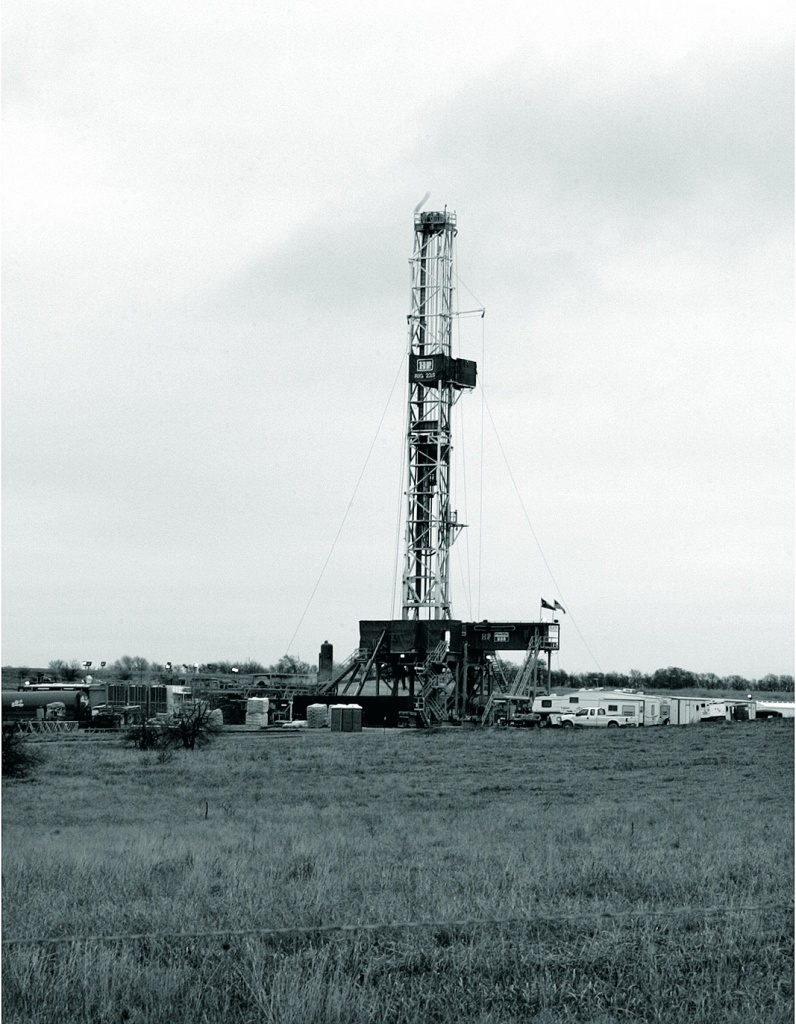
North Texas. The shale field Barnett Sheil. Here the "shale revolution" began
In the United States, the Slantsy Revolution is gaining momentum: exploration and production of shales - gas or oil - is already in 16 states and amounts to 34% of the total fuel and energy complex. And since 2016, the export of American shales to Europe will begin, where Gazprom's natural gas dominates. How began and what the shale boom can lead to-for the answer of The NEW Times went to Texas, the staff leader in the number of deposits mastered
We rush along Hyvei through the endless steppes of Northern Texas-they spread hundreds of kilometers under a serene blue sky, on which, contrary to official symbolism, the myriads of stars (Texas are called the “Lone Star State) due to the only star on its flag.-The New Times). To imagine how countless herds of cows grazed here a little more than a hundred years ago, it is not at all difficult. However, this serenity is deceiving. On the plain here and there, fenced areas surrounded by soundproofing walls are distinguished. Their purpose is issued only by a metal tower that rises above them - a drilling plant. Arriving closer, you understand that sound insulation does not completely save: at a distance of 100 meters, the buzz and periodic clang of metal are heard. The installation works - gas is extracted from the bowels of the Texas prairie.“Not very comfortable“ music ”, right? - The engineer of Devon Energy laughs Brad Foster, catching our embarrassed physiognomy through the semi -entered glasses. -Something reminiscent of an old car on minting coins. But so it really is! " Devon experts, according to Foster, knew that here, at the Barnett Sheil near Fort Werth, there were huge reserves of shale gas and you can achieve huge results in business. But success exceeded all expectations.
Prairia's bowels
The US energy was born in Texas - on January 10, 1901, the first largest oil deposit - Spindletop was opened in the town of Bomont (near Houston). A century later, in the north of the same state, the second birth of the industry took place thanks to the phenomenon of the “shale revolution”. (The New Times wrote in detail on this subject in No. 14.04.2010 and No. 18 dated 05/28/2012. ) The existence of shale gas deposits in the rocky soils of North Texas was known for a long time, but no one knew how to make his prey income until the technological breakthrough of the late 90s.
| *George Fidias Mitchell - pioneer of shale prey. In 1981, despite the negative conclusions of experts, he began the production of shale gas to Barnett Shele, in 1997 he introduced breakthrough technologies into the industry |
“When George Mitchell* tried to sell his company engaged in shale gas production in 1999, no one wanted to buy it, and we, including,” says Larry Nichols, one of the founders and until December last year, the President of Devon Energy, which has become the largest company for the production of shale gas. Barnett Sheil. - No one believed in his technology and its development. But after a couple of years, we decided to go to visit him directly to the place of prey and saw that everything, it turns out, works great. Then we realized: it's time to take. ”
In 2002, Mitchell sold his Devon Energy for $ 3.2 billion. “From the very beginning it was clear to us: the success depends on how quickly we could establish production,” the Devon Geologist Jeff Hall continues to talk over a cup of soluble coffee. - They began to drill at 18 installations and immediately began to think how to increase their number. But then there was a problem of the quality of wells ... "
Nevertheless, those who bought Devon from Mitchell did not lose. This purchase turned the territories adjacent to the Fort Werthu, from the geological puzzle to the most “hot” place of the US oil and gas industry. Over the past ten years, Devon alone drilled more than 5 thousand “wells” on Barnett Shele, increasing its production by almost six times. As a result, the turnover of the company, created almost from scratch in 1971, today exceeds $ 15 billion.
Bee hive
Other concerns, which have invested in a promising industry in time, also reap the fruits. For example, the founders of the Chexapeake Energy, which is now one of the leaders in the field of shale production, Obri McClandon and Tom Ward in 1989 introduced in its authorized capital only $ 50 thousand years later, the revenue exceeded $ 11.6 billion, and instead of ten people in the company are working in the company today, and now this concern is experienced by the crisis of crisis. Difficulties, experts believe that he will be able to avoid bankruptcy.
The peak of the Slender Ligorus was the end of 2009, in which the Exxonmobil oil giant acquired Xto Energy for $ 31 billion, thus also becoming the largest gas producer in the United States. In 2010, Royal Dutch Shell bought East Resources Inc., one of the largest companies producing shale gas in the Appalachian basin, for $ 4.7 billion. Finally, in 2011, Chevron joined the race, having bought Atlas Energy, another large independent manufacturer of shale gas. $ 4.3 billion.
Today Texas boils like a bee hive. In the bars of Dallas, Forta-Uerta and Houston, almost all the conversations-about the beginning of the new era of world energy. New enterprises open, over the past five years, about 100 thousand jobs have been created, the flow of population is growing, and even in the air, animation is felt. According to the Vice President of the Consulting Company of IHS Daniel Yergin, who wrote a number of bestsellers on an oil topic and the Pulletcean Prize awarded to them, 1.7 million employees were used in the fuel and energy complex, and by 2020 this number can increase to 3 million, in the same 2020, said Yergin, expected to profit from The oil and gas industry will add about $ 113 billion to the federal budget.
The course is independence
According to analysts, the “shale revolution” led to a number of factors: in addition to developing and improving Frexing technologies, the wide possibilities of a free entrepreneurial environment that existed in the United States, a favorable investment climate and the growth of world prices for “classical” oil and gas, are confident by Larry Nichols.
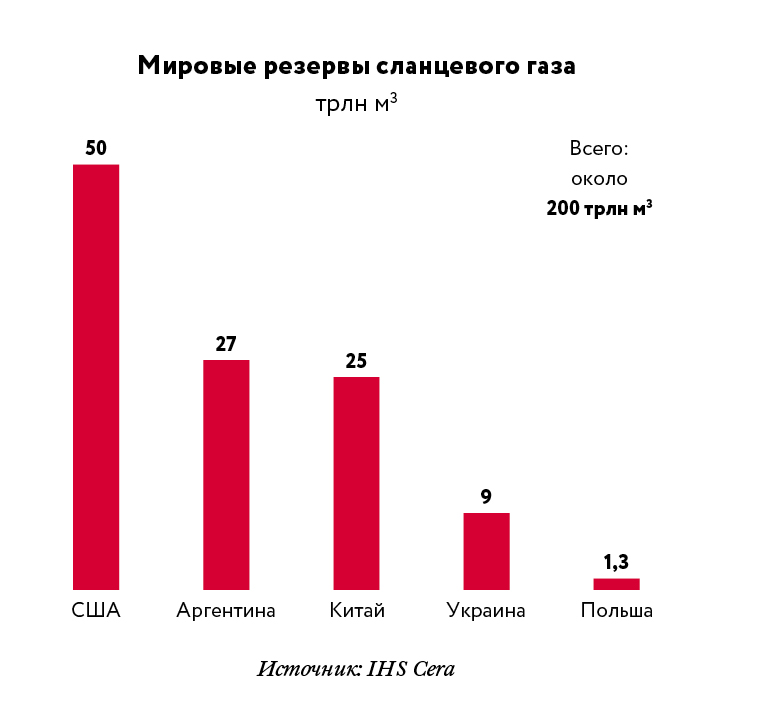
America today is more close to energy independence. Slender gas reserves in the world are estimated at 188 trillion cubic meters, while in the USA it is concentrated, according to the international energy agency (IEA), about 50 trillion cubic meters. If in 2000 the share of shale gas in the structure of the total US gas production did not exceed 1%, then in 2011 it reached 34% (214 billion cubic meters). As a result, over the past ten years, gas imports in the United States have declined by 45%, including imported natural gas (LNGs) - by 19%. According to the forecasts of the IEA, by 2015, the share of shale gas in the United States will increase to 43%, and by 2035 to 60%. Thus, the United States will become the world's largest gas producer, overtaking Russia.
However, the “shale revolution” created the conditions for a new energy future not only in America, but throughout the world. As experts expect, in 2015, on the Pacific coast of the United States, the first port will open for the export of shale gas to Asia, where today high demand for energy resources and energy prices are very high: so, gas prices in Japan today reach $ 600 per thousand cubic meters.
China, who has experienced difficulties in the domestic energy market in recent years, has also become interested in the production of shale gas on its territory, the benefit of its reserves in the Middle Kingdom is large - about 25 trillion cubic meters (estimates of the Chinese Ministry of Natural Resources). The Chinese government set a goal-to establish the production of shale gas by 2015 and reach the level of production of 100 billion cubic meters by 2020. Already, Chinese companies are forming joint enterprises with American manufacturers (Shell, Chevron, Cheespeake Energy, Devon). However, Wood Mackenzie to analysts this goal seems to be unrealistic due to the complex geology of China, a lack of water resources and insufficient foreign participation. Yes, and the volume of Chinese resources, they believe, official sources overstate: the figure of 11 billion cubic meters, in their opinion, looks more believable.
The US shales of the United States inspired European countries, primarily Great Britain, Germany and Poland, which since the late 2000s began to actively conduct the intelligence of shale gas in their territories with the involvement of American companies. However, according to the experts of the British Royal Institute of International Relations (Shatham House), a number of factors impede the successful commercial development of shale in Europe: a more complex geology, dense population, strict regulation in the field of environmental protection and protests of environmental organizations, as well as a lack of financial incentives and tax benefits. According to Chatham House analysts, the shale gas will still play a role in Europe, but not earlier than 5-10 years later.
Russian private traders showed interest in the US shale projects by private Russian investors. One of them is Mikhail Yuryev, the ex-vice-speaker of the State Duma, in January of this year announced his intention to attract about $ 2 billion through the AMSHALE CAPATAL PARTNERS Foundation for the production and processing of shale gas and oil. According to him, at least half of the funds raised will amount to the money of American investors and about $ 200 million - Russian. This decision, according to Yuryev, is largely due to the fact that small and medium -sized companies in the Russian energy market with its limited access to resources and an uncompetitive environment have little chance of survival. But in the USA these obstacles are absent.
The Yuryeva fund will focus on investing in shale projects in Texas, Montana and Louisiana. In addition, Yuryev is going to use the price advantage of the American gas market: cheap shale gas made various energy -intensive production, in particular, the production of chemicals. Therefore, in Louisiana, for example, Yuryev plans to build a plant for the production of urea for its supply to the growing US nitrogen fertilizer market.
It is noteworthy that Yuryev began investing in shale projects three years ago through Pesto Investments Group. And even then, he publicly declared the consequences of the Slantsev Revolution for Russia. According to him, the Russian government should sell its main assets in the oil and gas industry - Gazprom, Rosneft and Transneft. Moreover, to do this as soon as possible, while they “cost a lot”, because in ten years their cost will fall greatly - according to Yuryev, ten times.
"
Some believe that the protests of ecologists against the “harmful” production of shale, now and then passing in different American states are sponsored from Moscow
" Glory look
Official Moscow prefers the slate to ignore. According to the Gazpromov Institute of VNIIGAZ, in Russia a total of about 20 trillion cubic meters of shale gas. The head of Gazprom, Alexei Miller, has repeatedly called the “shale revolution” planned by the “PR campaign in the media”, and his deputy Alexander Medvedev was “soap bubble”. The aplomb top managers is based on their confidence that the demand from Europe, where Gazprom supplies more than 200 billion cubic meters of natural gas per year, will inevitably grow. Meanwhile, the company's reports published in mid -February last year indicate the opposite: the drop in exports to Europe in 2012 amounted to 8%, and this was only the beginning. The full entry of the United States to the export market of gas and the beginning of the production of shale in Europe will lead to the fact that Sales of Gazprom will only fall.
However, many American experts in Texas assured us: Bling, Moscow actually closely monitors the development of events. Some even believe that the protests of ecologists against the “harmful” production of shale, now and then passing in different American states, are sponsored from Moscow. “The Russians understand that the days of their dominance (in the energy market) are numbered, and try to protect themselves,” said Fiona Hill, senior researcher at the Washington Institute of Brukings, Senior Researcher. Her words are indirectly confirmed by the fact that Gazprom has just concluded a contract with the consulting company Pace Global, which is studying the situation in the shale gas market located in Virginia.
According to experts of VNIIGAZ, the industrial development of shale in Russia does not make sense to start earlier than 2025–2030. Well, if Moscow really adheres to these dates, the World Slantsy Revolution, most likely, will pass by Russia.
** Mariliz Arditi, expert on energy and risks of the industrial influence of the Association “France. Nature. Environment":**Shtanets are now obtained by a hydraulic way - in France, as in many other European countries, this is prohibited by law: environmental damage and danger to humans are too large. Firstly, in order to serve one shale shaft, you need 300-400 trucks that will constantly carry water, and it is pointless to build a water supply, because the lifetime of the mine is five years. Secondly, in addition to water, high toxic compounds that pollute the soil are used to break the layers. But most importantly, think about what is happening with the water that is used for production! Saturated by gas, it does not just remain in the soil, but enters the surrounding reservoirs. There were examples when people living next to shale deposits could no longer drink tap water, because soda poured from the tap.
Of course, the Americans do not give a damn about it-they still bargained the opportunity to get the slate at George Bush Jr., without looking back at the legislation on soil, water and even drinking water. But I hope that most European countries will wait for an invention of some new, safer method of production.
Dmitry Zliznorev took part in the preparation of the material (Washington)
Photo: AP Photo