
Translated material
Give your work screws on the labor market?
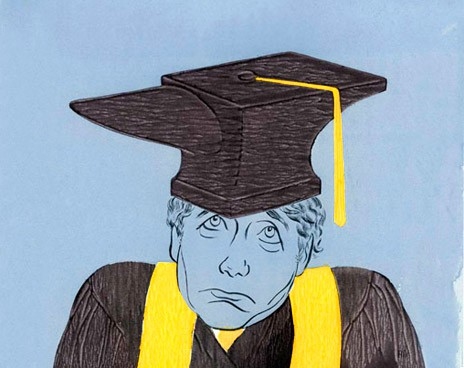
In the educational center "Memorial" was a round table " How to reform a higher school and protect the interests of teachers and students: history and modernity ." To discuss the problem, the doctor of historical sciences, professor of the RANEPA and RSUS Konstantin Morozov, a member of the organizing committee for the convocation of the constituent conference of a free trade union of university teachers Pavel Kudyukin, a doctor of historical sciences, representative of the Universal History of the Russian Academy of Sciences Vadim Damier, associate professor of the History Faculty of Moscow State University, Aleksey Gusev and other experts. Slon publishes fragments of discussion.
What is happening with teachers now?
Konstantin Morozov: Without a doubt, you cannot make the teacher extreme. Now the Minister of Education is direct responsibility for the state of affairs of higher education. Under the leadership of the previous minister Andrei Fursenko, for several years, the collapse and degradation of the entire system took place, and the authorities actually entitled to self. Those negative moments that have now divorced in our universities are the low quality of teaching, bribery, corruption, and so on - of course, need to be treated, but not as it is done, for example, with the exposure of dissertations now. Teachers should not act as beating boys, they should not be objects of those exercises of the Ministry of Education, which supposedly knows what is needed for the country. Teachers should be equal to the participants in the process, they must determine the strategy, choose the education necessary for us, decide what goals it should pursue.
The issues of the labor of teachers, their scientific activity, salaries and protection of interests are extremely relevant, so it is no coincidence that recently the process of consolidating this group has recently begun - now the issue of the emergence of a free trade union of teachers of Russia is now on the agenda. The conversation about the development of the scientific activity of the teacher, about the mandatory publication of one or another number of works reminds me of the expression of one satirist: “Why does the ballerina just twist your foot? Let's tie a dynamo machine to it, let it produce electricity. ” Some teachers were behind the poverty line and are forced to work in two or three work. To approach this issue from the point of view that they do not sit at eight hours at the workplace every day, loom and, therefore, need additional work, it is simply impossible. If you look at European teachers and try to offer them this, it will cause bewilderment and laughter, because it would not occur to anyone to load the professor with so many cases for such a salary and still demand scientific achievements.
Pavel Kudyukin: Russia runs ahead of the steam locomotive, and many neoliberal trends are expressed in an incredibly exaggerated form. If in Western Europe and North America there is institutional inertia and the level of self -organization of the university community is quite high, then in Russia the latter is completely absent; In addition, we do not have a single community of teachers, only a scattering of separate employees of higher education. Institutional inertia partly fits into neoliberal logic.
The Soviet education was just imprisoned on what we are again offered to focus on - to drive on a mass scale of the screw on the labor market. Many do not work in their specialty, although this is a big question - what does it mean to work in a specialty in a modern extremely dynamic economy? If a person can do something else besides his alleged activity, this suggests that education performs some more serious functions.
What makes us collect signatures against the new law on education? This is, first of all, the fact that the new law is destructive for the modern education system. It involves the utilitarianization of higher education, its commercialization and avoiding the preparation of not only a narrowly sharpened specialist, but also a humanistically educated citizen. Either neoliberal capitalism will kill higher education, or a higher school in the person of teachers and students will contribute to destroy neoliberal capitalism and replace it with a more humanistic and fair social structure.
What is the root of evil?
Vadim Damee: If in Soviet society, education was subordinated to the release of those people who will fulfill the plan, that is, ultimately subordinate to the economy, then in our time education is also subordinated to the interests of the economy, that is, the production of qualified labor for the labor market. It makes sense to put this question not only in humanistic, but also in a general social plan.
Education, as well as healthcare, refers to social services, and the activities of these services go beyond simple training of specialists. Just as medicine is the provision of the right to life, education is to ensure the right to the future. And in this case, social services cannot and should not serve the interests of the economy. Since Soviet times, we continue to forget the same truth - not a person for the economy, but an economy for humans. But we live in another era, when other winds are blowing, already named here neoliberal. We love to look at the West, but we forget that our interests are very different. In addition, we only take from there what we like. Meanwhile, in the West there was such a thing as 1968, when education reforms went against those reforms that are now taking place around the world, including in Russia. The question was raised that education is a social mission, it should serve as the formation and development of a human person, and not the economy, and that the current education should be changed towards greater democratization and accessibility, under the control of teachers and students.
Do we go today with new reforms towards freedom and democratization of education? No, we are moving towards elitarization, to narrow the circle of people who receive education, so that the system is as much as possible, so that people, even when they receive an education, receive it on a limited scale. If such economic criteria as profitability and effectiveness began to apply education, then the mechanism called scissors entered the work here. In many Western countries, this is called the regime of strict savings; It is now carried out in countries such as Spain, Portugal, Italy. We don’t seem to have a crisis, but if we look at the educational budget, then we will face all the signs of this regime. The budget for this year: military expenses increase by 26%, education costs are reduced by 3%. Scissors cut the future of our children. The method of this cutting, by the way, is very simple - it is enlargement. Now everything is enlarged - hospitals, schools, universities, this resembles the notorious Khrushchev’s enlargement of collective farms.
This trend needs to be stopped, it will not stop by itself, because people who adopt laws do not want to listen to society, and it is impossible to persuade their society to listen to society. They begin to reckon with people only when they shout loudly and act loudly. And in this sense, the creation of military trade union organizations that could be resisted that could recall the rights of employees of the field of education and students, is, of course, necessary.
Alexey Gusev: The quality of education is quite low, the knowledge gained by students is often unnecessary, they cannot be used adequately. In addition to all this, education is transferred to a commercial basis, but teachers continue to receive a meager salary. The teacher's voice is almost not heard. Where is the root of evil of everything that happens? There is an opinion that the reforms of the 1990s and 2000s are to blame for everything, and the way out is seen in completely returning to Soviet programs and textbooks. In fact, the education system suffers from the heritage of the Soviet system, the system that was formed in the Stalin period. Then the education system was supposed to correspond to the overall totalitarian model of the development of society - it was not the ability to critical thinking and the production of own visions, but the willingness to subordinate and do the work. Hence the attitude towards passive assimilation of knowledge, memorization, an authoritarian type of communication between a teacher and a student and the lawlessness of teachers before his superiors. Today all these things are preserved. The problem is not the excessiveness of reforms, but rather in their failure.
On the other hand, the reforms went, go, are planned in the future - what is reformed? It is not what causes dissatisfaction with the university public, the discontent of society as a whole. It seems to me that in the course of these reforms there was a hybridization of the Russian education system, when new values formed in the Stalin era joined the new values that arose under the influence of modernity in the 1990s and 2000s. As a result, a system of education was obtained, combining political authoritarianism and market-capitalist fundamentalism. In the paradigm of this system, education is considered not as a person’s right, but rather as a certain service, that is, what is provided on an optional, and therefore paid basis. Hence the commercialization of education follows. Higher school becomes a place to make money-hence the decrease in state funding and its transfer to students, an increase in expenses for a military-reinforced sphere. The desire to save on teachers, the introduction of effectiveness models also fit into this logic. It turns out that the teacher is on pressure, he is motivated to ensure that the final product (graduate) is produced with minimal costs.
How to change this situation? The field of education cannot change in isolation from other spheres of public life. Education is only an organic part of the social system. Therefore, the first step towards changing approaches in education is the democratization of the entire political system. But this is not the field of the trade union, the field of the trade union consists in protecting the interests of the rights of teachers as hired workers. This is the most effective tool for influencing the system from below.
What is the situation with the availability of education?
Konstantin Morozov: This problem is extremely important. On the one hand, this is the possibility of social elevators for all segments of the population, even for the most disadvantaged. It is necessary to prevent the stratification of society in the future, because over the past twenty years it has reached a monstrous scale. On the other hand, one should not forget that there are not enough talented people, and if you do not carry out purposeful work to search for future lomonos and not allow them to enter universities, the situation will become even more critical. In Soviet times, it was much better in this regard, remember at least the rabfaks. In European countries and in America, there are a lot of ways to find and support talented children. Do not chase elitism and achieve that only children of wealthy parents study in prestigious universities.
Vadim Damee: I believe that the availability of education implies that anyone can get this. It is known that in some European countries, for example, in France, the university is accepted without exams, that is, the university is open to everyone. And this is normal - in this way we get not all kinds of personnel, but a person adapted for existence in society.
What about us with accessibility now? Here are some figures from the new law on education: during the coming years, the number of budget places should be reduced from 170 to 10 thousand units to 132. Notice, when tuition fees increased in England, this caused sharp protests, in Canada all universities were raging until the new government canceled the increase. Now remember that our wages are extremely low, nevertheless, people continue to be silent. In my opinion, the promotion of paid spheres in all areas of life borders on a crime.
Konstantin Morozov: The reorganization of the university to the commercial platform leads to the loss of the most important thing - we forget that this is also a temple of science, a place with a special atmosphere. A corporation should be felt here. Another thing is that in Soviet times this corporation was so cleaned that there was little solidarity in universities (I was always against creating a trade union inside universities-something incredible should happen so that the teachers at the same department could agree with each other).
The teacher-student is also important, because all the basic skills, say, a student-student or a diploma student receives not at a lecture, but with personal contact with the professor. And the transformation of the teacher into a car to give lectures and the creation of a diaphoretic system kills the most important thing and gives rise to an imitation of science and scientific activity. Articles will breed - from one to make five with different names, but with a common meaning. This is already happening, and in the coming years it will only progress. And we will receive following the letter of the law, but the loss of spirit.