
Translated material
"The country fell ill with a mania of greatness"
80 years ago, the Nazis staged a provocation with arson of the Reichstag. Dore Nassov (nee pettin) at that time was seven years old, and she remembers how the Nazi dictatorship was affirmed
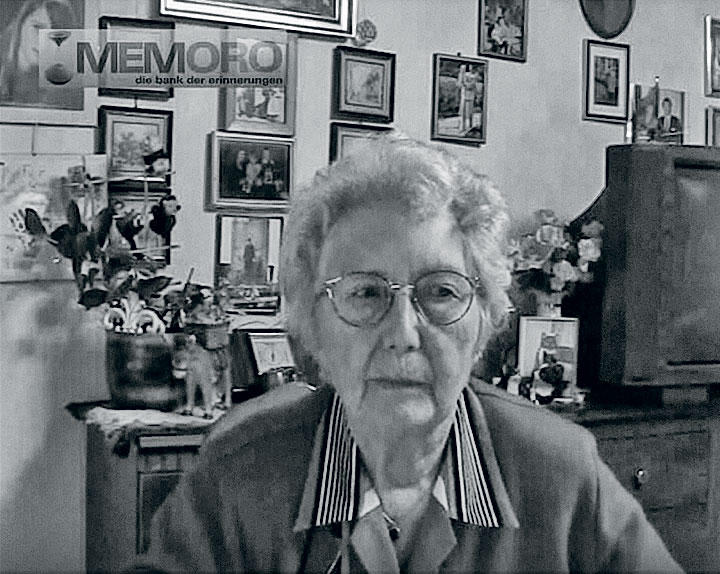
Dora Nasz in his Berlin apartment
I was born in 1926 not far from Potsdamerplatz, and lived on Koenigetzstrasse. This street is located next to Wilhelmstrasse, where there were all the ministries of the Third Reich and the residence of Hitler himself. I often come there and remember how it all began and how it all ended. And it seems to me that it was not yesterday or even five minutes ago, but is happening right now. I have very bad eyesight and hearing, but everything that happened to me, when Hitler came to power, and during the war, and in its last months - I see and hear very well. But my face cannot clearly see, only individual fragments ... But my mind is still working. I hope (laughs).
Do you remember how you and your loved ones reacted when Hitler came to power?
Do you know what was happening in Germany until 1933? Chaos, crisis, unemployment. On the streets are homeless. Many were starving. Inflation is such that my mother, to buy bread, took a bag of money. Not figurative. And a real small bag with banknotes. It seemed to us that this horror would never end.
And suddenly a person appears who stops the fall of Germany into the abyss. I remember very well how delight we were in the first years of his reign. People had a job, roads were built, poverty left ...
And now, recalling our admiration, the way we all and my friends and friends praised our Fuhrer, how ready we were ready to wait for his performance for hours, I would like to say this: we need to learn to recognize evil while it became invincible. We did not succeed, and we paid such a price! And they forced others to pay.
They didn't think ...
My father died when I was eight months old. The mother was completely apolitical. Our family had a restaurant in the center of Berlin. When the SA officers came to our restaurant, everyone bypassed them. They behaved as an aggressive gang, as proletarians who have received power and want to recoup over the years of slavery.
| *On the night of November 9, 1938, Jewish pogroms ("Crystal Night") began in Germany. About a hundred Jews were killed, 26 thousand sent to concentration camps. |
In our school there were not only the Nazis, some teachers did not enter the party. Until November 9, 1938* We did not feel how serious everything was. But that morning we saw that in the stores that belonged to the Jews, glasses were broken. And everywhere the inscriptions are “Jewish store”, “Do not buy from the Jews” ... That morning we realized that something bad was beginning. But none of us suspected the scale of the crime would be committed.
You see, now there are so many means to find out what is really happening. Then almost no one had a phone, rarely anyone had a radio, there is nothing to say about the TV. And Hitler and his ministers performed on the radio. And in the newspapers - they are. I read newspapers every morning because they were lying for customers in our restaurant. They did not write anything about deportation and the Holocaust. And my friends did not even read newspapers ...
Of course, when our neighbors disappeared, we could not not notice this, but they explained to us that they were in a labor camp. Nobody spoke about the death camps. And if they said, then we did not believe ... a camp where people are killed? Can't be. You never know what bloody and strange rumors do not happen in the war ...
Foreign politicians came to us, and no one criticized Hitler's policy. Everyone shook his hand. We agreed on cooperation. What was we thinking?
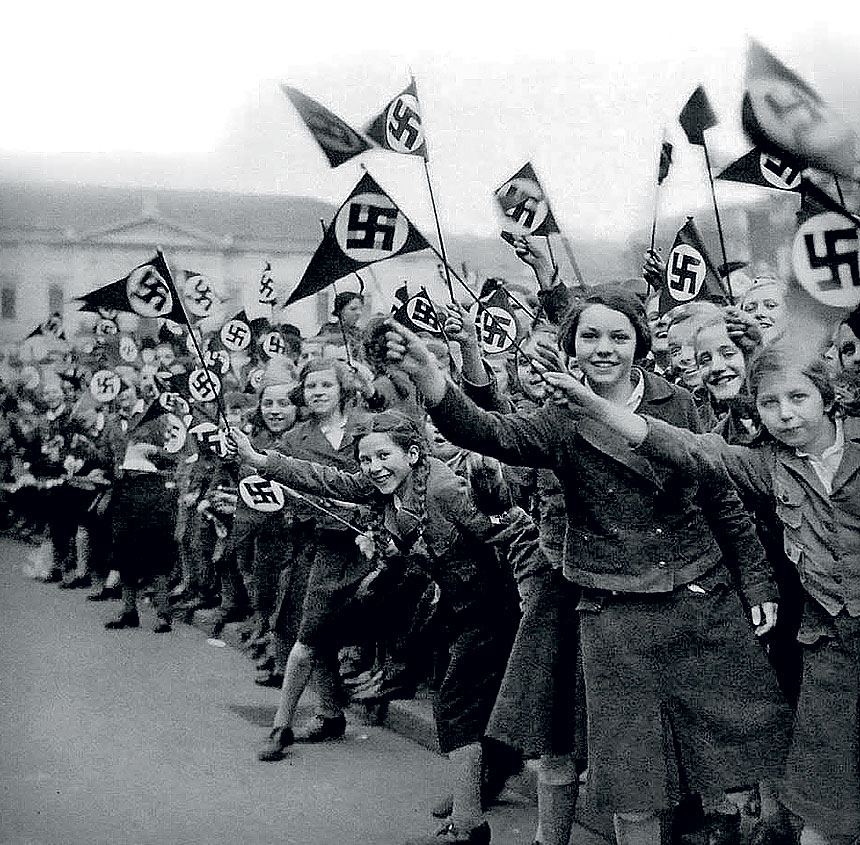
Thousands of peers of the dora were in the National Socialist "Union of German Girls"
Did you talk about the war with your friends?
In 1939, we did not have an understanding of what war we were unleashed. And even then, when the first refugees appeared, we did not particularly indulge in thoughts - what all this means where it would lead. We had to feed them, put on and give a shelter. And of course, we could not at all imagine that the war would come to Berlin ... What can I say? Most people do not use the mind, so it was before.
Do you think that you also did not use the mind in due time?
(After a pause.) Yes, I did not think about much, did not understand. I didn't want to understand. And now, when I listen to the notes with Hitler’s speeches-in some museum, for example, I always think: my God, how strange and scary what he says, but I, young, was among those who stood under the balcony of his residence and shouted with delight ...
It is very difficult for a young person to resist the general stream, to think that all this means to try to predict - what can this lead to? At ten, I, like thousands of my other peers, joined the Union of German Girls, which was created by National Socialists. We arranged parties, looked after the elderly, traveled, went together to nature, we had holidays. Summer Solstice Day, for example. Bonfires, songs, joint work for the good of Great Germany ... In a word, we were organized according to the same principle as pioneers in the Soviet Union.
Girls and boys, whose parents were communists or social democrats, studied in my class. They forbade their children to take part in Nazi holidays. And my brother was a little boss in Hitler Youth. And he said: if someone wants to in our organization, please, if not, we will not force. But there were other little Fuhrers who said: whoever is not with us was against us. And they were very aggressive to those who refused to take part in the common business.
Pastors in uniform
My friend Helga lived right on Wilhelmstrasse. Hitler often drove along this street, accompanied by five cars. And once her toy fell under the wheels of the Fuhrer car. He ordered to stop, gave her to approach and get a toy from under the wheels, and he got out of the car and stroked her head. Helga still tells this story, I would say, not without trepidation (laughs).
Or, for example, in the building of the Ministry of Air Transport, which was led by Goering, a gym was built for him. And my friend, who was familiar with someone from the ministry, could calmly go to the personal gym of Goering. And she was missed, and no one searched her, no one checked her bag.
It seemed to us that we were all a big family. You can’t pretend that all this was not.
And then crazy began - a whole country fell ill with a mania of greatness. And this was the beginning of our disaster. And when friendly politicians came to the station of Anhalter Banghof, we ran to meet them. I remember how Mussolini met when he came ... But what about? Is it possible to miss the arrival of Duche? It is difficult for you to understand this, but every time has its own heroes, its own errors and their own myths. Now I am wiser, I can say that I was wrong, that I should have thought deeper, but then? In such an atmosphere of universal excitement and conviction, the mind ceases to play a role. By the way, when the Molotov -Ribbentrop Pact was signed, we were sure that the USSR was not an enemy for us.
In 1941, you did not expect a war?
We rather did not expect the war that would begin so soon. After all, the whole rhetoric of the Fuhrer and its ministers came down to the fact that the Germans needed lands in the east. And every day on the radio, from newspapers, from performances - everything spoke of our greatness ... Great Germany, Great Germany, Great Germany ... And how much this great Germany is not enough! An ordinary person has the same logic: my neighbor is Mercedes, and I have only Volkswagen. I want too, I'm better than a neighbor. Then I want more and more, more and more ... And somehow all this did not contradict the fact that most of us were believers ...
There was a church near my house, but our priest never spoke about the party and about Hitler. He was not even in the party. However, I heard that in some other parishes, pastors perform right in the uniform! And they say almost the same thing from the amvon that Fuhrer himself says! These were completely fanatical pastors-Nazis.
There were pastors who fought with Nazism. They were sent to the camps.
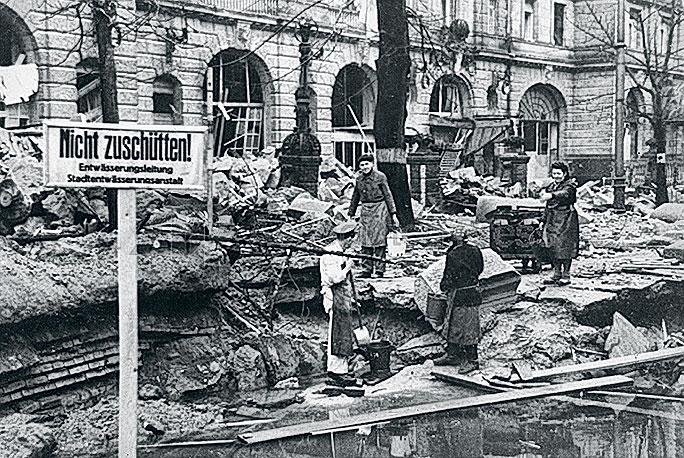
Destroyed Berlin. 1945
The textbooks wrote that the German race is the highest?
Now I will show you my school textbook (the school textbook of 1936 takes out from the book shelf). I keep everything: my textbooks, my daughter’s textbooks, things of the late husband - I love not only the history of the country, but also a small, private, my story. Look, the 1936 textbook of the publication. I am ten years old. Read one of the texts. Please, out loud.
Der Fuhrer Kommt (Fuhrer's coming).
Today, Adolf Hitler will fly to us by plane. Little Rainhold really wants to see him. He asks his dad and mom to go with him to meet the Fuhrer. They walk together. And many people have already gathered at the airfield. And everyone misses the baby Rainhold: "You are small - go ahead, you must see the Fuhrer!"
The plane with Hitler appeared in the distance. Music plays, everyone freezes in admiration, and now the plane landed, and everyone welcomes the Fuhrer! Little Rinhold is delighted in delight: “He flew in! Arrived! Hale Hitler! " Unable to withstand delight, Rainhold runs to the Fuhrer. He notices the baby, smiles, takes his hand and says: “How good that you came!”
Rainhold is happy. He will never forget this.
Now it’s funny and bitter to read it, but then these texts seemed completely normal to me.
| ** Anti -Semitic film "Jew Zyss" Fayta Harlan was shot by personal order of Goebbels in 1940 to justify the open grass of the Jews. |
We went to anti -Semitic films with the whole class, to Zyuss Jews **, for example. In this cinema, it was proved that the Jews are greedy, dangerous, that they have one evil, that we need to free our cities from them as soon as possible. Propaganda is a terrible force. The worst. So I met a woman of my age not so long ago. She lived in the GDR all her life. She has so many stereotypes about Western Germans! She speaks about us and thinks (laughs). And only having met me, she began to understand that Western Germans are the same people, not the most greedy and arrogant, but simply people. And how many years have passed after the union? And we belong to one people, but even in this case, prejudices inspired by propaganda are so tenacious.
Now I can’t understand how you can share people by national basis. I am an old man, and now it seems to me that everything is so simple: if someone has a lot, he must share this; That you cannot despise or even dislike a person for the fact that he is a different nation ... But I will not make you a report on morality (laughs). I have heard so many times in my youth that the Slavic race is the lower race ... How could you believe it?
Did you believe?
When every day the country's leaders say the same thing every day, and you are a teenager ... Yes, you believed. I did not know a single Slav, Pole or Russian. And in 1942 I went - voluntarily! - From Berlin to work in a small Polish village. We all worked without salary and a lot.
Did you live in the occupied territory?
Yes. The Poles were evicted from there, and the Germans who lived before in Ukraine came. My name was Emma and Emil, very good people. A good family. In German spoke as well as in Russian. I lived there for three years. Although in 1944 it became obvious that we were losing the war, still in that village I felt very well, because I benefited the country and lived among good people.
It was not embarrassed that the people who had lived there used to be expelled from this village?
I didn't think about it. Now, probably, it's difficult, even impossible to understand ...
Where is the train going
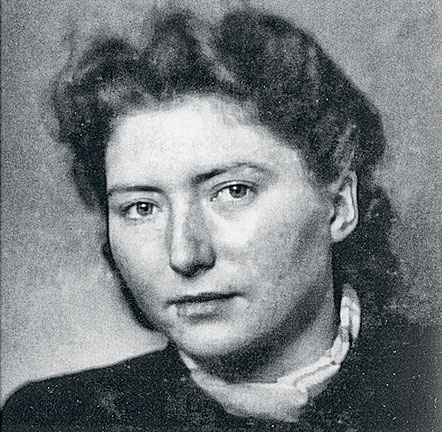 |
| Dora Nasz after the war |
In January 1945, I began an attack of appendicitis. The disease, of course, found time! (Laughs.) I was lucky that I was sent to the hospital and operated on. Chaos had already begun, our troops left Poland, and therefore the fact that medical assistance was provided to me is a miracle. After the operation, I lay for three days. We, sick, were evacuated.
We did not know where our train was going. They understood only the direction - we are going to the West, we run from the Russians. Sometimes the train stopped, and we did not know if he would go further. If documents were demanded on my train, the consequences could be terrible. They could ask me why I am not where my homeland sent me? Why not on the farm? Who let me go? What difference does I get sick? Then there was such a fear and chaos that they could shoot me.
But I wanted to go home. Only home. To mom. Finally, the train stopped not far from Berlin in the city of Glazhermund. And there I went. An unfamiliar woman, a nurse, seeing what condition I am in - with unhealed seams, with an almost open wound, which was constantly ill - bought me a ticket to Berlin. And I met with my mother.
And a month later I, still sick, went to get a job in Berlin. It was so strong fear! And with him - upbringing: I could not abandon my Germany and my Berlin at such a moment.
It is strange for you to hear this - about faith and fear, but I assure you, if the Russian person of my age heard me, he would perfectly understand what I am talking about ...
I worked in the tram park until April 21, 1945. On that day, Berlin began to fire so terribly as they had never fired. And I, again without asking anyone, ran away. Weapons were scattered on the streets, tanks were burning, the wounded shouted, the corpses were lying, the city began to die, and I did not believe that I was walking in my Berlin ... It was a completely different, terrible place ... It was a dream, a terrible dream ... I didn’t come to anyone, I didn’t help anyone, I, as an enchanted, went to where my house was.
And on April 28, my mother, my grandfather and I went down to the bunker - because the Soviet army began to capture Berlin. My mother took only one thing with her - a small cup. And she only drank from this cracked, faded cup to her death. I, leaving the house, took with me my favorite leather bag. I had a clock and a ring - and that’s all that I have from a past life.
And so we went down to the bunker. There it was impossible to step there - people around, the toilets do not work, a terrible stink ... No one has no food or water ...
And suddenly, among us, hungry and frightened, rumors are flashing: parts of the German army took positions in the north of Berlin and begin to win the city! And everyone had such hope! We decided to break through to our army at all costs. Can you imagine? It was obvious that we lost the war, but we still believed that victory was still possible.
And we, together with the grandfather, who was supported on both sides, went through the metro to the north of Berlin. But we did not go long - it soon turned out that the subway was flooded. There was a knee of water. We stood the three - and around darkness and water. Upstairs - Russian tanks. And we decided not to go anywhere, but simply hide under the platform. Wet, we lay there and just waited ...
On May 3, Berlin capitulated. When I saw the ruins, I could not believe that it was my Berlin. It seemed to me again that this was a dream and I was about to wake up. We went to look for our house. When we came to the place where he had stood before, we saw ruins.
Russian soldier
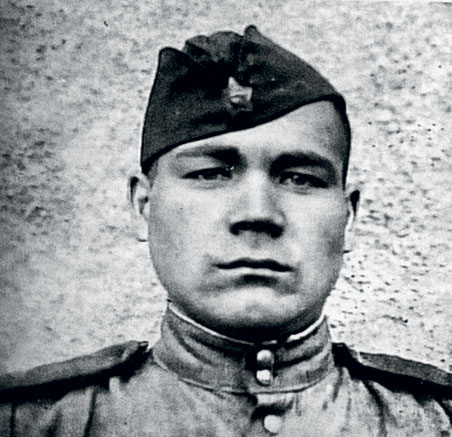 |
| Boris Abdulguzhin. 1945 |
Then we began to look for just a roof over our heads and settled in a dilapidated house. Starting there somehow, they left the house and sat on the grass.
And suddenly we noticed a wagon in the distance. There was no doubt: these are Russian soldiers. Of course, I was terribly scared when the wagon stopped and a Soviet soldier went in our direction. And suddenly he spoke in German! In very good German!
So for me the world began. He sat next to us, and we spoke for a very long time. He told me about his family, I about his own. And we both were so happy that there was no more war! There was no hatred, there was not even fear of a Russian soldier. I gave him my photo, and he gave me his own. In the photo, his postal front number was written.
For three days he lived with us. And I hung it on the house where we lived, a small announcement: "Busy tankers." So he saved us housing, and maybe life. Because we would be kicked out of a house suitable for life, and it is completely unknown what would happen to us next. I remember the meeting with him as a miracle. He turned out to be a man of inhuman time.
I want to emphasize especially: there was no novel. It was impossible to even think about this in that situation. What a novel! We should just survive. Of course, other Soviet soldiers met me ... For example, a man suddenly approached me in military uniform, abruptly pulled out a bag from my hands, threw it to the ground and immediately, right with me, helped at it.
Rumors reached us that Soviet soldiers with German women were doing, and we were very afraid of them. Then we learned what our troops were doing in the USSR. And my meeting with Boris, and how he behaved, is a miracle. And on May 9, 1945, Boris no longer returned to us. And then for many decades I was looking for him, I wanted to say thank you for the act that he committed. I wrote everywhere - to your government, to the Kremlin, the General Secretary - and invariably received either silence or refusal.
After Gorbachev came to power, I felt that I had a chance to find out if Boris was alive, and if so, then find out where he lives and what became with him, and perhaps even meet him! But even under Gorbachev, the same answer came to me again and again: the Russian army does not open its archives.
And only in 2010, a German journalist conducted an investigation and found out that Boris died in 1984, in the Bashkir village, in which he lived all his life. So we did not see him.
The journalist met with his children, who are now adults, and they said that he talked about a meeting with me and told the children: teach German.
Now in Russia, I read, nationalism rises, right? This is so strange ... And I read that you have less and less freedom, that on television - propaganda ... I so want our mistakes not to repeat the people who liberate us. After all, I perceive your victory of 1945 as liberation. You then freed the Germans.
And now, when I read about Russia, it seems that the state is very bad, and people are very good ... As this is said? Materhen Russland, “Mother Russia” (with an accent, in Russian), right? I know these words from my brother - he returned from Russian captivity in 1947. He said that in Russia they treated him humanly, that he was even treated, although they could not do this. But they were engaged in, spent on the prison time and medicine, and he was always grateful for this. He went to the front by a very young man - politicians took advantage of him, like many other young men. But then he realized that the fault of the Germans was huge. We untied the most terrible war and are responsible for it. There can be no other opinions.
Did the awareness of “German guilt”, the guilt of the whole people? As far as I know, this idea has long met resistance in German society.
I can’t say about all the people ... But I often thought: how did it become possible? Why did this happen? And could we stop it? And what can one person do if he knows the truth if he understands what nightmare everyone walks so vigorously?
| *** In August 1936, summer Olympic Games were held in Berlin. Shortly in front of them, in February 1936, Germany took in Garmish-Parthenkirhen (Bavarian Alps) and the Winter Olympics. |
And I also ask: why were we allowed to gain such power? Really, according to rhetoric, by promises, curses and calls, our leaders did not understand what everything was going to? I remember the 1936 Olympics *** - Nobody said a word against Hitler, and the international sports delegations that were walking around the stadium welcomed Hitler with a Nazi greeting. No one knew then how it would end, even politicians.
And now, now I am just grateful for every day. This is a gift. Every day I thank God that I am alive and that I lived such a life that he gave me. Thank you for meeting my husband, gave birth to a son ...
My husband and I moved to the apartment, where we are talking with you now, in the fifties. After close, dilapidated houses where we lived, it was happiness! Two rooms! Separate bath and toilet! It was a palace! See a photo on the wall? This is my husband. Here he is already old. We are sitting with him in a cafe in Vienna - he laughs at me: "Dora, you are taking me away again." This is my favorite photo. Here he is happy. He has a cigarette in his hands, I eat ice cream, and the day is so sunny ...
And every evening, passing by this photo, I tell him: "Good night, Franz!" And when I wake up: "Good morning!" You see, I glued the statement of Albert Schweitzer on the frame: "The only mark that we can leave in this life is a trace of love."
And it is incredible that a journalist from Russia came to me, we are talking and trying to explain to you how I felt and what the other Germans felt when they were crazy and won, and then, when our country was destroyed by your troops, and how the Russian soldier Boris saved me and my family.
I think that I would write in my diary today if I could see? That a miracle happened today.
Translation: Katya Collmann
Photos: from a personal archive, a screenshot from YouTube.com, Ap Photo