
Translated material
Nikolai Nikolaevich Vorontsov
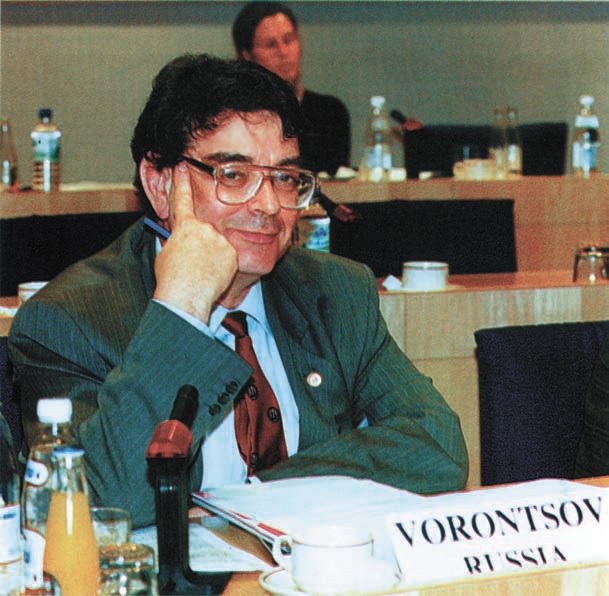
All living things are the result of a complex game of genes with the environment. He was generously gifted and managed to realize very much in many ways. The four -year -old Wunderkind Kolya Vorontsov was shot in the cinema, then he studied at the school in the violin class. Elena Fabianovna Gnesina looked at the water. Before the war, she presented Kohl Tom Bram “mammals”. And only this book the boy took with him into evacuation. Returning to Moscow, he gets into a circle at the zoo, to a wonderful biologist and teacher P.P. Smolin, creator of the school of naturalists.
In 1950, the 16-year-old excellent student Nikolai Vorontsov enters the biological and soil faculty of Moscow University. In a 1948 Lysenkovskaya session, a classic curriculum survived the faculty, which was very affected after the Lysenkovskaya session. Forbidden disciplines - genetics and general biology - an inquisitive young man got outside the walls of Moscow State University. He heads the NSO of the Faculty and still publishes his first scientific works. Participant of the school circle at the Department of Zoology E.S. Kalyaeva recalled: “Our 20-year-old teacher became a guide for us of scientific traditions officially prohibited after the defeat of domestic biology in 1948.” Nikolai is a key figure in the home biological circle of Mathematics Professor A.A. Lyapunova, who taught his genetics. After entering the Lyapunovs family, Vorontsov for many years was lucky to be in the ethical field of this outstanding scientist-inteligent. The Soviet government was afraid of domestic circles: after a speech on the Lyapunovsky circle N.V. Timofeevsky-Rosovsky is prohibited with meetings of the Partyburo, the Komsomol assembly, reprimands ... The anti-Stalinal XX Congress of the party in February 1956 prevented the tragic turn of events.
With the honorship of the Moscow State University, Vorontsov becomes a graduate student of the then very strong Zoological Institute of the Academy of Sciences in Leningrad. For eight years of work in Zina, he did his starting work on mammals morphology, came to the conclusion about the uneven pace of evolutionary transformation of organs and to the principle of compensation for their functions.
Here, based on the chromosome theory of species of species in mammals (karyosystematics), Vorontsov began work on the use of genetic approaches to systematics and evolution. In 1958, he went down in the history of Soviet biology with a review in the Moip Bulletin about the importance of these studies in the systematics of mammals. These impudent steps were taken against the gloomy background of Lysenkovschina. Compared to Moscow in Leningrad, it was easier. In June 1957, Vorontsov managed to print the first article in the USSR in the “Leningradskaya Pravda” on the biological influence of nuclear explosions. And in Moscow, a sized graduate was banned from entering his faculty.
He seemed to be preparing to head the environmental department of a huge country, having managed to work in academic institutions - from west to east - Leningrad, Moscow, Novosibirsk, Vladivostok, participating in 44 expeditions. He wrote about himself: “I was lucky to be a student of different zoological, genetic and evolutionary schools of both of our capitals.” And I admitted that he feels both Muscovite and Leningraders at the same time.
The end of Lysenkovshchina with the resignation of N.S. In 1964, Khrushchev opened up new opportunities, but also demanded great efforts to eradicate biological ignorance. But even earlier, Vorontsov managed to read the courses of general biology and theory of evolution at the Medical Institute and at the Physics and Foundation of the University. The “People’s Academician” hand was not reached there. On their basis, he will write a school textbook “General Biology”. Nikolai Nikolaevich wrote perfectly.
The “golden” period in the scientific work of Vorontsov continued in Siberia, in Akademgorodok, where at the Institute of Cytology and Genetics he creates a group of evolutionary cariosystems. Despite the small number, soon this group becomes recognized in the USSR as a leader in the study of biological diversity and mechanisms for the formation of species.
In 1963, an article by Academician V.A. Engelhardt and associate professor N.N. appeared in the newspaper Izvestia. Vorontsova "Nuclear trials and human health." Vorontsov made a lot of effort so that nuclear tests were discontinued in three media, three powers at the same time. After many years, the minister, and then the deputy Vorontsov will become a participant in a large number of anti -core events, including the Greenpeace protest campaign in the Mururoa Atoll. As a result, the French president did not dare to resume the tests.
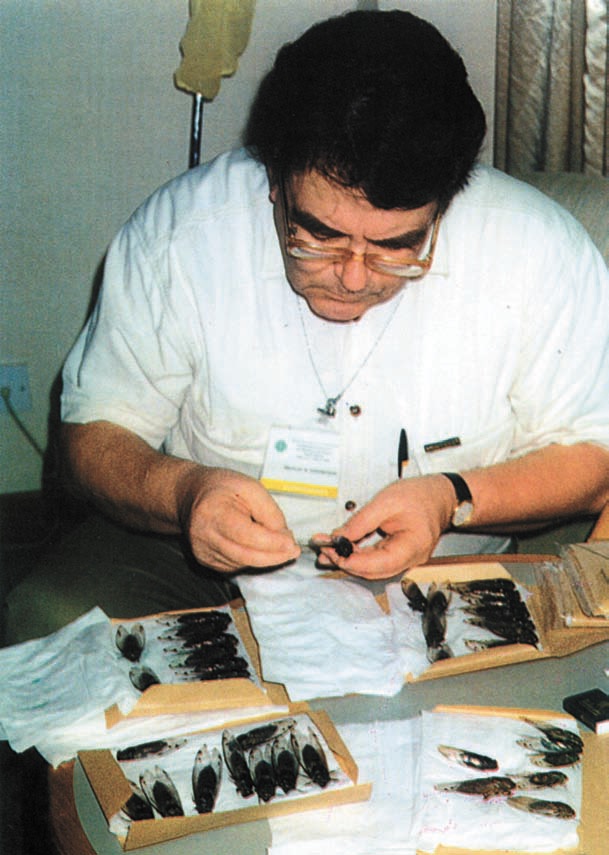
Working in Novosibirsk and being the scientist of the Siberian branch of the AN, Vorontsov became an entitled participant in the fight against the Academy of Sciences, led by Acad. M.A. Lavrentieva against Baikal's pollution. The biologist, bored with the Baikal cellulose plant, showed: "The drains are pure, because they live in them crayflane crayfish." N.N. Lays and determines the "indicator" look. It turned out that he was an exception, just this sideplay is the inhabitant of polluted waters. This was the first major experience of Vorontsov’s performance at the state level. Later he will also oppose the transfer of the waters of Siberian rivers to the south.
The next wonderful segment of Vorontsov’s life began in 1970 in Vladivostok. He headed a sleepy provincial biological and soil institute. Scientific seminars and conferences began, a radical reorganization of the library business, an invitation of bright researchers. Scientific youth enthusiastically accepted the new. It was amazing how much you can do in a short time. But the regional authorities did not like him - he was a rare guest in high offices. In 1977, he had to return to the capital.
In the first free elections in the USSR, Nikolai Nikolaevich was elected People's Deputy of the USSR from the Academy of Sciences. A wave of democratization raised him to the post of head of the environmental committee. Its strategic task was to achieve from the authorities awareness and recognition of the weight of the environmental component in plans to renew the state, to withstand the traditional technocratic approach. The approach of Vorontsov, say, during the construction of the hydroelectric power station was different: what is the price of the issue for the country's economy? Yes, the price of a kilowatt hour will fall, but what will be losses from lost pastures and fish death?
It fell to his share to start clearing the rubble accumulated by the generation of fathers for the five -year plan of industrialization and the “atomic era” literally. He visited the Minister at the Kola Mountain Plant, who was famous for his pollution, which, together with Kirov, was created by the large business executive Nikolai Vorontsov Sr..
Having headed the committee, Vorontsov began with the inventory of the huge economy that he got - with the preparation of the report on the state of the USSR natural environment. Despite an impressive reserve of knowledge, N.N. He preferred to rely on the collective mind of scientists. The report made up dozens of scientists and practitioners. The scientific community trusted Professor Vorontsov to the prominent ecologist. Academics S.P. collaborated with him Zalygin (writer, in the past Meliorator), N.N. Moiseev, A.L. Yanshin. Vorontsov invites him to his deputies of the largest expert on the environmental microbiology of Academician G.A. Zavarzina.
If the domestic heritage in the field of ecology as a science was impressive, then in terms of law and publicity and in the creation of this stateganese we lagged behind for decades. The Committee (and then the Ministry) prepared the "Law on Environmental Protection" and the "Law on Special Self -Protected Natural Territories." Vorontsov’s fame abroad made it possible to develop our country's proposals in the international “Convention on Biological Diversity”. Under him, the widespread international cooperation of the USSR in the field of ecology began. The task was facilitated by the fact that Vorontsov was a member of several foreign academies and a laureate of a number of international awards. Among them, the International Ecological Award of the Society named after M. Plack, awarded to him in 1990. Professor Wolfgang Haber, the ecologist and the laureate of this award, said at the solemn ceremony in the Roman Caesar Hall in Frankfurt: “Vorontsov awarding not only his great scientific merits, but also the courage and responsibility that he showed by taking this new burden (the post of Minister of Ecology).”
The committee contributed to the establishment of the environmental network of the republics and regions, gathered the forces of scientists and practitioners in the field. In his reception, there were constant "walkers". Vorontsov attached particular importance to the reserve work close to him and managed to do a lot here. Within the framework of the conversion, it was planned to use production capacities and scientific and engineering thought of the military-industrial complex for the needs of the country's environmental safety. In the first place was the creation of medium monitoring tools.
The affairs of the department seemed to go uphill. Formal success was the transformation of the Committee into the Ministry. At the top, they began to reckon with the first non -partisan minister in our history. But Vorontsov constantly had to withstand the pressure on himself personally and the department both from the opponents of the new and from the “identities”, the enemies of the “Imperial Center”. As a scientist to him, the inextricability of the unified environmental space of the planet was obvious to him and, of course, its 1/6 part - the USSR. He visible the perniciousness of localism and the need to preserve at least the Union of Ecologists of the Republics of the country.
Vorontsov was a gambling person with great public temperament. His weakness was gullible against adventurous people. The failure of the scientist is seen in the creation of the Russian Academy of Sciences as an alternative to the Russian Academy of Sciences. And his good merit was the campaign to award a group of genetic veterans who did not change the scientist in difficult years. They received high awards from the hands of the President of the USSR. He supported the libraries, achieved the revival of the temple of Kosma and Damian on Sovetskaya Square, and in August days of 1991 he performed in the barracks to prevent bloodshed, was in the White House and on the tank next to Yeltsin. Nikolai Nikolaevich knew how to find a common language with people, was a loving husband and father. A brave and witty person, he performed perfectly. He fascinated his beautiful and strong baritone, but jokes could be unsaisable. Especially in youth. Yu.F. Bogdanov recalls how in Zina he was middle -aged, “lifelong” M.N.S., an activist of the Political City, who really wanted to become the eldest, for which there was not enough scientific papers. Nicholas with a friend invented and posted an announcement of the competition for the post of S.N.S. The point “List of scientific papers” was marked with footnote: “not mandatory”, but it was required to indicate the size of the shoes. Offended, suspected of the authors, attributed the announcement of the deputy. Director, and he, a connoisseur of humor, advised him to return him to the board. The young impudent began to protest: “What are you doing! Why hang such a mocking announcement?! "
The lifetime list of works by N.N. Vorontsova is 586 names, including more than 40 monographs. The scientist finished the last book “The Development of Evolutionary Ideas in Biology”, being seriously ill.
Pupil of Vorontsov, and now the Parisian professor I.T. Volobuev called him "our great contemporary." And he compared large scientists with composers, noting the important role of interpreter-artists, which, depending on talent, can be very large or small. “Composers” - carriers of great ideas - you can count on the fingers. It seemed to Volobuev that this question greatly occupied his leader. Nikolai Nikolaevich attributed himself to the "performers."
“Contractors” with such erudition, with such breadth and temperament, are not enough for us.
E.V. Ramensky,
Biologist, assistant Minister of Nature Management
and environmental protection of the USSR
The author is grateful E.A. Lyapunova for the materials provided