
Translated material
In Chile, they launched the world's largest observatory, which allows you to look into the past of the universe
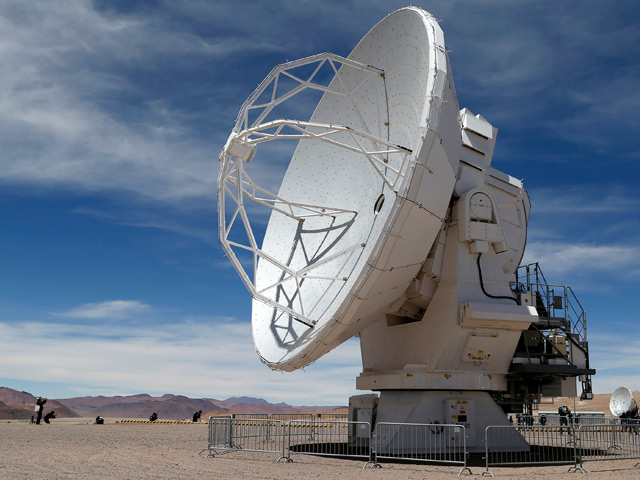
In the Chilean desert, the Atacama officially opened the largest international astronomical observatory Alma (The Atacama Large Millimeter/Submillimeter Array), which has been under construction since 2003. Despite the fact that so far not all objects work, the observatory, which is intended to study the processes that took place over the first hundreds of millions of years after the Big Bang, already have the first significant achievements, BBC reports.
In the project worth 1.4 billion dollars, scientists and engineers of Europe, North America and East Asia are involved and at the moment it is 59 radio telescopes of millimeter and submilimeter range, united into a single network - interferometer. In general, by October 2013, 66 radio antennas will be installed here: 54 antennas with a diameter of 12 meters and 12 with a diameter of 7 meters. The distance between them can vary from 150 meters to 16 kilometers. The total area of the complex by October 2013 should exceed 150 square kilometers. To correlate the work of all antennas at the station, a supercomputer is installed, capable of performing 17 quadrillions of operations per second.
One of the most significant results of Alma’s work was presented today in a study in Nature magazine. The report states that the radio telescope discovered galaxies, whose age was much more than scientists had imagined before. The two most distant of the 26 recorded galaxies originated about 12 billion years ago, that is, 1-2 billion years after the Big Bang, when the Universe arose, the Alma Observatory website says.
The activity of star formation here is many times more than in our galaxy. If about one star per year is “born” on the Milky Way, then hundreds of thousands of new stars appear here annually, writes The Daily Mail . Moreover, among them there are those that are brighter than the sun 40 million times.
“The farther the Galaxy is, the farther we look into the past, and the more we have the possibilities to trace all the stages of the formation of the Universe for 13.7 billion years of its existence,” the scientist Joachin Viyira from the California Technological Institute quoted NATURE. In the course of further study of ancient galaxies, researchers will try to understand how primary molecular clouds formed and what accelerated their transformation into the first luminaries of the universe.
“For this, we have all the conditions.“ Look deeply ”in the universe often interferes with poor visibility. But the ideal place for this observatory was chosen - on the mountain plateau on which it is located, precipitation is very rare, in connection with which there are almost never fogs,” said the BBC, the Spanish scientist, also participating in the project, Balthazar Wigo. According to him, grandiose discoveries from the observatory can be expected over the next 30 years.