
Translated material
Flow in the dam
The three special opinions of the members of the Constitutional Court, in fact, who recognized the fact of the law on rallies, again attracted attention to the highest court of the country. What it was: a protest inside the elite or protest of professionals against a “enraged printer” - The New Times sorted out
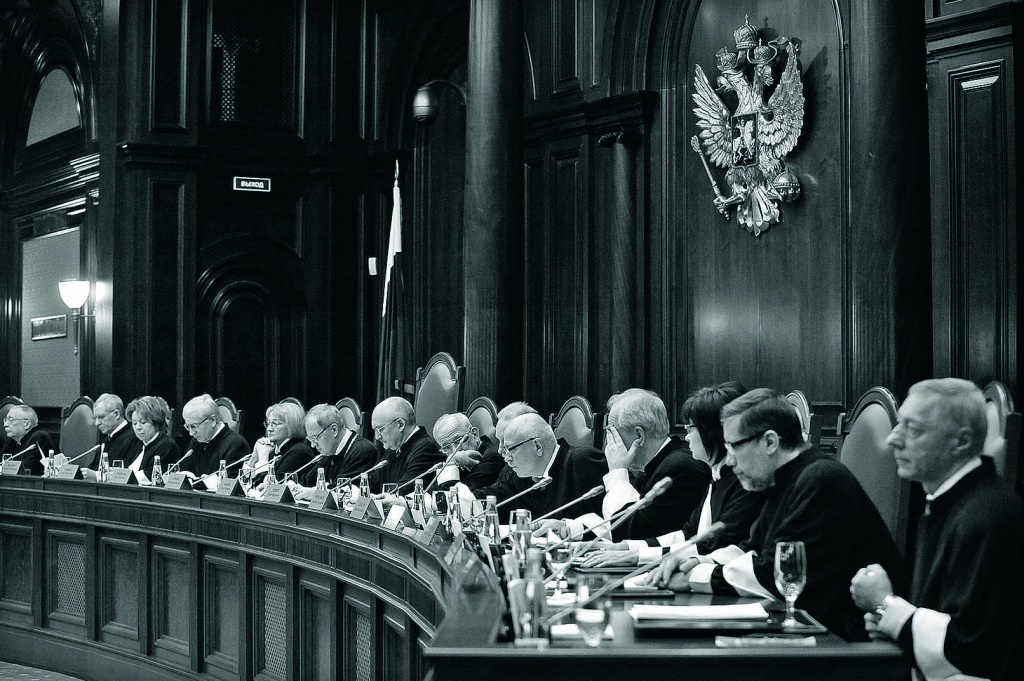
After several years, the Constitutional Court is back in the news: judges are considering a complaint under the rallies' law. February 15, 2013
"Why did you write a special opinion?" - the judge of the Constitutional Court Yuri Danilov asked The New Times. Danilov 62, in Soviet times, he was an instructor of the Voronezh regional committee of the CPSU and the chairman of the regional court and for 19 years of stay in the Constitutional Court only twice expressed his disagreement with the decision of colleagues in the Constitutional Court (“special opinion” - the adopted form of disagreement with the verdict of the court): the first time in 1995, the second - on February 14, when the Constitutional Court checked for the compliance of the Constitution of the Russian Federation, the notorious law About rallies.
| *A number of deputies from “Fair Russia”, the Communist Party and Leader of “Another Russia” Eduard Limonov were filed a complaint to the Constitutional Court |
KS refused the applicants*, but after a few days three special opinions appeared on the court’s website - members of the Constitutional Court of Vladimir Yaroslavtsev, Yuri Danilov and Sergey Kazantsev (exactly in this order they appeared on the site): they stated that the disputed law contradicts the Constitution of the Russian Federation. Before Yaroslavtsev, who is part of the five Constitutional Councils of the Constitutional Court on special opinions, it was not possible to get through, Kazantsev refused to enter the details, but Yuri Danilov was ready to argue his position: “Got it!” - Thinking a minute, he answered the New Times correspondent. And he further explained that his deputies “got”, to whom he wanted to “remind you that there are internal labor regulations”, that is, the procedure.
| | | --- | | 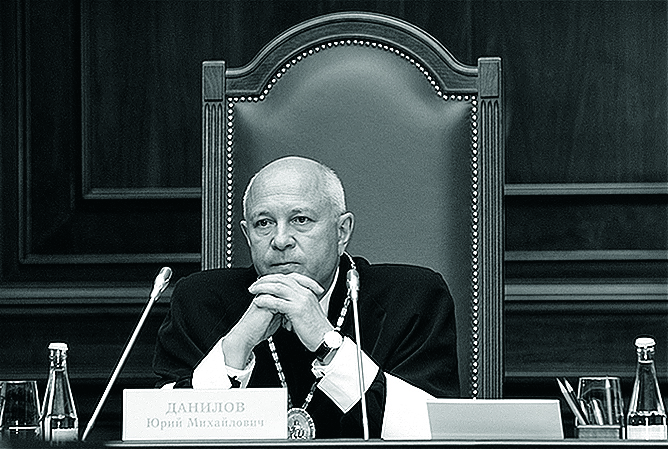 | Judge Yuri Danilov usually does not give an interview. For The New Times, he made an exception
The fruits of the poisoned tree
According to Judge Danilov, the deputies, firstly, showed frank neglect of the subjects of the federation, where they did not send the law, as it should be according to the procedure. Secondly, they allowed themselves to change the concept of the law in the second reading, which is also a violation of the procedure. And thirdly, the deputies violated the regulations, which they themselves accepted: the authors of the amendments have the right to argue their position within three minutes, the deputies reduced this time first to one minute, and then to 30 seconds **.
| ** The deputies from the Fair Russia faction Gennady and Dmitry Gudkov were going to make 468 amendments, of which 50 did not manage to introduce. As a result of the so -called “Italian strike”, arranged by just aircraft on June 5, the Law on rallies was adopted 15 minutes before midnight. See The New Times No. 20 of June 11, 2012 and No. 43-44 of December 24, 2012 |
“Democracy is primarily a procedure,” Judge Danilov recalls in his special opinion. “Each of the indicated violations of the procedure for adopting the challenged law concerns the fundamental foundations of the parliament and in itself is sufficient to recognize the Constitution of the Russian Federation that is not appropriate.” Summarizing, the judge writes: "In the end, it is pointless to look for ripe fruits on the branches of the poisoned tree." Danilov explains the essence of metaphors as follows: “In American jurisprudence, there is a doctrine of the“ fetal of poisoned tree ”, namely: evidence obtained with impaired procedure are unacceptable, since these evidence, as fruits, grow on a poisoned tree, which is the investigation of the case. I calculated this analogy appropriate. And here and here we are talking about violation of procedural procedures. ”
"The court is not a swamp"
To the question of The New Times, why, despite the obvious flaws, his colleagues by a majority vote recognized the law on rallies to constitutional, Judge Danilov replied: “I cannot reveal the secret of the deliberative room. But why do you think that only three judges voted for the unconstitutionality of the law? The court is not a swamp, and we rarely have decisions unanimously. And in our special opinions there is nothing heroic or political. And I am far from the idea that someone will try to make responsibility for what I wrote. ”
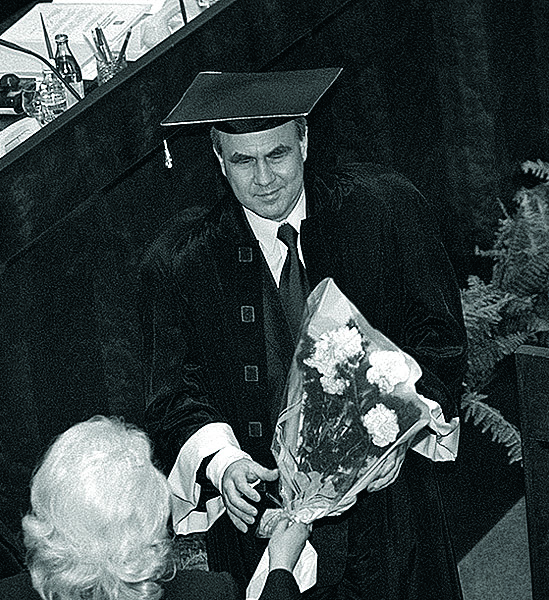 |
| Judge Sergei Kazantsev insists that a special opinion is not heroism, but the right of a judge allowed to him by law |
|
58-year-old judge Sergei Kazantsev, who was appointed in the Constitutional Court in 2002 to the place of the deputy chairman of the court Tamara Morshchakova (she formally resigned by age, but was actually considered one of the most “inconvenient” for the authorities of the KS *** judges), also does not see in its special opinion nothing out of the number of output. “This is the right of a judge,” he said in an interview with The New Times, “and he does not risk anything.” “That's why journalists in their articles can express opinions that do not coincide with the opinions of other journalists,” he added after a small pause.
| *** In order for Morshchakova to leave his post, amendments were specially adopted to the Law on the Constitutional Court of the Russian Federation, according to which the judges who began to fulfill their duties until 1994 had to leave their post upon reaching the age of 65. **** Natalya Morar was deported from Russia to Moldova on December 16, 2007 by order of the FSB after the publication of the sensational article “Black Cash desk of the Kremlin” , and she was not allowed in the Russian Federation for 4 years and 3 months. Only on March 23, 2012, after the intervention of President Medvedev, our colleague was able to come to Moscow again. |
Here, however, the story of the many -year -old KS Judge Anatoly Kononov immediately comes to memory, who worked in the highest court of the country of 19 years, often disagree with his decisions of his colleagues and was forced to resign in January 2010 - he was strongly resigned: he was categorically against the refusal of the Constitutional Court to consider the complaints of The New Times about the violation of her constitutional Rights **** and gave a number of sharp interviews in which he criticized the KS.
The sacrificial altar
The third judge, who expressed sharply against the law on rallies, is 61-year-old Vladimir Yaroslavtsev. “The bringing to the sacrificial altar of the State Duma of Constitutional Law of citizens to freedom of assembly for the sake of momentary desires on the“ high -speed ”adoption of the law, of course, does not paint the State Duma of the Russian Federation and does not add authority,” wrote Yaroslavls in his special opinion.
 |
| Judge Vladimir Yaroslavtsev in 2009 almost lost his post due to an interview with the Spanish newspaper El Pais |
He is in the Constitutional Court since October 1994 and, unlike Judge Danilov, writes special opinions quite often. By the way, he also voted against the Morar case and also in an interview with reporters sharply criticized the lack of independence in the Russian court, and he, like Kononov, was threatened with the termination of powers on “discrediting grounds”. But Yaroslavtsev pleaded guilty at the Plenum of the Constitutional Court and remained as part of the court.
Why, after almost four years, the judge of Yaroslavtsev again decides to write a special opinion on the political issue? After all, it is known what he risks: the judges of the CS have a very high salary-it is more than 300 thousand rubles a month plus different benefits-from a cottage on Krestovsky Island in St. Petersburg to a service car and many other benefits. Unfortunately, Yaroslavtsev himself failed to ask this question: his phone was constantly turned off. But one of the former judges of the KS explained The New Times that for self -respecting judges, it is very important to show people beyond the walls of the court, that they do not share the “vile point of view” that the Constitutional Court expressed in certain cases.
The professor of Moscow State University, constitutionalist Elena Lukyanova, also agree with this: “Judges of the CS have their own reputation, their own“ ordination ”. It is important for them that others will think about them. ”
“Special opinions have no legal significance,” says Mikhail Krasnov, professor of HSE, a specialist in constitutional law. “But they allow lawyers to be honest with themselves and descendants.” The sharpness of the special opinions of Yaroslavtsev and Danilov is also explained: they are convinced of their rightness - violations of the procedure in the Law on rallies are obvious. ” Krasnov is convinced that no organic conclusions will follow disagreement.
On guard of the authorities
Most of The New Times interlocutors say that after December 2005, the Constitutional Court confirmed that the appointment of governors complies with the basic law, completely ignoring the 1996 decision on a similar issue (then the CS recognized the election of the Governor of the Altai Territory by the legislative body of the region), many became clear to many: the Constitutional Council defends power, not the constitution. Then, in December 2005, to the question of journalists, why two decisions are made in the framework of one constitution, Valery Zorkin replied: “As the society and the development of the legislative sphere, the legal position of the Constitutional Court may be clarified.”
Journalists wrote that Valery Zorkin deduced the “law of movement of legal positions”: there is no need to change the constitution, if it can be interpreted in different ways.
Since then, the loyalty and servility of the Constitutional Court has already become a lady in the tongue, therefore, even now, after eight years, few people have surprised that with the most gross violations of the Basic Law of the Russian Federation, the judges dared to recognize the law on rallies unconstitutional.
“Judges understand that this law is in the center of public attention. It is clear to them that the presidential administration is “rooting” for him: judges cannot openly go against the authorities. This once again confirms that we do not have constitutional justice, ”Mikhail Krasnov issues his verdict.
It is all the more amazing that in the bowels of the Constitutional Court, the head of which in their programmatic articles in the “Rossiy newspaper” collapses not only on “creative oppositionists”, “ready to call any“ Varangians ”(including special forces of NATO countries) to support the establishment of“ new statehood ”in Russia on the model of Libya, but quite sharp statements in the European Court of Human Rights are still possible-at least some kind of still possible at least some Free opinion.
However, political scientist Georgy Satarov has his own explanation. “This is far from the only case when certain officials allow themselves to be diverse,” he says. - Take the same "Law of Dima Yakovlev." There, even members of the government did not agree with the "common line." I can offer my hypothesis, which allows you to explain all these different cases: in society there is a weakening of power. The power of power is not in the use of power, on the contrary, frequent use of force is evidence of weakness. The same hypothesis also works that Putin in every way demonstrates that his power has not actually weakened. However, the bureaucracy always knew that he was illegitimen, and often did not obey him. Therefore, the vertical did not always work. The farther, the more such examples will be. Before the dam collapses, separate small holes always appear through which water oozes. This is now happening. ”
Photo: ITAR-TASS, Dmitry Dukhanin/Kommersant, Dmitry Kostyukov/Kommersant