
Translated material
The feelings of believers will weave in the Criminal Code
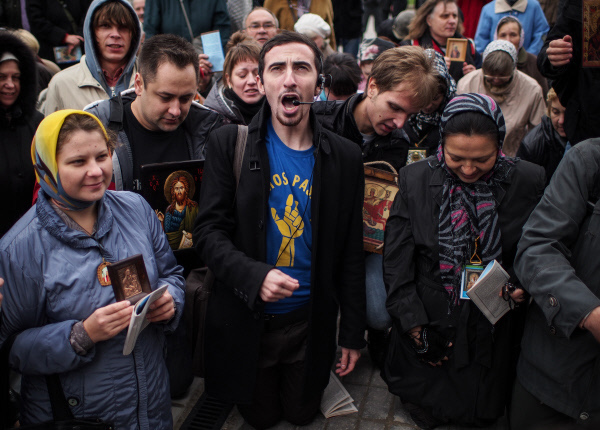
Orthodox activists near the building of the Moscow City Court, where a cassation appeal is considered to be a sentence to the Pussy Riot punk group. Photo: RIA Novosti
The bill “On the Protection of the Feeling of Believers” will be considered in the first reading on March 22 - this was announced by the head of the relevant committee on criminal law Pavel Krasheninnikov at a round table in the State Duma. The initial concept of the document will radically change - the bill can “lower on the brakes” and replace a number of additions and tightening in the articles of existing criminal and administrative codes.
The project on the “protection of the feelings of believers”, which establishes responsibility for insulting religious feelings, entered the State Duma in September last year. The Criminal Code was planned to be supplemented with Article 243.1, according to which the “public insult of worship and religious rites”, as well as the religious feelings of citizens, would be punishable by a fine of up to 300 thousand rubles or imprisonment of up to three years. The desecration or damage of objects of religious veneration and places for worship was proposed to be punished with a fine of up to 500 thousand rubles or imprisonment of up to five years.
Administrative fines provided for in Article 5.26 of the Code of Administrative Offenses “Violation of the legislation on freedom of conscience, freedom of religion and religious associations” also increased. Citizens who encroached on freedom of conscience had to pay 30 thousand fine, and officials - 100 thousand. Finally, Article 5.26 of the Code of Administrative Offenses was proposed to expand the new composition of the administrative offense: desecration and damage to religious and litigation, signs and emblem of worldview symbolism. Such an offense was to be punished with a fine of up to 50 thousand rubles.
In January, the bill on the protection of the feelings of believers received a negative review of the government, which stated that the new article 243.1 has the signs of the existing Article 213 of the Criminal Code of the Criminal Code, and the elimination of these contradictions can be achieved by supplementing the “Hooliganism” article with appropriate qualifying features and establishing more strict punishments.
Many experts indicated that most of the bill’s proposals duplicate the norms existing in the legislation.
Despite the fact that the head of the criminal law committee Pavel Krasheninnikov supported the concept of the bill and recommended to consider it in the first reading, he also added that the document contains a number of flaws, in particular the terms of expansion interpretation in jurisprudence: “worship”, “religious rites”, which may cause abuse of the law. In addition, Krasheninnikov indicated that the bill duplicates the existing article 148 of the Criminal Code “Obviating the right to freedom of conscience and religion”.
“By the second reading, we will also offer a number of stylistic and semantic amplifiers, perhaps we can change some of the line of sanctions,” Krasheninnikov promised the head of the State Duma Committee on Public Associations and Religious Organizations, Yaroslav Nilov. At the same time, Nilov added that "we have no itching people in jail."
“Everything was mixed up: the Communists are punished for insulting the feelings of believers,” complained lawyer Henry Reznik, referring to one of the initiators of the bill, co -chair of the interfacing deputy group to protect Christian values, Sergei Gavrilov, who is a member of the Communist Party. Reznik called the bill "unfit." According to him, instead of “pulling an insult to feelings in the Criminal Code,” if desired, you can increase fines and supplement the existing article 5.26 of the Code of Administrative Offenses, which prescribes punishments for violations of freedom of religion.
In the search for a similar legislative initiative in the history of Russia, Reznik reached the Cathedral Code of 1885, where he discovered a solid section describing the crimes of blasphemers - it was in the Cathedral Code, as in the “Law on the Protection of the Feelings of Beliefs”, it was supposed to judge not for actions, as is done in legal norms, but for the thoughts and feelings that these actions cause.
“Partly the initiative of the bill“ On the Protection of the Feeling of Beliefs ”echoes Article 282 of the Extremism Criminal Code,” Nikolai Svanidze, chairman of the Commission of the Public Chamber to harmonize interethnic and interfaith relations, recalled.
Representatives of religious faiths, present at the round table, unlike experts, spoke approving about the bill. For example, Father Vsevolod Chaplin even proposed to introduce a punishment for desecrating not only religious, but also of any worldview symbols expensive for people. “You cannot desecrate both symbols that are expensive for believers and symbols, expensive for supporters of a worldview, whether communists, liberals or other supporters of political doctrines,” Chaplin explained.
The New Times also published material on this subject in No. 3 (272) of February 4, 2013 - “ Return of an atoning sacrifice ”