
Translated material
On the other side of Chavez
What country did the late commandant leave behind? The New Times studied the mourning Venezuela
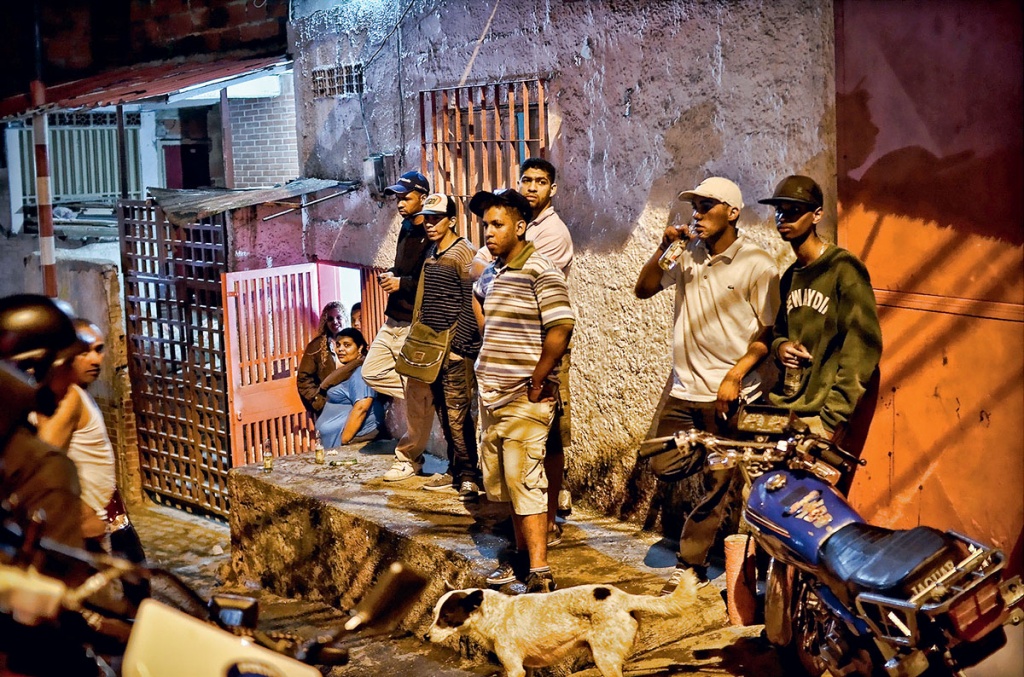
Police raids in the outskirts of Karakas are often carried out only for a checkmark
Hugo Chavez is still not buried. On March 15, his body in a closed coffin was placed in the Museum of the Revolution, as long as the National Assembly will decide whether it is possible to bury the commandant in the pantheon next to the national hero of Venezuela Simon Bolivar, according to the law, you can get here only 25 years after death. However, it was in this honor that the successor of the President Nicholas Maduro insists, in the first profession - the bus driver, whom Chavez produced to the Ministers of the Interior, and at the end of his life called his political heir. He informed the world that it was Chavez who had become a holy throne for the Latinian in heaven, and he belongs to the hypothesis that hated Yankees infected Chavez with cancer. The same was reported to the world by President of Bolivia Evo Morales, Iranian President Mahmoud Ahmadinejad, as well as Russian politicians Gennady Zyuganov and Vladimir Zhirinovsky.
However, a heart attack was the official version of the death of President Venezuela. This was stated by the head of the presidential guard Jose Orneell, who was at the time of death next to the president. Why exactly he accepted the last breath to the commandant, and remained unclear. How unclear and when Chavez still did not become: death occurred at about 16.30, Maduro addressed the nation already at 17.00. That's how sporely. The leader of the opposition Enrique Caprice, as expected, accused the government of concealing information about the death of the president: "Who knows when and what he actually died from."
Sorrow technology
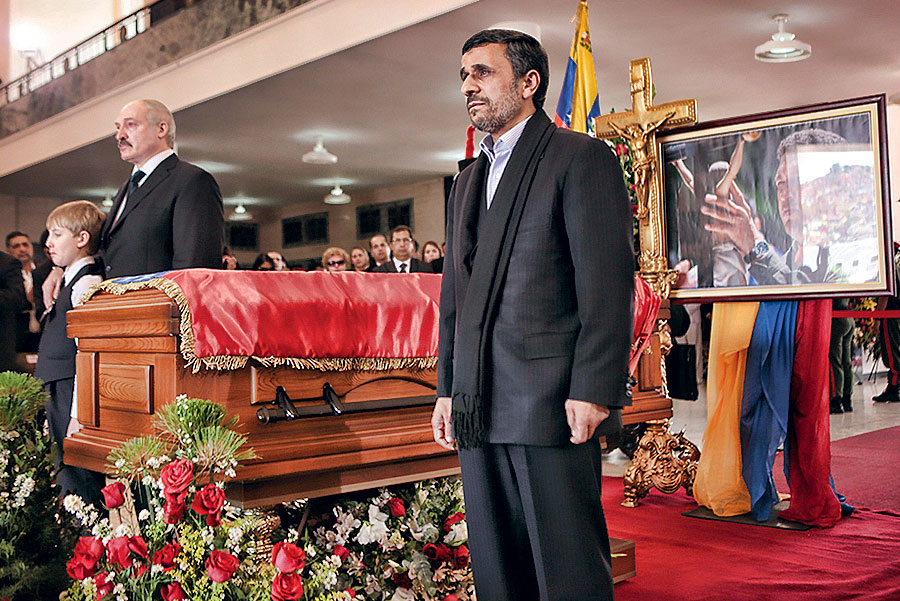 |
| Mahmud Ahmadinejad met at the coffin of commandant with his colleague Alexander Lukashenko and his son Nikolai |
On the television screens, a bacchanalia immediately began explanations in love to the departed president. In principle, in different variations, two formulations were repeated under the portraits of the commandant on tens of thousands of fences and walls: “Chavez is the heart of the Motherland” and “Chavez is a great mission for the world”. But the most reverent was the performance of the Minister of Energy of Rafael Ramirez, who assured that the PDVSA state oil company and one of the world's largest Paraguana Refining Center NPPs are guaranteed to supply fuel to the domestic market. This is, according to the minister, loyalty to the covenants of the leader. However, the protection of oil fields and refineries was doubled.
The day after the death of Chavez, a “dry law” was announced in the country, prohibiting the sale and use of any alcohol, including beer. Even on the beaches of expensive hotels, only soft drinks were served (beaches - folk property).
Most large stores and supermarkets immediately closed until the end of the mourning days, because there was a rumor that they could cancel the distribution of food and the poor will go to rob. The military was brought to the streets.
The farewell ceremony was surprisingly chaotic. When the guards took to the guard when the coffin was introduced into the building of the military academy, some people with backpacks and cameras rummaged in front of them. One of them collided with a guardsman, carrying Chavez's front door on outstretched hands, and the guardsman almost fell. The associates of the coffin (among them for some reason was not Maduro) were dressed in the front line, some in field form with short sleeves. According to the sign of a kind of nondescript face, one of them suddenly came out of the coffin and the place was occupied by another. And all this on the go.
Soon there was an idea of embalming, then a crystal sarcophagus, then an eternal rest in the Museum of the Revolution or in a specially rebuilt mausoleum, the extension of mourning for a week, because the people, they say, did not have time to say goodbye, until it was finally announced that it was too late.
“Look,” says Antonio Dimas, a German teacher at the University of Karakas, pointing to a group of women in colorful clothes. “I see them for the third time.” They are from the slum. They were told: “You will not go say goodbye, you will not get another food set. So they go to cry. ” As expected, people were delivered to the body of Chavez by buses, which does not mean, of course, that his death was not touched by the hearts of millions of Venezuelans.
The country of non -working people
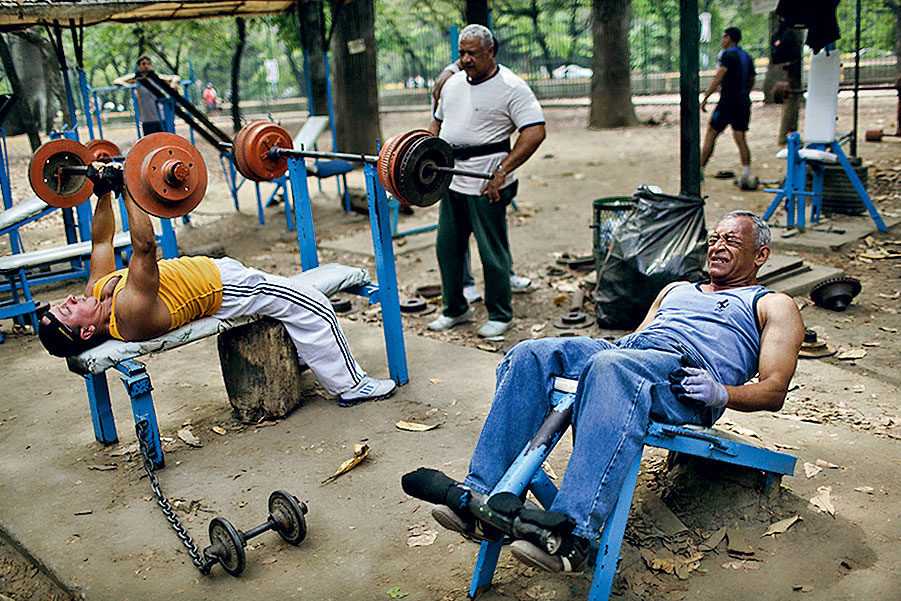 |
| Park in Karakas |
In Venezuela, the relations of the people and the authorities only at first glance seem simple. “Having proclaimed himself the president of the poor, Chavez opened the gateways of unrestrained lumpenization of the population,” said Daniel Hoyos, director of the University of Economics at the University of Buenos Aires, who was lectures in Karakasa at the University of Buenos Aires. The possibility of even ghostly prosperity the poor connects only with his name. The same food packages for which the posters cry are only the peak of the iceberg. In six million karakas, about a third of the inhabitants live in Barrios - slums on the slopes of the hills around the city. Barrios "Petara", "January 23", "Magalyana de Catai" - the largest. More than a million people live in one “petara”. In recent years, Chavez created in Barrios something like the "committees of the poor." They directly received money from the budget, bypassing the bureaucratic apparatus - this led to the frantic popularity of the president. And giant theft. For the head of the committees often stood people with a very dubious past and present. The New Times correspondent managed to talk with one of the “committees” - Hulio Gomez, who came to meet with a gun in the back pocket of Short. “I saw, opposite the Melea Hotel, on the wall of the house, portraits of our Chavez and his friend Lukashenko? - said maliciously Hulio. - So, Lukashenko put collapsible wooden houses in Venezuela. They were given to the inhabitants of the slum for free, but they quickly sold them to our own people, and they themselves returned to Barrios. We resold at home and earned well. ”
Taking advantage of the oil manna, the Chavez government - we must pay off his due - it launched the most generous social policy in Latin America. And achieved considerable results. Over the past 13 years, the National Oil Company has transferred $ 123.7 billion to social programs, only in 2011 this amount amounted to $ 39.6 billion. True, oil workers did not invest in production or modernization of production, so oil production was reduced from 3.2 million barrels in 2005 to 2.7 million in 2011. But the number of Venezuelans living behind the poverty line from 20.3% in 1998 fell to 7% in 2011, children's mortality reduced twice. Chavez opened a chain of stores for the sale of basic necessities "Merkal". Prices here are almost 40% lower than in ordinary stores. And this despite the fact that 80 % of food is imported. Distribution products make up approximately 40 % of the national commodity market, many deliveries are often controlled by the same “committees of the poor”.
Gasoline in Venezuela is not bought for liters - for tanks. And it is difficult to determine its exact price: somewhere from 200 to 250 liters per dollar. At the same time, it is forbidden to import used cars, so that the country drives on the rolleries of the 60s and 70s.
Flights are also very cheap: 500-600 kilometers - thirty dollars, if counted at an unofficial rate. But almost no plane goes on schedule. The delays reach five hours, or even more. Airlines are waiting for “filling”, if it is not, then the flight is generally canceled. Therefore, the tourism business practically does not work: everything is given to the local authorities, who already receive money from the budget.
They say we are boobs
“Social programs are an inescapable source of crime,” the coordinator of the Venezuelan Council for violence (OVV) Roberto Briseno Leon explained that all the past 12 years, the government deliberately pursued a policy under the slogan “not to do nothing against crime”. And this is similar to the truth: for example, before well -known events in the Rodeo prison, when the prisoners held a prison in their hands for 27 days, and more than 30 people died when suppressing the rebellion, weapons were freely among the prisoners, even automatic.
With the advent of Hugo Chavez, a real criminal reel began to power in Venezuela. If in 1998 4,500 people were killed there, then in 2012-more than 21 thousand, while 92% of the murders are committed from firearms and 91% of the murders are not disclosed. According to OVV, Venezuela is in second place in the killings after Honduras - 73 people per 100 thousand inhabitants per year (in Honduras - 85.5 per 100 thousand). At the same time, Karakas became the most dangerous capital of the planet - here in 2012 122 people per 100 thousand inhabitants were killed. The percentage of disclosure of robberies and thefts approaches zero, practically do not investigate things about the abductions of people (about 17 thousand per year): the victims and their families are simply afraid to write statements to the police, which itself is often connected with the bandits, all the more stolen still try not to kill, but to return for the purchase. Moreover, they are abducted not only by the rich: the “express smitting” became a real scourge and poor quarters.
One of the main reasons for the unfolding anarchy is the “perestroika” of the police. Hugo Chavez believed that the main function of the police is educational and preventive, not repressive. In general, the police became a socially close to the guys from Barrios. Conclusion: “In the evening, it is better to ride around the city quickly and do not stop at traffic lights,” the local guide Patricia Ernandes taught me. “Do not wear expensive watches, do not wear jewelry, do not walk alone, do not shoot suspicious girls.”
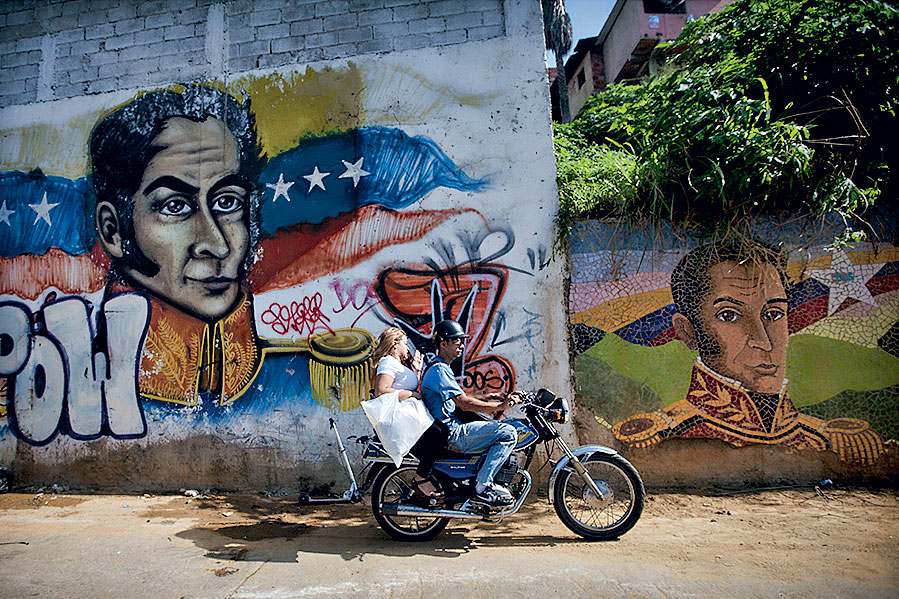
The national hero Simon Bolivar is the same popular hero of the Venezuelan walls as Hugo Chavez
Bolivar Bolivar is different
About ten days before Chavez’s death, the official Bolivar exchange rate fell by two percent to 8.3 Bolivar per dollar. However, even on official sites they warn: do not pay credit cards and do not change in official exchangers, because this is pure robbery. The real course of the resellers - at least 21 bolivars per dollar, and everyone is changing all - from taxi drivers to guides and pimps.
Double currency also gives rise to a parallel economy. The minimum salary in the country is approximately $ 170, but at the same time, unemployment and poverty allowance is about $ 300. True, at the official rate. Of course, not to work much more interesting at all. Today, even in oil fields, many foreigners work - Chileans, Argentines, Brazilians. The same picture is in the mining industry. The official level of unemployment in the country is 7-8%, but even the authorities themselves do not believe it: in reality, 70–80%do not work among the poor in the slums.
Along the roads there is an abandoned technique, rusty pipes are lying. The number of incomplete construction projects is unthinkable. Only during a trip to the region around Karakas did I count over two hundred frozen objects. Meanwhile, many roads even in deaf places are lit by tens of kilometers. In public buildings in Karakas, the backlighting burns around the clock: electricity does not save here.
"We will live without it"
The presidential elections are scheduled for April 14, the election campaign should be held on April 2–11. But the election struggle began in Venezuela long before the death of the leader of the nation. Interrupting even the Baseball matches so beloved by Chavez, the ten -minute propaganda program “Venezuela on the march” with the same hero - proclaimed heir Nicolas Maduro is a broadcast daily. Here he meets with cultural figures, here he presents a CD with Chavez's performances, here is a red book with his speeches, so he talks with the patient in the hospital, he gives the keys to new apartments. The will of the late Chavez, who assigned the performance of presidential duties on his deputy in violation of the Constitution (they should have been fulfilled by the chairman of the National Assembly Diosdado Cabel), is higher than the law. Therefore, in order to avoid the excitement of Chavez, they try to deify even more. Yes, and the family of the deceased is pulling up: his vice president Maduro appointed the son-in-law of commandante, Minister of Education Horche Arreaz.
Life in Karakas, meanwhile, goes, as the publicist Peter Burghard wrote, according to the same “surrealist model”. From the ban on the sale of alcohol, the authorities, for example, decided to refuse, but introduced a new rule that prescribes on weekends to sell at least three liters of any alcoholic beverage in some hands. Would you like a beer or rum - you won’t sell one bottle, only three liters. And literally a few days before Chavez’s death, the airports introduced a “visiting fee” in the amount of 95 bolivars - almost $ 12 at the official rate. Interestingly, the receipts were not given to anyone.
Khan Mikes, an employee of the Karakassky Avil Hotel, built, by the way, still Nelson Rockefeller in 1942, before my departure, commented on Chavez’s departure: “We lived with him, live and without it.”
And that is true.
Photos: Meridith Kohut/The New York Times, Reuters, Ap Photo