
Translated material
Law on the prohibition of fools
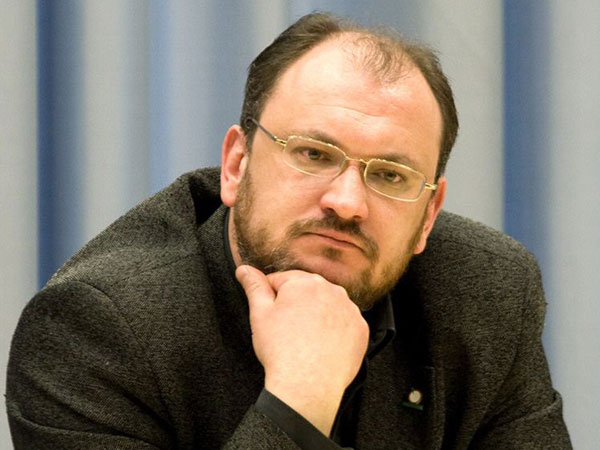
The former leader of the St. Petersburg Yabloko, deputy of the city parliament, Maxim Reznik, submitted a bill to consideration by his colleagues, which will limit the right -hearted to participate in the elections. Deputies of the St. Petersburg City Assembly will discuss the bill Maxim Reznik in late March.
If the Reznik initiative is first accepted by his St. Petersburg colleagues, and then federal parliamentarians, then people with mental illness and “behavior disorder” with average and severe or often aggravating manifestations (including schizophrenia, delusions, habits and drives), as well as epiletics) will lose the right to be elected.
The bill Maxim Reznik can be considered the “subtle trolling” of his colleague, Vitaly Milonov. If Reznik is known as a liberal politician, then Milonov’s views are distinguished by extreme conservatism. Sometimes the discrepancies in the worldview of Milonov and the liberal public are so great that the mental health of the deputy is called into question.
Recently, Milonov has become perhaps the most famous regional deputy in the country. On his initiative, the state began to fight the propaganda of homosexuality. He also insisted on providing embryos of Russian citizenship - in this way he hoped to stop abortions in the country. He proposed to ban the hookah as propaganda of drugs, cancel teaching to schools of evolution, close MTV, transfer Alexander Nevsky’s cancer from one hall to another for celebrations on the occasion of the 400th anniversary of the reign of the Romanov House. More recently, he said that “as a practitioner” knows that 80 percent of pedophiles are homosexuals. And the other day I met with the English actor Stephen Frahem, who is also known for openly recognizes his homosexuality.
Vitaly Milonov himself, who heads the Legislation Committee in the Legislative Assembly of St. Petersburg, reacted negatively to Reznik’s initiative. “The dissidents were also considered crazy. Voters have the right to have the representative whom they want, and not those whom the Ministry of Health considers normal, ”he said. At the same time, the deputy said that he negatively evaluates existing restrictions for the work of mentally ill in the public service, as well as a “criminal” filter for election candidates.
It is worth recognizing that sometimes Russian deputies truths with fairly strange proposals. At the same time, sometimes it happens that in a few years they previously funny initiatives become adopted laws.
In 2006, the New Izvestia newspaper published a list of stupid, according to the editorial office, bills that are unlikely to ever be adopted. Some still remain incomprehensible. For example, deputies proposed distributing the central bank gold and foreign exchange reserves to those who give birth to a third or more child - only 200 thousand per family. On the other hand, it was proposed to cancel alimony for illegitimate children if a man did not give a written obligation to support the child. One deputy considered that the Russians who were married to a foreigner should immediately deprive citizenship. During the epidemic of "bird flu", there was a proposal to shoot migratory birds so that the virus was not brought to Russia.
However, many initiatives were accepted or at least discussed, seriously. Offer to ban the cartoon "Well, wait a minute!" Due to the fact that the hare is mocking the wolf, it did not pass, but the ban on the cartoon was seriously spoke in connection with the ban on the propaganda of smoking. The marking of all television programs by age restrictions (18+, 14+, 10+, etc.) in 2006 seemed stupid, in 2012 it was made mandatory. The gambling business was still prohibited, although in 2006 a tent with "automatic" stood on each corner. However, now stands-but called differently. The reckoning of the Julian calendar was not seriously discussed to return the chronology, but the arrows at the summer time were recorded. The Russian authorities approached the ban on tonic drinks only in recent months. The deputies reacted to the idea of placing vidocamers to combat corruption in all offices of officials, but in 2012, cameras worked in all polling stations of the country.
In 2006, few have seriously spoke about the transfer of the capital and the bill on the distribution of authorities on the cities of Siberia and the Far East only laughed, and now the Constitutional Court has moved to St. Petersburg, and other authorities are planned to be transferred to the former Moscow Region. So far, however, the move is not carried out too actively.
Of the completely impracticable initiatives, we can recall the proposal to hold an amnesty in honor of the 60th anniversary of Zhirinovsky, announce the day of the Victory Day of CSKA in the UEFA Cup and give all the deputies a diploma on legal education after 4 years of meeting in parliament.
 To psychiatric chief: Tiensmed.ru
The mental health of deputies is not only about Maxim Reznik. In mid -February, in the House of British communities, it was decided to open the cabinet of a psychiatrist. The deputies themselves asked about this and allocated about 40 thousand dollars from the budget. The duty of the physician will include the struggle against stress and depression among members of the parliament. A similar office was from 1995 to 2003 and in the State Duma - only there he took a psychologist. Today, deputies are only in a year undergo a medical examination, but they are not obliged to visit a psychiatrist.
By the way, Vitaly Milonov made the support of the idea of British deputies. In an interview with Kommersant FM, he stated that "the adoption of the law by which the persons of the same sex can marry and adopt children, of course, is a very disturbing symptom." “Maybe here it is even worth increasing funding, since a normal person will never vote for such a law for such a law,” the deputy said.
In 2011, a full -time psychiatrist appeared in the parliament of Japan. He is responsible, including for suicide prevention. In the capital of Ukraine, all employees of the City Hall and district administrations of Kyiv undergo a mandatory verification by a psychiatrist and a narcologist.
In general, the mental health of deputies and officials is a thing, of course, good and useful in all respects. But only annual checks are unlikely to be achievable - a system that takes to work mentally ill, itself requires serious improvement.